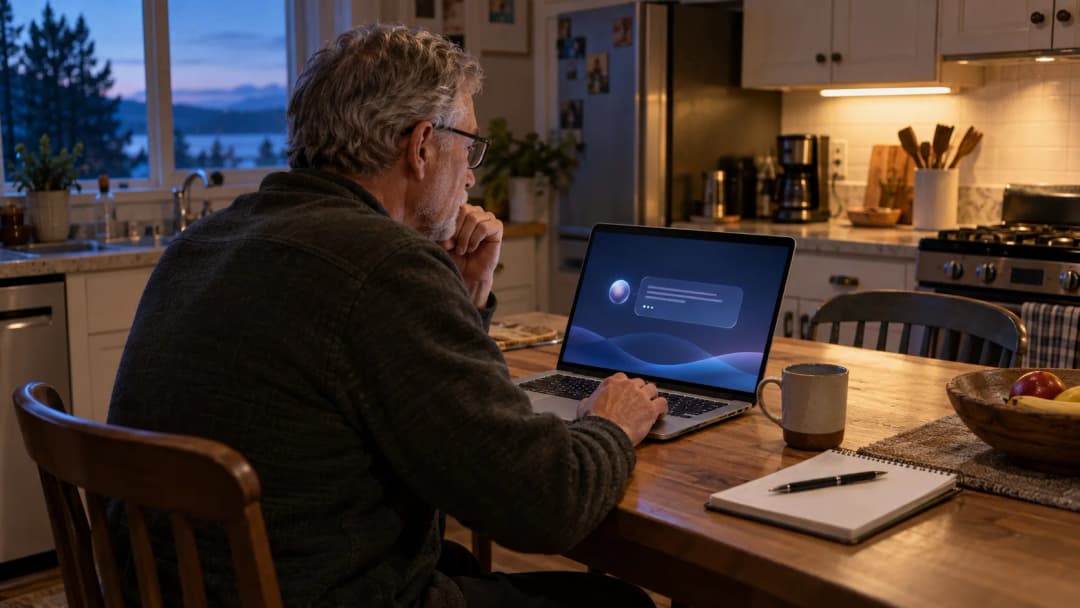
What Were We Saving All That Time For?
Technology gave us faster ways to work. Growing older teaches us to ask what we plan to do with the time we saved.
Technology gave us faster ways to work. Growing older teaches us to ask what we plan to do with the time we saved.
It gets easier to notice the older you get.
When you are young, saving time usually means finding room to do more. Work faster. Drive faster. Finish one job so you can begin the next one. A full calendar can feel like evidence that life is moving in the right direction.
Later, you begin to see time differently.
You notice how often people hurry through breakfast, hurry through traffic, hurry through work, and then hurry through whatever was supposed to help them relax. We rush toward the weekend, then fill the weekend so completely that Monday arrives before we had time to notice Saturday.
The strange part is that we have never had more machines designed to save us time.
A computer can do in minutes what once required hours. A smartphone can carry an office, a camera, a map, a library, a calendar, and several people who apparently need an answer right now. Artificial intelligence can take a conversation bouncing around in somebody’s head and help turn it into a finished article.
All of that is remarkable.
But it raises a question we do not ask often enough:
What were we saving all that time for?
When Work Learned to Travel
I have always tried to enjoy life and make room to play. I was also fortunate that, once the internet became part of everyday business, much of my work could travel with me.

Running a magazine once meant being tied more closely to an office, a desk, a telephone, stacks of paper, and the people who happened to be standing nearby. The internet changed that. A laptop could go in the vehicle. Files could cross the country without a delivery truck. Questions could be answered from somewhere that did not have fluorescent lights hanging overhead.
That was freedom.
It meant work no longer had to occupy one particular building. A person could handle business, then look up and realize there was still a lake, a campground, a family visit, or an afternoon worth enjoying.
That freedom is real. It should not be dismissed simply because technology also created new problems.
In 2024, about one-third of employed Americans who worked on an average day did at least some of that work from home. For many people, portable work reduces commuting, creates flexibility, and makes it easier to remain productive while life is happening somewhere other than an office.
The office escaped the building.
Then it climbed into our pocket.
The Freedom and the Leash
The same phone that lets us leave the desk can make every place feel like the desk.

We can answer email from a porch, approve something from a grocery-store parking lot, solve a problem from a hotel room, or join a meeting from a place nobody on the meeting needs to know about. That can be wonderfully useful.
It can also mean the workday no longer has a clean edge.
International labor researchers have described this tension for years: digital communication can improve flexibility and work-life balance, while also blurring the line between working time and personal time. Both can be true because the device that creates freedom is the same device that keeps announcing that somebody needs something.
Most American adults now own a smartphone. That means the modern office does not merely travel well. It sleeps on the nightstand, rides in the cupholder, goes to dinner, and occasionally interrupts the bathroom with a notification that absolutely could have waited.
The problem is not that the phone can reach us.
The problem is that reachability quietly became availability—and availability began pretending to be an obligation.
Every Minute We Saved Found Another Job
Time-saving technology usually does save time.
Email is faster than mailing a letter. Online banking is faster than driving to a branch. GPS is faster than unfolding a map across the steering wheel and pretending we knew where we were. A dishwasher is faster than washing every plate by hand. A computer can organize, calculate, search, copy, edit, and deliver work at a speed that would have looked impossible not very long ago.
The mistake is assuming saved time remains empty.
It rarely does.
When one task becomes faster, we often add another task. When communication becomes immediate, people expect immediate replies. When travel becomes easier, we travel farther. When work becomes portable, we carry more of it.
We created thousands of ways to save time, then treated the saved minutes like an open parking space: something had to be put in them immediately.
That is why modern life can become faster without feeling less crowded. Efficiency changes how much we can do. It does not decide when enough has been done.
Not Everyone Controls the Clock
It is easy to tell people to slow down. It is harder to acknowledge that many people do not have much control over their pace.
Some work two jobs. Some care for children, parents, or spouses while earning a living. Some have schedules built by employers, school calendars, medical appointments, bills, traffic, and responsibilities that cannot be solved by putting the phone on silent and walking toward a sunset.
A lecture about “being present” is not especially useful to somebody trying to make rent before Friday.
Technology can matter most in those situations. A remote appointment can save a long drive. Online work can create opportunities for someone with limited transportation. A phone can help a small business operate without a large staff. Artificial intelligence can help a person communicate ideas that spelling, typing, or confidence once kept trapped inside.
Saving time is not foolish. Sometimes it is the difference between managing life and being buried by it.
The deeper question is what happens when we finally gain control of a few minutes. Do we use them deliberately—or hand them to the next demand that reaches us first?
Play Is Not the Opposite of a Useful Life
Somewhere along the way, adults can begin treating play as something that must be earned after every useful task has been completed.
That is a clever arrangement because useful tasks reproduce overnight.
There will always be another email, repair, bill, load of laundry, patch of grass, meeting, article, or mysterious red error message waiting for attention. If enjoyment begins only after the list is empty, enjoyment may die waiting for clearance.
Play does not have to mean doing nothing. It may be cooking over a real fire, fishing, building something, driving somewhere without a business reason, listening to water, talking on a porch, or learning something simply because curiosity showed up.
These moments are not failures of productivity. They are some of the reasons productivity matters.
Work supports life. Life was not created to provide work with a convenient storage container.
The Best Technology Leaves the Human in Charge
The answer is not to throw away the phone, unplug the computer, or become suspicious of every machine that performs a task faster than we can.
The better answer is to decide what we want technology to remove—and what we still want to experience ourselves.
A temperature probe can remove the guessing from cooking without building the fire, choosing the wood, managing the heat, or deciding when the food is right. GPS can prevent us from becoming lost without choosing where we want to go. AI can help organize a thought without supplying the life that made the thought worth having.
Good technology removes friction.
It should not automatically remove judgment, craft, conversation, patience, or the satisfaction of participating in our own lives.
The goal is not to do everything the hard way. The goal is to avoid making “easy” the only thing we know how to value.
Time Saved Is Not Time Stored
The phrase “saving time” makes it sound as though the minutes are placed somewhere for later use.
They are not.
There is no account where Tuesday’s unused half-hour earns interest. No drawer holds the ten minutes saved by online checkout. No vault keeps the afternoon we promised ourselves we would enjoy after one more task.
Time saved is only time redirected.
It can be redirected into more work, more worry, more scrolling, more errands, or more noise. It can also become rest, play, conversation, attention, learning, or the simple experience of not being in a hurry for a little while.
Technology gives us choices about time. It does not make the choice for us—although the notification settings certainly make a strong sales presentation.

What Were We Saving It For?
When I was younger, I thought of technology mainly in terms of what it allowed me to accomplish. That still matters. It is incredible what one person can do with a computer, a smartphone, an internet connection, and now AI.
But age adds another measure.
The question is no longer only, “How much can I get done?”
It is also, “What did getting it done make room for?”
Maybe it made room to travel while keeping a business alive. Maybe it created time for family. Maybe it allowed somebody to write again after years of believing the words would never come out correctly. Maybe it gave an exhausted person one quiet hour at the end of the day.
And maybe, sometimes, we saved time only to fill it with another thing we were not going to remember.
Getting older may not make time move faster. It may simply make us more aware that the minutes we keep trying to save are not separate from life.
They are the life.
So keep the computer. Keep the smartphone. Keep the internet and the artificial intelligence. Use every good thing they can provide.
Then, once in a while, close the screen, put the phone down, and spend some of the time they saved on something that does not need to prove it was productive.
That may have been the point all along.