

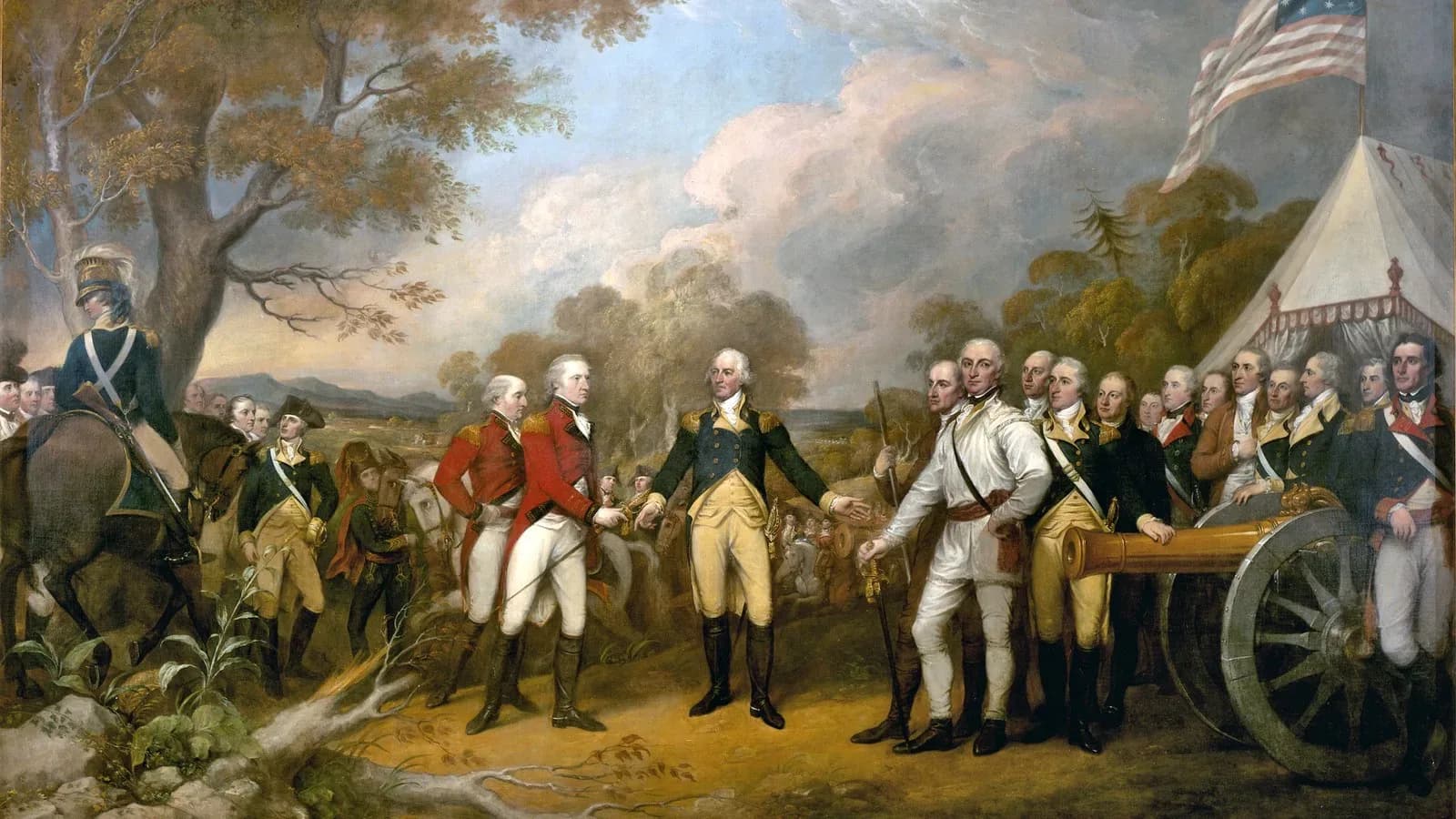
Burgoyne Surrendered at Saratoga 249 Years Ago Today. Congress Answered With Prayer and Confession.
On Oct. 17, 1777, nearly 6,000 British and German troops surrendered at Saratoga. Congress then called a national day of thanksgiving and repentance.
On Oct. 17, 1777, 249 years ago today, nearly 6,000 British and German soldiers laid down their arms on the grounds of an abandoned fort in Saratoga, New York. A ragged young country had just beaten a world-class army. Two weeks later, Congress asked the whole nation to get on its knees.
A plan to split the colonies
From the start of the Revolution, British leaders understood that controlling the Lake Champlain, Lake George and Hudson River corridor would cut New England off from the colonies to the south, according to the National Park Service. In 1777, Gen. John Burgoyne proposed doing exactly that. He would march south from Canada, take Fort Ticonderoga and push down the Hudson to Albany, where he expected to meet Gen. William Howe coming north from New York City.
It did not work out that way. Howe went after Philadelphia instead and never came up the Hudson. A second British force under Lt. Col. Barry St. Leger stalled at Fort Stanwix and retreated to Canada.
Burgoyne launched his invasion on June 17, 1777, with an army of about 9,000, including about 4,000 British regulars and 3,200 German troops, the park service's campaign timeline says. At first he succeeded. Americans abandoned Fort Ticonderoga in July after the British hauled cannon up a mountain overlooking it, a blow that badly demoralized the American army. Then his fortunes turned. At Bennington in August, American militia under Brig. Gen. John Stark cost Burgoyne almost 900 men.
Freeman's Farm, Bemis Heights and the surrender
Burgoyne crossed the Hudson in September, abandoning his supply lines, and ran into Gen. Horatio Gates' army dug in on Bemis Heights. He attacked at Freeman's Farm on Sept. 19 and again at Bemis Heights on Oct. 7. Both attacks failed. In the second battle, British forces were driven from the field, and Burgoyne's situation went "from perilous to desperate," the park service says.
He retreated north in a heavy downpour to the village of Saratoga. With food almost gone and American guns bombarding his lines, Stark's militia closed off his only escape route. After days of negotiation, Gates and Burgoyne signed a "convention," and on Oct. 17 the British and German troops surrendered their arms.
The park service calls Saratoga a turning point in the war. The surrender proved "America's ability to beat a world-class army," revived hopes for independence and "sends shockwaves that will be felt worldwide." It helped secure a formal alliance with France, whose military and financial support contributed directly to the final victory at Yorktown in 1781.
Congress called the nation to prayer
What happened next tells us something about the men who founded this country. On Nov. 1, 1777, the Continental Congress recommended that the states set apart Thursday, Dec. 18, "for solemn thanksgiving and praise," according to the text of the proclamation as printed in the Journals of Congress.
The proclamation began by declaring that "it is the indispensable duty of all men to adore the superintending providence of Almighty God." It gave thanks that God had been pleased "to crown our arms with most signal success."
But Congress did not stop at celebration. It asked Americans to "join the penitent confession of their manifold sins, whereby they had forfeited every favor," and to pray that God, "through the merits of Jesus Christ," would "mercifully forgive and blot them out of remembrance." It asked God to bless schools "for cultivating the principles of true liberty, virtue and piety," and to prosper "that kingdom which consisteth in righteousness, peace and joy in the Holy Ghost."
Victory and humility
Read that again. At the high-water mark of the war so far, America's governing body did not boast. It confessed sin and named Jesus Christ. It treated victory as a gift, not an entitlement, and it understood that a nation that had "forfeited every favor" needed mercy more than it needed applause.
That instinct ran deep in the founding generation. Dock Line recently noted that Noah Webster called the Bible the source of all that is good. The Congress of 1777 would have agreed.
Saratoga was won by courage, by militia who turned out, by commanders who held their ground and by a British plan that fell apart. Christians can affirm all of that and still say what Congress said: the outcome belonged to God. "Except the LORD keep the city, the watchman waketh but in vain" (Psalm 127:1).
Americans today argue about almost everything. But on this anniversary, we could learn from that ragged Congress in a hard year. Give thanks for victories. Confess our sins honestly. And remember that "righteousness exalteth a nation: but sin is a reproach to any people" (Proverbs 14:34).
More Faith Stories
 Today
TodayA Calvary Chapel Pastor and His Wife Were Gunned Down in Mexico After He Led a Funeral
 Last Week
From His Hospital Room, Pope Leo Says Mass and Calls Putin About a Besieged Ukrainian Town
 Last Week