

Refugio Takes Its Name From the Last Spanish Mission in Texas
Franciscans founded Nuestra Señora del Refugio in 1793. It moved twice, endured hunger and raids, and left its name on a Texas town.
The town of Refugio carries the name of a mission. Nuestra Señora del Refugio, Our Lady of Refuge, was the last of the Spanish missions in Texas, according to the Handbook of Texas entry on the mission. It was founded on Feb. 4, 1793, by Franciscans of the College of Nuestra Señora de Guadalupe de Zacatecas.
A mission that moved twice
The mission did not start where the town stands today. In 1791, Fray Manuel J. de Silva and Fray José Francisco Mariano Garza toured the Matagorda Bay region looking for a site to reach the Karankawa people, the Handbook says. Earlier efforts at two other missions had failed when the Karankawas left, but they promised the priests they would come to a mission on the coast.
The Karankawas helped choose the first site, at a place called El Paraje del Refugio, the "Place of Refuge," on Goff Bayou in what is now Calhoun County. Life there was hard. Food was short, the buildings leaked, and after its first year the mission was only six small wooden buildings with tule roofs, a corral, a shed and a stockade. Attacks added to the need for a safer, better site, and the mission moved in June 1794 to Rancho de los Mosquitos on Mosquitos Creek.
In January 1795 it moved a final time, to the site of present-day Refugio, which was thought better for farming. Fray Silva formally dedicated it on Jan. 10, 1795, keeping its original name.
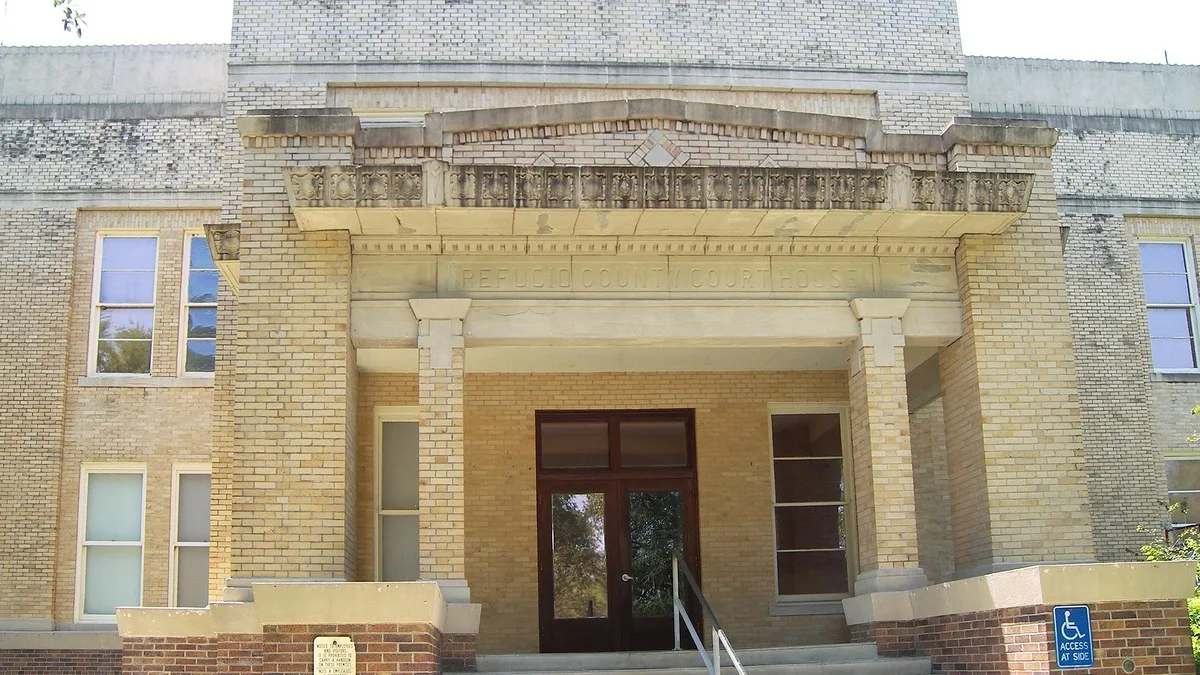
The Refugio County Courthouse in Refugio, photographed in 2008. This photo is for illustration. Photo: Larry D. Moore / Wikimedia Commons, CC BY 4.0.
Faith through hardship
The years that followed brought hunger, desertions and raids. A census in October 1795 counted 82 Indians at the mission, down from 138 at its founding, the Handbook says. Comanches attacked and stole livestock. Even so, most construction was finished by 1799. Most buildings were made of driven poles with adobe walls and thatched roofs. Only the church and the blacksmith shop are believed to have been stone.
The mission reached a population of 224 in 1804. In 1807, Rosario Mission was ordered closed and its people merged with Refugio's. But attacks, internal conflicts and an unsteady food supply wore the mission down. Gov. José Antonio Saucedo ordered it secularized and closed on July 10, 1824, and its remaining belongings were carted away to La Bahía, now Goliad. Efforts to restore it between 1825 and 1829 failed. The mission was finally abandoned in 1830.
The surviving records for 1807 through 1828 show 214 baptisms. Sixty-nine were Spanish children and the rest were Indians, the Handbook says. One priest, Fray Miguel Muro, wrote that baptisms after July 1824 were done in the parish of La Bahía because the minister could not live at the mission due to Comanche attacks.
A town takes the name
Irish settlers who arrived in the 1830s named their town for the mission, and they probably used the ruins as building material. Today much of the mission site is owned by Our Lady of Refuge Catholic Church, and traces of the foundation lie beneath the present church and its lawn, according to the Handbook.
The Handbook entry on the town says the villa of Refugio was officially established in 1831. As late as 1859, the ruins of the old mission were still the most distinguishing feature of the town. By then it had three churches and two schools.
For more on Texas history and faith, read how Del Rio got its name from a Mass said there and about the Texas Baptists vote in Waco.
Our view
The men who founded Refugio's mission came a long way to share the Gospel with people who had already walked away from two missions. They faced hunger, leaking roofs and raids, and they kept going for more than three decades, by our count from 1793 to 1830. Whatever one thinks of Spain's larger aims, that kind of perseverance is worth remembering.
A town's name is a small sermon. Refugio means refuge, and the Scriptures call the Lord a refuge and a fortress. It is fitting that a church still stands over the old foundation, and that the town still carries the name.
More Faith Stories
 This Week
Rusk Gathers to Pray After a Year of Turmoil at City Hall
 This Week
More Than 1,200 Poll Chaplains Will Stand Outside Voting Sites Tuesday. Peacemakers Must Keep Their Hands Off the Scale.
 This Week