Can You Measure Faith by Counting Churches?
America's religious map records buildings and attendance. It cannot fully record what happens around kitchen tables—or what people carry into the world afterward.
America's religious map records buildings and attendance. It cannot fully record what happens around kitchen tables—or what people carry into the world afterward.
Faith does not become smaller when the gathering moves from a sanctuary to a living room.
The Things We Know How to Count

If someone wanted to map religion in America, the first instinct would be to count churches. Mark every sanctuary, chapel, synagogue, mosque and temple, add the membership rolls and compare Sunday attendance. The result would be useful. It would also be incomplete.
The 2020 U.S. Religion Census made the most extensive congregation count ever attempted in the country: more than 350,000 congregations representing over 370 religious bodies. Its state and county records can show where organized faith has a visible presence, which traditions are strongest and how many people are connected to reporting congregations.
Pew Research Center's 2023–24 Religious Landscape Study adds another view. It asked more than 36,000 adults in every state about prayer, belief, religious importance and attendance. One-third of American adults said they attended services in person at least monthly. When online and television participation were included, the share participating at least monthly rose to 40 percent.
Those are meaningful facts. They are not a measurement of faith itself.
Six States, Six Different Religious Landscapes
A comparison across the country quickly shows why one number cannot explain a community.
Texas combines a large evangelical presence with Catholic traditions, historically Black churches, immigrant congregations, megachurches, storefront ministries and small gatherings spread across enormous urban and rural distances. Mississippi remains part of the nation's most religious region by conventional measures. Churches there often serve as community institutions as well as places of worship. Utah's landscape has long been shaped by the Church of Jesus Christ of Latter-day Saints, yet the state is also changing as migration and religious disaffiliation alter its population. Ohio offers another mixture: Catholic parishes, Protestant traditions, urban congregations, small-town churches and communities affected by decades of industrial and demographic change. Massachusetts has historic church buildings in abundance, although a steeple inherited from earlier generations does not guarantee a full sanctuary today. Oregon represents a West where formal affiliation is generally lower and religious life may be less visible in the public landscape.
These states are worth comparing precisely because none supplies a simple equation. More buildings can reflect population, history, denomination or settlement patterns. Higher attendance can reflect culture, age, family structure or the strength of one particular tradition. Neither tells us, by itself, what kind of neighbors live there.
The Church the Census May Never See

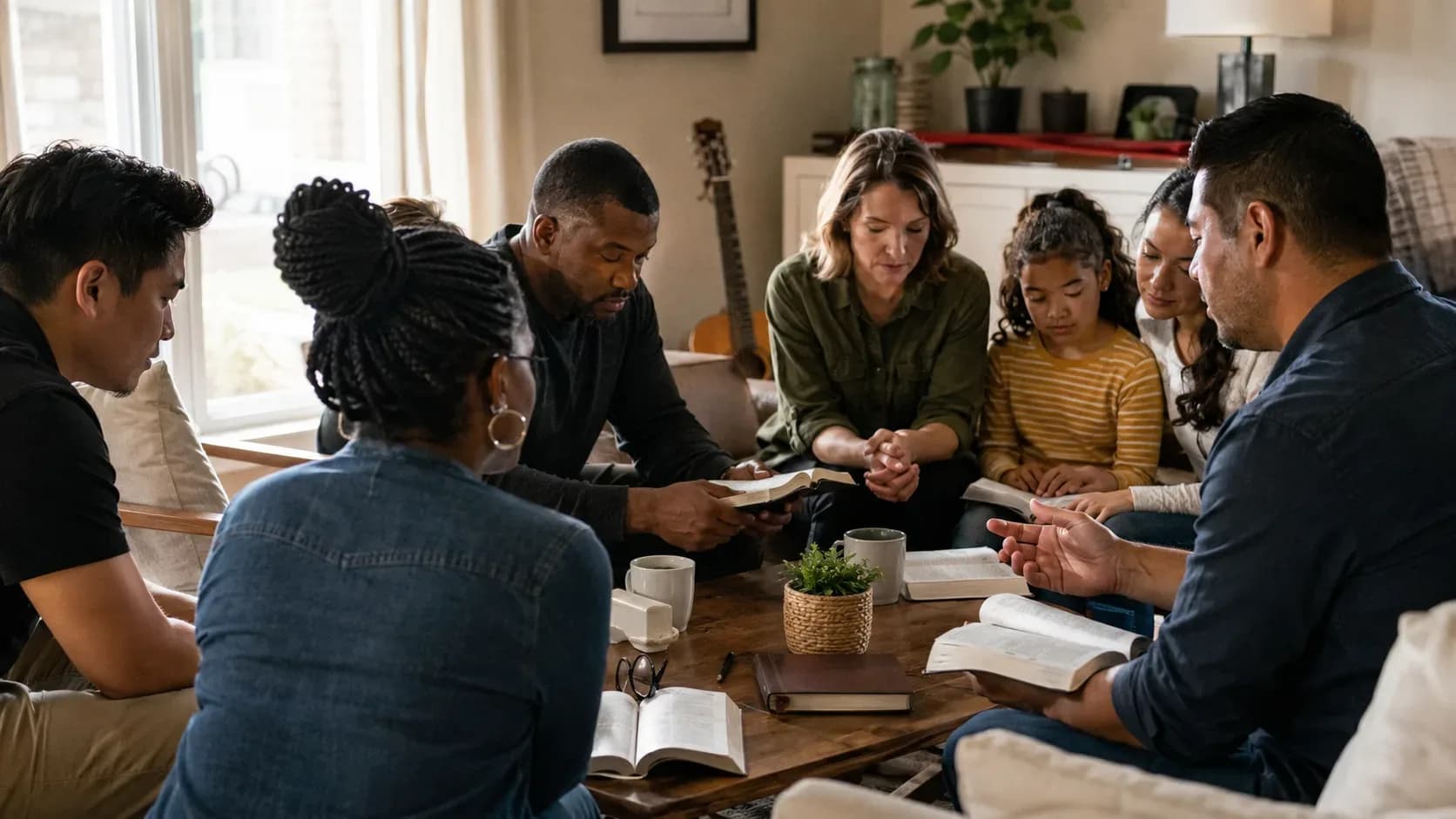
Then there is the home church: a handful of people in a living room, around a kitchen table or gathered in a converted garage. It may have no sign, payroll, property, denomination or central office. It may never appear in a formal congregation list. Yet the people inside may pray together, study scripture, care for one another and serve their community week after week.
Some home gatherings are connected to established churches and may be counted indirectly. Others are independent and almost invisible to researchers. Family worship, informal Bible studies and temporary gatherings blur the boundary further. The problem is not that researchers forgot an easy category. It is that decentralized faith is difficult to find without changing its nature.
Online participation creates another layer. Pew found that 23 percent of adults watched religious services online or on television at least monthly. Some also attended in person; others participated only remotely. A laptop on a kitchen table can now connect a home in Oregon with a service in Texas, while an older adult in Ohio may remain part of a congregation without entering the building. America may not only be changing how much it worships. Faith may also be changing address.
A Large Building Measures a Large Building
Religion or faith never depended on how large the church was. A grand sanctuary can hold a sincere, active congregation. A small living room can hold one too. Either gathering can also become routine, inward-looking or disconnected from the needs outside its walls.
Attendance records who entered on Sunday. It cannot show what each person carried into Monday. A membership roll cannot measure whether someone sat beside a grieving neighbor, delivered groceries, forgave an old injury, visited a hospital or treated a stranger with dignity. Those actions do not prove a person's theology, and people with no religious affiliation perform them every day. But if we are asking whether faith shapes a community, behavior deserves a place beside buildings and attendance.
The uncomfortable truth works in both directions. A state with heavy church participation is not automatically kinder. A state with low formal attendance is not automatically without faith, conscience or community. Counting steeples and declaring winners would produce a tidy ranking—and teach us very little.
What the Numbers Can Tell Us
The numbers remain valuable when we ask them the right questions. Congregation counts can reveal institutional reach. Attendance can show participation. Denominational patterns can explain history and migration. Changes over time can warn that an old structure no longer fits the people around it.
They can also reveal the limits of our categories. Pew's latest work separates in-person attendance from online participation because worship no longer occurs through one doorway. The Religion Census undertook special efforts to count nondenominational congregations and groups without centralized reporting. Both are signs of responsible research adapting to a changing landscape.
But there will always be a remainder: the quiet gathering that does not report, the person who prays without joining, the family that worships at home and the congregation whose real influence is visible mainly in what its people do.
What Do People Carry Out?

A better national comparison would place the formal map beside the lived one. Count congregations per resident. Examine monthly participation rather than raw totals. Include online worship and acknowledge home churches. Then look at volunteering, charitable service, mutual aid and the local institutions that people rely upon when something goes wrong.
Even then, we should resist claiming that statistics have measured the human heart. They have measured patterns around it.
A church building can be beautiful, useful and deeply important. It can preserve memory, gather generations and provide a place where people learn to serve. A home church can create intimacy and responsibility that are harder to maintain in a crowd. Neither form owns faith. Neither size guarantees it.
Perhaps the most revealing question is not how many churches a state has, or even how many people enter them. It is what happens after the gathering ends. The map can show us where the buildings stand. Faith is better revealed by what people carry out the door.