

They Didn't Leave God. They Left the Building.
Fewer young Americans belong to churches, but that does not automatically mean they stopped believing. Faith now moves through phones, arenas, campuses and kitchen tables — and the church of tomorrow may look surprisingly like the church at the beginning.
Younger Americans may be less attached to denominations, membership rolls and Sunday routines. But Bible apps, campus worship, arena gatherings and kitchen-table churches tell a more complicated story. The institution may be losing its automatic claim. The search for God has not gone quiet.
On a Sunday morning in 1926, a family might have heard one set of church bells, walked to one familiar sanctuary and sat in the same pew their parents had occupied. The church was not merely where they worshiped. It was where children met their friends, neighbors organized help, couples married, families grieved and the town learned who needed a meal. For many Americans, belonging to a church was part faith, part family inheritance and part geography. You went because that was your church, your people and your place.
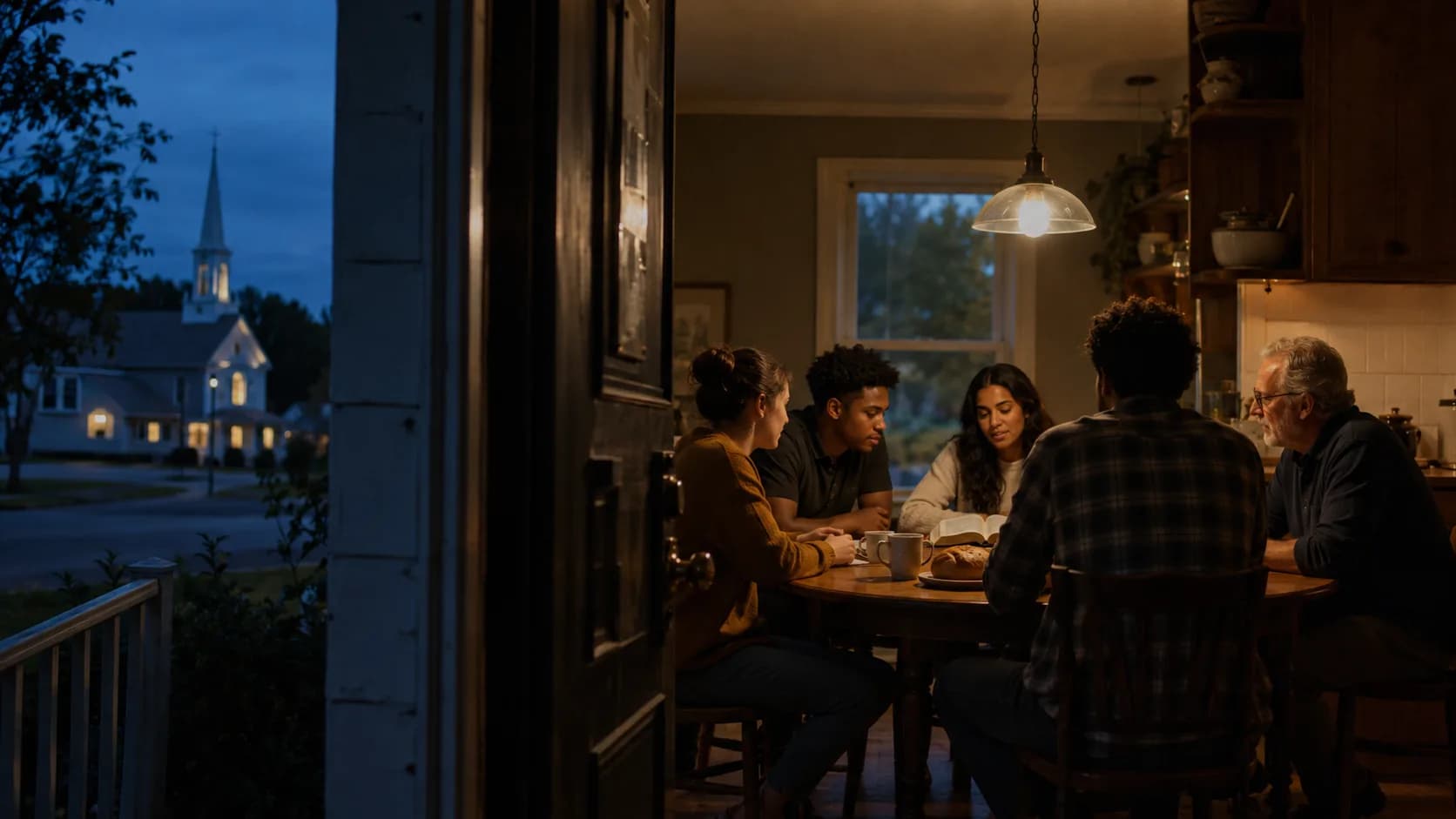
A century later, a young woman may listen to a Bible podcast while driving, read Scripture on her phone at lunch, join worship with several thousand people in an arena on Friday and sit with six friends around a kitchen table on Sunday night. She may know the words to every song and have serious questions about God, yet never appear on a congregation's membership roll. If we measure both lives only by who occupies a pew at 10:30 Sunday morning, we may misunderstand them both.
The numbers say decline. They do not say silence.
The Institutional Change Is Real

Pew Research Center's 2023–24 Religious Landscape Study found that 62 percent of American adults identify as Christian, down sharply from the 78 percent measured in 2007. Twenty-nine percent now describe themselves as religiously unaffiliated — atheist, agnostic or nothing in particular. Church attendance has also declined over the longer term. In the latest Pew study, one-third of American adults said they attend religious services in person at least monthly. But that is not the whole count. Twenty-three percent said they watch services online or on television at least monthly, and 40 percent participate at least monthly in one form or the other — in person, virtually or both.
That does not mean everyone who left a congregation remained Christian. Many did not. It also does not mean a livestream, a playlist or an occasional arena gathering provides everything a healthy church community can provide. It means an empty seat cannot tell us the entire story of the person who is not sitting in it.
Pew also found that Americans are far more likely to say their spirituality has increased over their lifetime than decreased. The American Bible Society's 2025 State of the Bible survey reported that the share of Gen Z adults classified as "Scripture engaged" rose from 11 percent to 15 percent in one year; among millennials, it rose from 12 percent to 17 percent. The same survey found that about half of Americans wished they read the Bible more.
These surveys use different questions and cannot be stitched together into one declaration of national revival. They can, however, keep us from making an equally careless declaration of national spiritual death.
The Church Has Left the Building Before
Every generation thinks its technology is the one that changed everything. In truth, American churches have been negotiating this change for a hundred years. On January 2, 1921, Pittsburgh's KDKA broadcast a worship service from Calvary Episcopal Church. Engineers reportedly wore choir robes so their equipment would not distract the congregation. By 1924, evangelist Aimee Semple McPherson had launched a radio station from Angelus Temple in Los Angeles, bringing sermons, music and religious programming into homes across the region.
The microphone created excitement and worry. If a person could hear a more compelling preacher without leaving the parlor, some clergy wondered, why would that person keep walking to the neighborhood church? It is almost exactly the question churches ask about YouTube today.
Radio became television. Neighborhood congregations followed families into the suburbs. Some sanctuaries grew into campuses with bookstores, coffee counters, concert lighting and multiple services. Worship music absorbed the sound of each new generation. A sermon that once reached two hundred people could eventually reach two million. The methods changed because the people changed — where they lived, how they worked, what they listened to and how they formed community. The church did not survive the twentieth century by refusing every new doorway. It carried an old message through each one.
Then COVID-19 locked many of the physical doors. In spring 2020, Pew found that more than eight in ten regular churchgoers said their congregation was streaming or recording services. Five years later, the share of Americans participating in some form of religious service — in person, virtually or both — had remained around four in ten across six Pew surveys. The proportions moved between rooms and screens, but the combined total changed surprisingly little. The pandemic did not invent church beyond the building. It made nearly every congregation acknowledge that it already existed.
Young People Are Not Looking for a Younger Copy of 1955

This is where older and younger Christians often talk past one another. One side sees lower membership, weaker denominational loyalty and fewer families in the pews. The other sees institutions that sometimes seem more concerned with protecting a brand, a building or a political identity than with answering difficult questions honestly.
Young adults did not grow up with one pastor, three television channels and a town where everyone knew the same hymns. They grew up able to compare a local sermon with a theologian across the country before lunch. They can hear a worship song from another continent, join a live Bible discussion after midnight and find an online community built around a question they were afraid to ask in person.
That freedom has a cost. A confident voice with a microphone can be wrong. An algorithm rewards emotion, certainty and outrage more reliably than humility. A digital personality can gather followers without submitting to any local accountability. A person can consume religious content every day and still have nobody who would notice if he stopped answering the phone.
But dismissing the entire digital world as shallow misses what young people are doing there. The Associated Press has documented young Christians learning from podcasts and social media outside traditional settings, and also young adults crowding into Atlanta's 2819 Church for direct biblical preaching, contemporary music and small-group community. The pattern is not simply entertainment replacing doctrine. Often it is a demand that belief feel lived, honest and connected to real questions. They are not necessarily asking for less faith. They may be asking for less distance between what a church says and what its people do.
Grief Revealed Something the Attendance Charts Could Not
The response to Charlie Kirk's killing in September 2025 offered a difficult but revealing example. Kirk was a political figure, and every gathering connected to him carried that political weight. A memorial cannot be treated as a national survey, and grief is not the same as lifelong discipleship. Yet whatever one thought of Kirk's politics, the public response from many young people could not honestly be described as spiritual indifference.
At Texas A&M, hundreds gathered for a candlelight vigil that included prayer and worship. At the much larger memorial in Arizona, contemporary Christian music and explicitly religious language filled a stadium alongside political speeches. Similar scenes appeared online and in smaller gatherings around the country.
The lesson was not that every young person suddenly agreed. They did not. It was that thousands of younger Americans already possessed a vocabulary of Scripture, worship, prayer, sin, forgiveness and eternity — and they were willing to use it in public. For anyone who thought the spiritual life of a generation could be measured only by weekly attendance, it was a reminder to look again.
The Church May Be Going Home

There is something almost circular about all of this. Before Christianity had cathedrals, campuses, denominational offices or parking committees, it had houses. The Book of Acts describes believers continuing together, sharing meals and breaking bread "from house to house." Paul sent greetings to "the church that is in their house." The earliest congregations were communities of people gathered around teaching, prayer, food, generosity and the conviction that Christ was present among them.
The sentence many people remember comes from Matthew 18:20: "For where two or three are gathered together in my name, there am I in the midst of them." Jesus did not say where two or three are registered. He did not mention a mortgage, a sound system, a stage or a minimum attendance figure.
That does not make church buildings unimportant. A sanctuary can hold a century of baptisms, weddings, funerals, potluck suppers and whispered prayers. A healthy congregation can bring generations together in a way the internet rarely does. It can organize care for the sick, teach children, bury the dead, challenge selfishness and remain when the exciting speaker has moved on.
Nor does meeting in a living room automatically make a group healthy. A house church can become isolated, personality-driven or unaccountable just as easily as a large institution can. Small is not the same as wise.
The question is not building or no building. It is whether the people gathering — anywhere — are becoming more truthful, more generous, more accountable, more capable of forgiveness and more willing to carry one another through ordinary life. That work requires more than content. It requires names, meals, interruptions and somebody who will come when the hospital calls.
What a Building Can Hold — and What It Cannot Contain
Perhaps the church of the next decade will be both larger and smaller. Larger, because one message can cross borders instantly and worship can fill an arena. Smaller, because some of the deepest formation may happen with eight people in a home who know one another well enough to recognize when an answer is rehearsed and a heart is hurting.
The healthiest future may not be a contest between the sanctuary and the kitchen table. It may be a relationship between them: the large gathering offering teaching, shared worship and a sense of belonging to something beyond ourselves; the small gathering offering accountability, questions, meals and care close enough to touch.
Churches that understand this will not spend all their strength trying to force people back into an old attendance pattern. They will ask what only gathered human beings can give each other, then make that harder to imitate and easier to find. They will use technology as a doorway, not confuse it with a home. They will measure more than seats.
Young people, for their part, may discover that freedom from an institution does not remove the need for community, correction or commitment. Faith built entirely around preference can become another feed to scroll past when it grows uncomfortable.
Both generations have something to teach the other. The older church remembers how to stay. The younger church understands how to move.
The church did not begin with a building. It began with people — a table, a prayer, a shared meal and a name spoken in faith. Two or three gathered together. And according to Jesus, He was already there.
More Faith Stories
 This Week
Sometimes the Best Sermon Is Seven Words on a Roadside Sign
 September 1, 2026
Can You Measure Faith by Counting Churches?
 August 2, 2026