Aging in Place Isn't a House Plan. It's a People Plan.
Most Americans would rather grow older at home, but an accessible house cannot make every decision or prevent every crisis. Real aging-in-place planning begins with people, paperwork, affordable safety changes and an honest backup plan.
Most Americans would rather grow older at home, but an accessible house cannot make every decision or prevent every crisis. Real aging-in-place planning begins with people, paperwork, affordable safety changes and an honest backup plan.
A Texas family once did nearly everything the retirement brochures recommend.
They built an accessible home for aging parents. The doorways worked. The bathrooms worked. Legal authority and financial records had been organized. Help could come to the house. The father died at home.
Then dementia changed the rules. The mother began running caregivers off. The same home designed around physical limitations could not make her accept help or recognize every danger. Eventually, the family had no safe choice but assisted living.
During the planning, a friend had said something that stayed with them: “That’s all well and nice, but some of us can’t build a new house.”
He was right. Aging in place is too often presented as a shopping list for people with money: build a one-story house, widen every doorway, renovate the bathroom, hire private caregivers and purchase enough technology to make the living room resemble a control center. Those things can help. They are not where the plan has to begin.
Most people want home. Home does not do the caregiving.
Three-quarters of Americans age 50 and older say they want to remain in their current homes as they age, according to AARP’s 2024 Home and Community Preferences Survey. Nearly as many want to remain in their communities.
That preference is understandable. Home holds routines, neighbors, pets, familiar doctors, church, the good coffee cup and the drawer where the batteries are supposed to be. Staying there can preserve independence and identity.
But a house cannot drive someone to an appointment. It cannot notice that the same medication was taken twice. It cannot decide whether a person who wandered down the road is still safe alone. It cannot give an exhausted daughter a full night’s sleep.
Family caregivers are the hidden structure holding much of aging in place together. AARP and the National Alliance for Caregiving estimated in 2025 that 63 million Americans—nearly one in four adults—were providing ongoing care for an adult or a child with a complex medical condition or disability. A 2026 AARP analysis valued the care provided to adults by family and friends at more than $1 trillion a year.
That is not a small family favor. It is an unpaid care system operating in kitchens, bedrooms and parked cars between doctor visits.
Start with what costs nothing

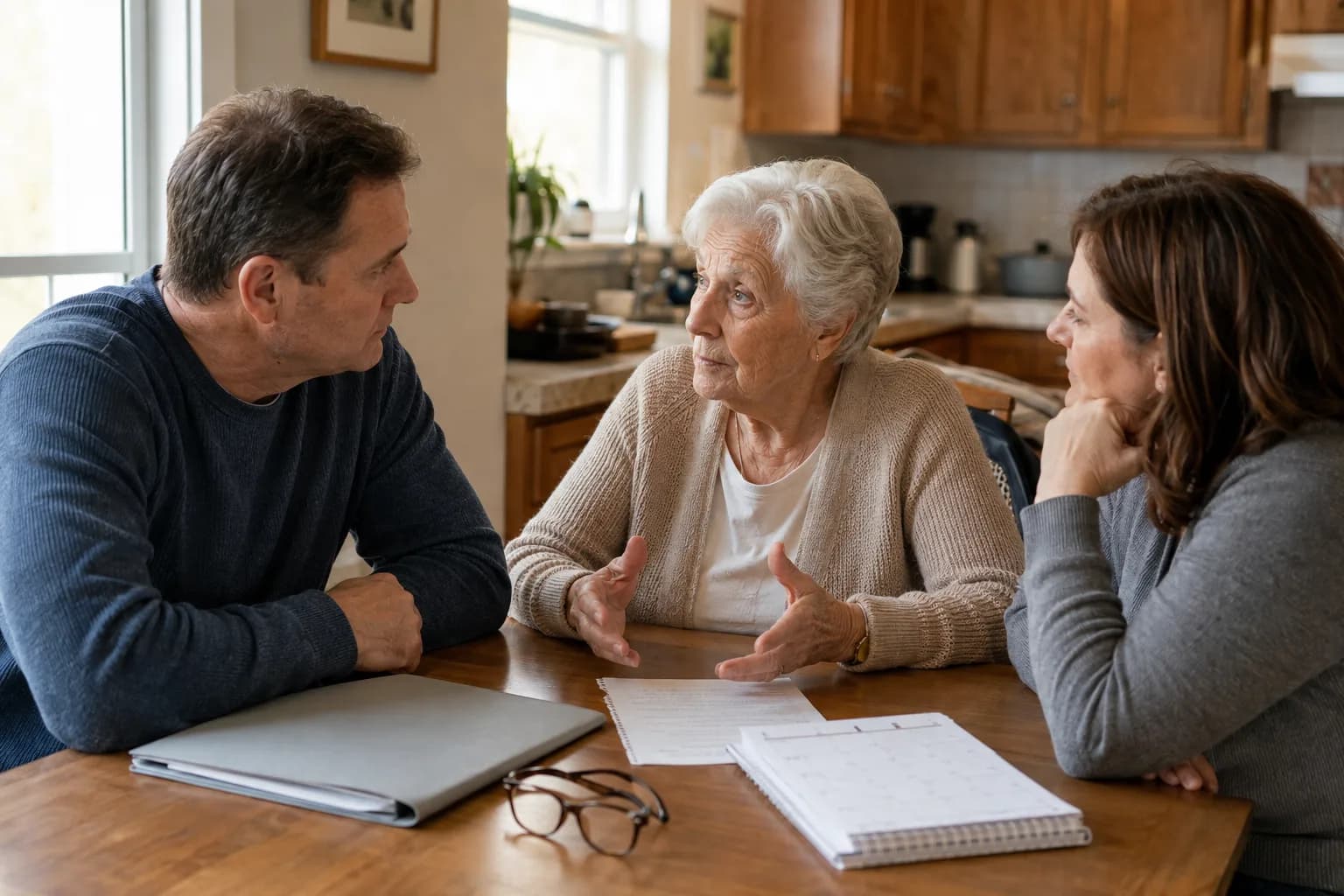
The most important preparation may be a conversation held before anybody needs permission to have it.
Who should speak for you if you cannot speak for yourself? Who can manage the bills? Which family member knows where the insurance papers, account list and medication list are kept? What kind of help would you accept at home? What conditions would mean that home is no longer safe?
Those questions cost nothing. Avoiding them can cost a family months of confusion.
The answers also need to be written down properly. A medical power of attorney, living will or other advance directive addresses health decisions. Financial authority is a separate matter. Wills, trusts, beneficiary designations, property ownership and powers of attorney each do different jobs, and state law matters.
The National Institute on Aging notes that advance directives can often be completed for little or no cost, with state forms available through public agencies and nonprofit organizations. More complicated estates or family situations deserve qualified legal and financial advice. The goal is not to copy somebody else’s arrangement. It is to make sure the right person has the right authority when it is needed—and understands the duty that comes with it.
One folder can be a beginning. Put the current medication list, doctors, emergency contacts, insurance information, legal documents and location of financial records in it. Tell two trusted people where it is. Review it after a move, death, diagnosis or other major change. That is aging planning, even if the house still has narrow doors.
Make the house safer in the order you can afford
Some home changes are expensive. Many are not.
Better lighting, cleared walkways, secured rugs, frequently used items moved within easy reach and a phone beside the bed can reduce everyday risk. Grab bars, railings on both sides of stairs, nonslip surfaces, lever handles and a handheld shower can be added one project at a time. Renters can ask a landlord what modifications are permitted and look for local assistance rather than assuming the answer is no.
The Centers for Disease Control and Prevention says falls are the leading cause of injury death among adults 65 and older, but it also emphasizes that falls can be prevented. The best improvement is not necessarily the most impressive renovation. It is the one that addresses the danger already present.
For one household, that may be a night-light between the bed and bathroom. For another, it may be moving a bedroom downstairs. For someone else, it may be admitting that the bathtub is no longer safe.
Accessibility should not become another way to make people feel they have failed. A family can begin with twenty dollars, an honest afternoon and a screwdriver.
Medicare is not a long-term-care plan
This is the sentence families often learn too late: Medicare does not generally pay for long-term custodial care.
It may cover qualifying medical care, rehabilitation or limited skilled services under specific conditions. It generally does not pay for the continuing nonmedical help many people eventually need with bathing, dressing, meals, transportation or supervision, whether that care is provided at home, in assisted living or in a nursing home.
Medicaid may help eligible people, and state programs, veterans benefits, long-term-care insurance and private resources may cover portions of care. Availability, eligibility and waiting lists vary.
That is why the financial conversation should not begin with “Which facility can we afford?” during an emergency. It should begin years earlier with “If one of us needs help every day, what resources would we use first?”
The answer may be savings. It may be family help, community programs, home- and community-based services, a smaller home, shared housing or a combination that changes over time. There is no single respectable answer. There is only the answer a household can actually carry.
Know where ordinary families can ask for help
Families do not have to understand the entire care system before making the first call.
The federal Eldercare Locator connects older adults and families with local services through Area Agencies on Aging. Depending on the community, those services may include meals, transportation, homemaker help, caregiver education, respite care, benefits counseling and home-safety assistance. The service can be reached at eldercare.acl.gov or by calling or texting 1-800-677-1116.
For dementia questions, the Alzheimer’s Association operates a free 24-hour helpline at 1-800-272-3900. A doctor, hospital social worker, faith community, senior center or local legal-aid office may also know about help that never appears in a glossy retirement plan.
Asking is not agreeing to move. It is learning what choices exist before the family is down to one.
Sometimes the disease changes the agreement

Families often make a promise: We will never put Mom or Dad in a facility. It is usually made with love. It can also become a source of needless guilt.
Dementia can produce wandering, confusion, suspicion and behavior that makes home care unsafe or impossible. A person may refuse the aide the family carefully arranged. Locks, alarms, identification and routines can reduce risk, but no floor plan can restore judgment that a disease has taken away.
There may come a time when the safest setting is not home. The National Institute on Aging acknowledges that moving a person with Alzheimer’s into residential care can become the best option—or the only one—as the disease advances.
That decision does not erase the years of care that came before it. It does not mean the family broke its promise. It means the promise had to change from “You will always live here” to “We will keep you as safe, known and loved as we can.”
A useful plan names the warning signs in advance: repeated wandering, fires or unsafe cooking, medication errors, frequent falls, aggression, inability to manage basic personal care, or a caregiver whose own health is failing. The exact decision still requires medical guidance and family judgment. Naming the possibilities early makes the later conversation less like a betrayal.
The choices may look different five years from now

Technology will change this landscape, perhaps faster than many families expect.
Today’s tools can already detect some falls, send reminders, unlock doors for approved caregivers and connect a person to family by voice or video. Assistive robots are being developed to carry meals, laundry and critical items through a home. Tesla describes Optimus as a general-purpose humanoid robot intended for unsafe, repetitive or boring tasks. Other companies are designing robots specifically to help people with mobility limitations live more independently.
Over the next four or five years, machines may become capable of more useful household support: bringing medication, monitoring unusual movement, helping with simple chores, placing an emergency call or giving a distant family member a better view of what is happening.
But a robot is not yet a substitute for a care plan. Reliability, privacy, physical safety, affordability and human oversight remain serious questions. A machine may become an extra set of hands. It should not become an excuse to remove every human voice from the room.
The sensible approach is to prepare with what exists now while leaving room for better tools later. Reliable internet, accessible electrical outlets, backup power and a home that is easy to navigate may matter as much to future assistance as a special robot-shaped space in the corner. Nobody should build today’s care plan around a promised delivery date. Nobody should assume today’s limited choices will remain limited forever.
A plan small enough to begin
Not everyone can build a new house. Not everyone can fund years of private care. Some people are renting, living alone, working past retirement or helping parents while raising children. A useful aging plan has to respect those lives.
Begin with one conversation. Make one folder. Fix the most obvious hazard. Choose the person who should receive the first call. Learn what the local aging agency offers. Decide what would make home unsafe, even if nobody likes the answer.
Then improve the plan when money, health, family or technology changes.
Aging in place is not a promise that everything will happen inside the same four walls. It is the work of preserving as much independence, dignity and connection as circumstances allow.
The house matters. The people make the plan.