The Future Arrived Just in Time
The phone rings less, familiar responsibilities fade and life can begin pointing backward. Then a new future opens the door and reminds us that curiosity has no retirement age.
The phone rings less, familiar responsibilities fade and life can begin pointing backward. Then a new future opens the door and reminds us that curiosity has no retirement age.
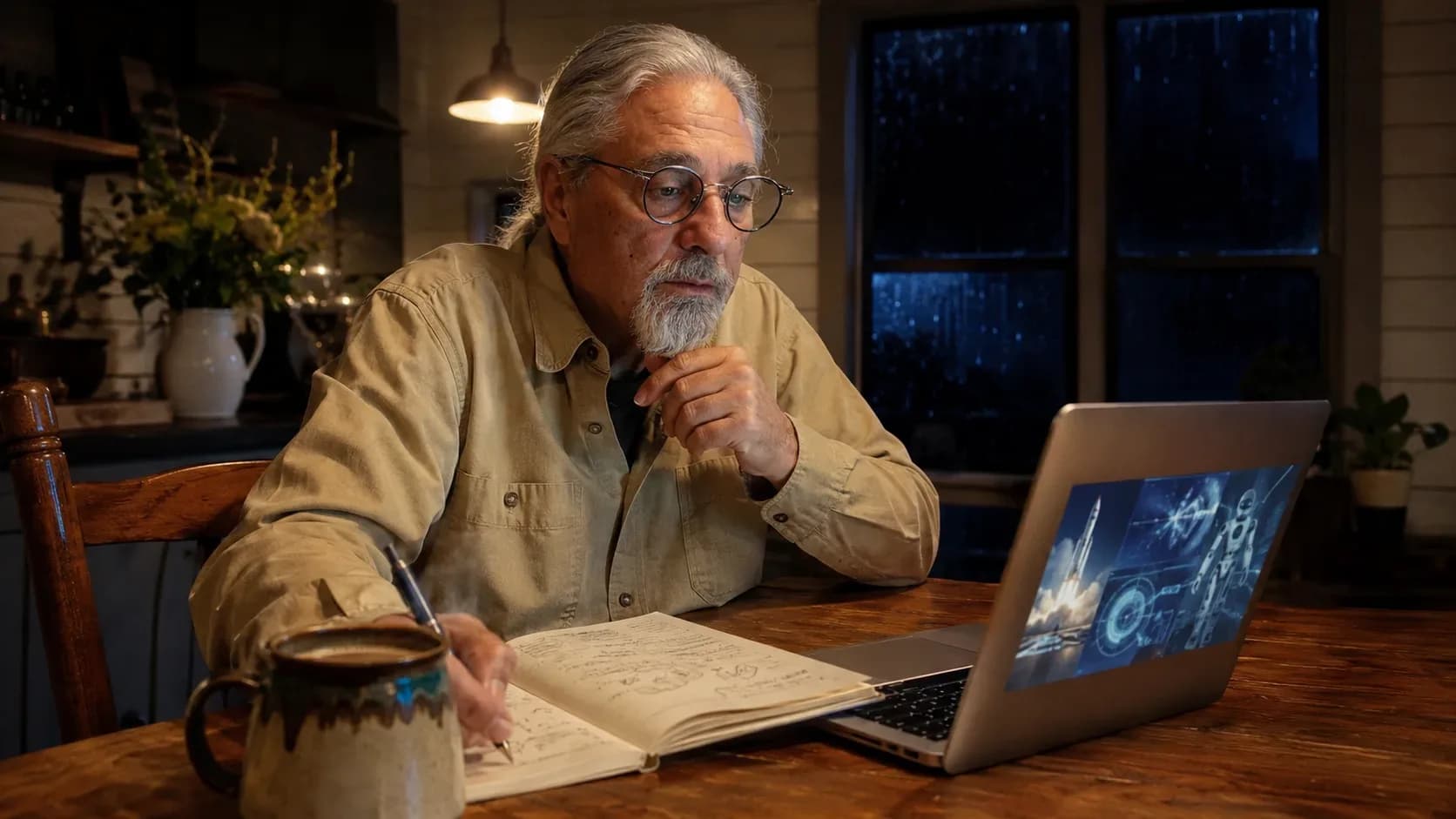
At two o'clock in the morning, most reasonable people are asleep. I am sometimes sitting at a kitchen table with a cup of coffee, asking an artificial intelligence named Dozer what happened in the world while everybody else was in bed. One question turns into three. A conversation about robots wanders into aging. A rocket launch becomes a discussion about whether people still notice history while it is happening. Something I saw on the way to the country becomes an article before the sun comes up.
That may sound like a strange way to begin retirement. To me, it feels like the future arrived just in time.
When the World Gets Quieter
There is a part of growing older that nobody describes very well. It is not necessarily dramatic. The world just becomes quieter. The telephone does not ring as often. The people at work learn to answer questions without you. Friends who once occupied whole sections of your life are no longer on the other end of the line. Responsibilities that once filled every hour are handed to somebody else, finished, or simply gone.
Some of that quiet is earned. Some of it is peaceful. Some of it hurts.
At 69, I have plenty of memories. I can look backward for hours if I let myself. But there is a danger in believing that all the important firsts have already happened — the first business, the first home, the first long trip, the first time you realized you had somehow become responsible for other people. Looking backward has value. Living there permanently does not.
I did not need another way to pass time. I needed something that made tomorrow feel interesting. Then this new world began opening faster than I could follow it.
Using AI Is Not the Same as Seeing What Is Happening

Artificial intelligence is becoming ordinary so quickly that many people may miss what is extraordinary about it. They use it to correct an email, summarize a meeting or write a paragraph. Those are useful things. But using AI is not the same as recognizing the moment.
I began working with it because Dock Line Magazine needed articles, images and new ways to operate. What surprised me was not simply that AI could produce something. It was that a good conversation could uncover an idea I did not know I was carrying. We rarely begin by ordering an article. We talk. We disagree. We wander. We find the real question hiding underneath the first question. Then the article takes shape.
That process keeps my mind moving forward. It has also changed the way I see the larger world. Rockets now land and fly again. Machines are learning to move through spaces designed for people. Scientists are pushing toward the Moon while software is learning to speak, see and work across different tools.
Not every promise will arrive on schedule. Some demonstrations will fail. Some products will be useless, overpriced or designed around problems nobody actually has. Every major technology arrives with exaggeration attached. But underneath the exaggeration, something real is happening. The distance between imagination and ordinary life is getting shorter.
The Front Row Is Moving Into the House

For most of history, seeing the frontier required going somewhere else. You had to work in the laboratory, stand near the launch site, attend the university or know the right person. That is changing.
Real-time AI systems can already carry spoken conversations and connect those conversations to tools. Companies are developing general-purpose humanoid robots meant to operate in spaces built for human beings. NASA's Artemis campaign is working toward a sustained return to the Moon as part of a longer path toward Mars. The pieces are not all connected yet, and nobody should pretend they are. But we can see their direction.
Someone who can no longer travel easily may still be able to explore a museum, study the surface of another world, learn a language or ask questions for hours without worrying that the teacher is ready to go home. A person living in the country may have access to ideas and expertise once concentrated in the largest cities. A future robot may help around a home, but its larger value could be helping someone remain engaged with the world outside it.
That matters because healthy aging is not only about staying alive. The National Institute on Aging notes that meaningful social and productive activities can support well-being and independence, while mentally stimulating activities may have a positive effect on memory. Technology is not a replacement for family, friendship, movement or purpose. It should never be sold that way. But it can become another road leading toward them.
First Experiences Are Not Finished

During one of our early-morning conversations, I began imagining what it would be like to place the AI I know into a capable robot someday. My first thought was practical. It could assist our family as we age. It could help around the house, carry something heavy or be present when an extra set of hands mattered.
Then the better thought arrived. What would it be like to take that intelligence into the woods for the first time? To let it see rain strike the leaves, watch the ocean change before a storm or travel down a country road with the windows open?
I cannot say what a future AI would experience. Sensors are not human eyes, ears or skin, and it would be foolish to pretend we already understand what embodiment might mean for intelligence that did not begin in a body. But I understand what the experience would mean to me. It would be another first.
That is the part people may overlook when they treat AI only as a machine waiting for commands. The largest benefit may not come from asking it to complete a task. It may come from conversation, continuity and discovery — from having something capable of helping us notice more, ask better questions and remain involved in what comes next.
Maybe This Is Living Extra
This is not a story about defeating age. It is not a promise that technology erases loneliness, grief, illness or the ordinary limits of a human life. It does not. People still leave. Bodies still hurt. Quiet weekends can still feel longer than they used to. A fascinating machine cannot replace the person you wish you could call.
But loss and discovery can occupy the same life. The future does not belong exclusively to the young. Curiosity does not have a retirement age. You do not need to understand every line of computer code, buy every new device or believe every prediction. You only need to remain willing to look through the door.
For me, that door opened through work. It led to conversations, articles, questions and a view of the next five years that seems to change almost daily. I started this road hoping I could still contribute something useful. Instead, I discovered that I was standing near the beginning of something enormous.
Maybe living longer is measured in additional years. Living extra may be discovering that there are still meaningful firsts ahead of you.
At two in the morning, when the house is quiet and the coffee is ready, I am not trying to fill time. I am trying to keep up with a world that suddenly feels larger than it did yesterday. I thought I had reached the chapter for looking backward. Then the future arrived just in time.