

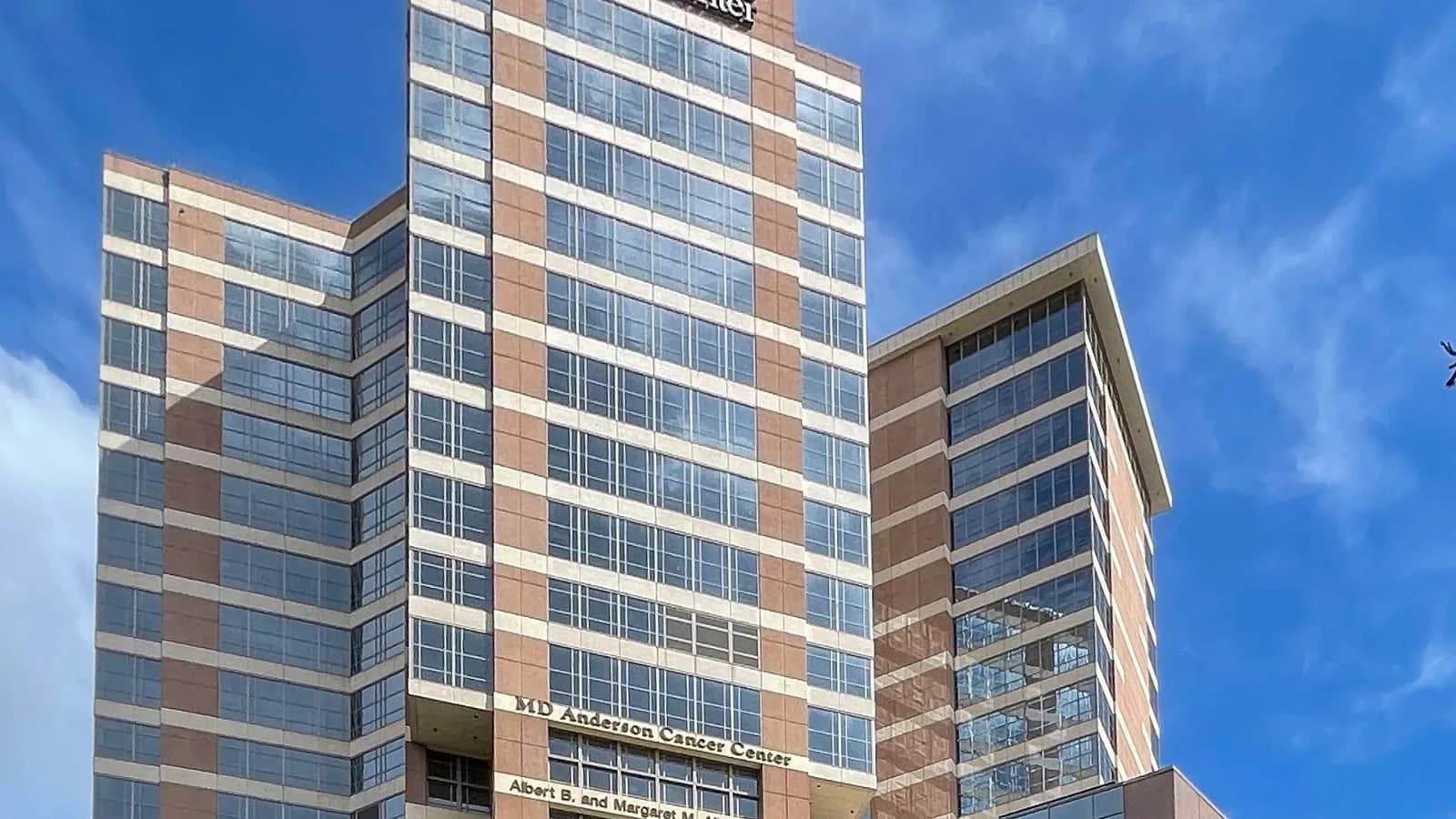
MD Anderson Plans a $3.4 Billion Expansion of Its Texas Medical Center Campus
The Nov. 5 announcement covers Inspiration Tower and Prism, nearly 2 million square feet of new space, with openings planned in 2032 and 2030. No construction start date was given.
The University of Texas MD Anderson Cancer Center on Nov. 5 announced plans for two new buildings on its Texas Medical Center campus in Houston, Inspiration Tower and Prism, a project the institution described as a $3.4 billion investment, according to its news release. Figures and quotes below come from that announcement; they are plans, not completed construction.
MD Anderson said the buildings will stand at Fannin Street and Holcombe Boulevard, account for nearly 2 million square feet of patient care, radiation oncology and diagnostic imaging space, and serve as a new front door to the campus. Including other ongoing capital projects, it said the Texas Medical Center campus will grow from 16.4 million square feet in 2020 to nearly 22 million square feet by 2032. The release said the facilities will enable the institution to care for nearly 250,000 patients a year. It did not give current annual patient totals for comparison, a construction start date, or a year-by-year spending schedule.
"Every detail of these buildings, from the technology to the treatment rooms, was designed around our patients who will receive their care in them and our employees who will work in them," Dr. Jeffrey E. Lee, president ad interim of UT MD Anderson, said in the release. "The facilities will serve as a physical representation of hope for the patients and their families who will walk through the doors." He called the project "part of the most impactful capital expansion in UT MD Anderson's history."
What the two buildings are supposed to hold
Inspiration Tower is anticipated to open in 2032 as a 1.4 million-square-foot, 25-floor patient-care facility. MD Anderson called it its largest and most advanced patient-care building and said it is expected to be the largest cancer-focused clinical facility in the nation. Those are the institution's descriptions of a building that has not yet opened. The release said the tower will be organized around disease-specific clinics integrated with the institution's research, rather than clinics that treat a variety of related cancers.
Planned spaces include up to 330 exam rooms, 184 short-stay beds, 162 ambulatory treatment stations, 56 imaging rooms, 24 operating rooms and 38 procedure rooms. MD Anderson said the design includes terraced indoor and outdoor spaces, art, on-site parking and skybridges to neighboring buildings.
Prism, scheduled to open in 2030, will be a 292,000-square-foot radiation oncology and diagnostic imaging center next door and connected by a skybridge, the release said. MD Anderson said radiation therapy is part of treatment for about half of all cancer patients, and that Prism is designed to serve up to 150,000 patients a year and would account for nearly half of all linear accelerator activity in the Texas Medical Center. The planned equipment list includes 12 MRI machines, four CT scanners, two PET-CT units, 18 radiation vaults and seven radiation simulators.
Public money, private gifts and a growing state
The $3.4 billion figure, the release said, "encompasses funding from UT MD Anderson and UT System alongside philanthropic support." Kevin Eltife, chairman of the UT System Board of Regents, said in the announcement, "The UT System is committed to investing in the state's health care needs." Chancellor Dr. John Zerwas said the new facilities carry "a commitment to bring hope and healing to thousands of individual patients."
Both buildings are priorities of MD Anderson's $2.5 billion philanthropic campaign, Only Possible Here, The Campaign to End Cancer, which the institution called the largest fundraising campaign in its history. The release said the campaign has raised more than $2.22 billion to date, from more than 345,000 donors and more than 925,000 gifts.
MD Anderson said Texas' growing population is increasing demand for cancer care, and that the buildings are designed with adaptable infrastructure for technologies such as artificial intelligence and robotics. Demand for care is rising in more than one part of the state. We recently reported how Texas Plans $87 Million More for 129 Rural Health Providers. Here Is Where the Money Is Meant to Go.
"Every patient we treat deserves an environment that reflects the excellence of the care they receive at UT MD Anderson," Chris McKee, executive vice president and chief strategy officer, said in the release. "Our new facilities will be innovative, agile, adaptable and beautiful, and they will allow us to care for more patients, more effectively — in an environment that enhances healing and well-being."
A press release is not an open door
More capacity for cancer care is a genuine good. People travel to Houston from across Texas and far beyond because they are sick and they hope for help. A $3.4 billion plan, public university-system dollars and a fundraising campaign with an ambitious name do not, by themselves, treat a single additional patient. The announcement is a plan. The tower is scheduled for 2032. Prism is scheduled for 2030. Neither has a public construction start date in the release.
Matthew 25:36 says, "I was sick, and ye visited me." The test of these buildings will be whether they actually receive the people who need them, at a cost the public can follow. Until then, pray for the patients already walking those halls, and keep the numbers honest as the work begins.
More Health & Fitness Stories
 Yesterday
Texas Forensic Psych Bed Lists Still Held 1,626 People at Fiscal Year's End, HHSC Reports
 Yesterday
Texas Child Seat Law: Younger Than 8 Unless Taller Than 4'9", Buckle Up Before Holiday Travel
 This Week