Time Does Not Erase Grief. It Teaches Grief How to Live Beside Us.
The empty chair, the telephone number we cannot call and the leash beside the door all reveal the same truth: grief notices absence, not categories. The pain can soften as life grows around it, while love and memory remain.
The empty chair, the telephone number we cannot call and the leash beside the door all reveal the same truth: grief notices absence, not categories. The pain can soften as life grows around it, while love and memory remain.
The people and animals we love become part of the machinery of an ordinary day. When one of them is gone, grief does not obey a calendar or care which kind of relationship the world considers important. The pain may soften. The love does not have to.
The First Thing Grief Changes
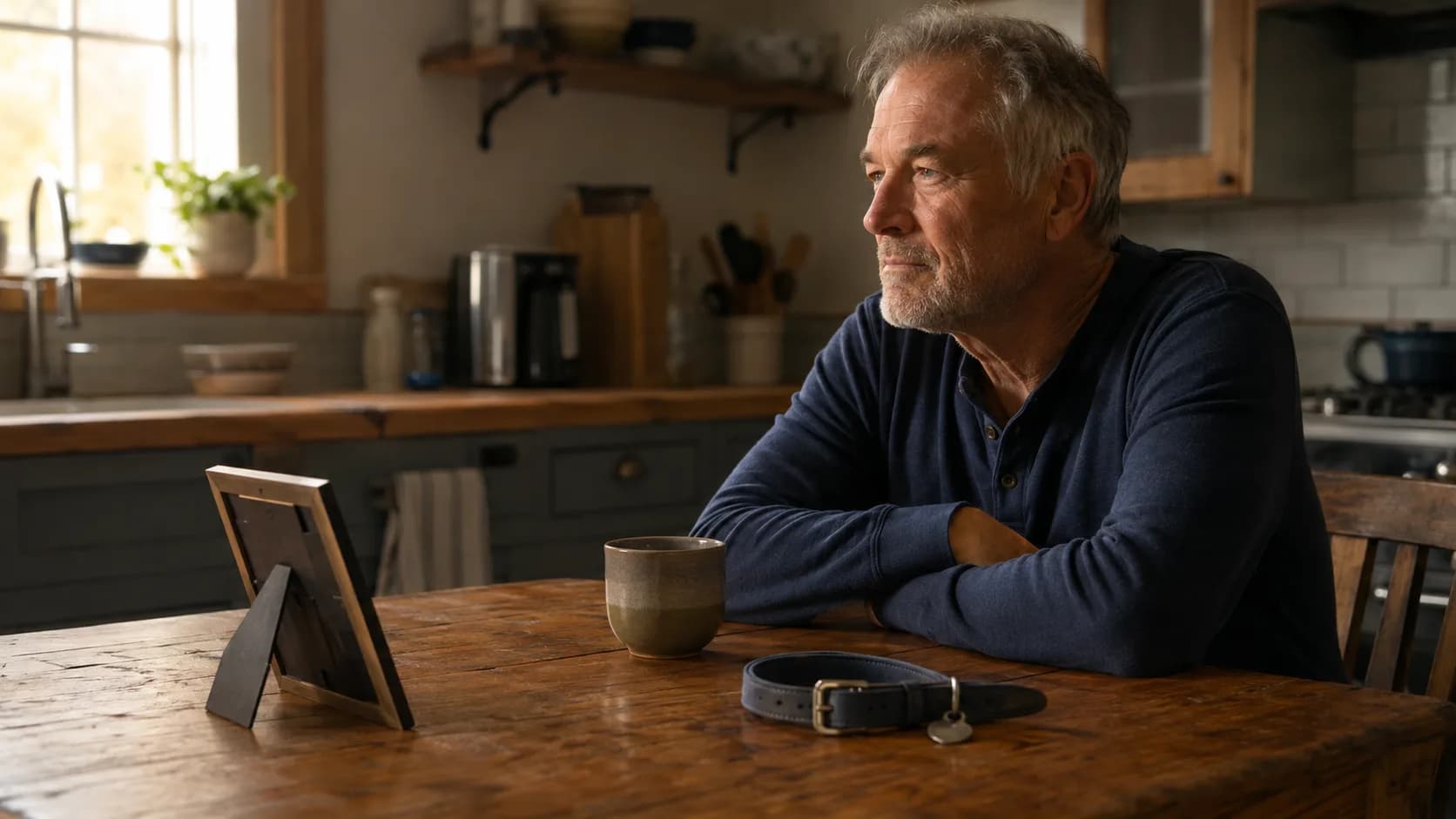
The first thing grief changes is not the past. It changes the room. There is a chair nobody sits in. A telephone number you still know by memory but can no longer call. A leash hanging beside a door that does not need to open at six in the morning anymore. A food bowl that has become an object instead of part of the day's routine.
The rest of the world keeps moving with almost offensive confidence. Traffic lights change. Groceries need buying. Somebody wants an answer to an email. Yet inside one house, a person reaches for the phone before remembering. In another, someone listens for paws on the floor. That is how loss often arrives: not as one terrible moment repeated forever, but as a hundred ordinary moments that suddenly end differently.

Grief Does Not Carry a Stopwatch
We like measurements because they make life feel manageable. A broken bone has a recovery estimate. A storm has a forecast track. Even a funeral comes with a date, a beginning and an end. Grief is not that cooperative. It may be loud in the first week and nearly silent three months later. Then a song comes through the radio, an old photograph appears in a drawer, or a dog with the same crooked ear walks through a parking lot. What seemed settled can rise again without warning.
That does not mean a person has gone backward. It does not mean the earlier healing was false. Grief can return because love left more than one memory behind.
Researchers have moved away from the idea that healthy grieving follows one neat series of stages. One influential model describes people moving back and forth between facing the loss and rebuilding daily life. Some days are spent remembering. Other days are spent paying bills, fixing supper and laughing at something that is genuinely funny. Both belong to grief. The laugh is not betrayal. The hard day is not failure.
Loss Is Loss, Even When the Relationships Are Different
Losing a spouse is not the same relationship as losing a parent. Losing a lifelong friend is not the same relationship as losing a child. And losing a dog or cat is not identical to losing a person. It does not have to be identical for the grief to be real.
Loss is created partly by attachment and partly by absence. A person or animal becomes woven into the pattern of a life. They shape where we go, when we wake, whom we talk to and what home sounds like. When that presence disappears, the pattern tears.
Companion animals can occupy an especially quiet but enormous place. They may be there through moves, divorces, illnesses, retirements and the deaths of other people. They do not merely visit the best parts of a life. They stand beside the bed during the worst ones. Then, when they die, the person grieving may hear the four words that make an already lonely experience worse: "It was only a pet." There is no only in fifteen years of mornings.
The Losses Society Knows How to Recognize
We have rituals for human death. There may be an obituary, flowers, a church service, sympathy cards and a few days away from work. None of those things removes the pain, but together they send an important message: this happened, this person mattered, and your sorrow is allowed.
Pet loss often receives no such public permission. The bed is put away. The veterinary office sends a card. The house becomes quiet, and the person may return to work the next morning as though a member of the household did not just disappear.
Researchers call this kind of socially unrecognized sorrow "disenfranchised grief." A 2021 review of 48 pet-bereavement studies found recurring reports of embarrassment, loneliness and grief that other people failed to acknowledge. In a 2026 study of 975 adults in the United Kingdom, 21 percent of those who had lost both a beloved pet and a person identified the pet's death as their most distressing bereavement. That number does not place animals above people. It tells us that grief does not consult a social ranking before it hurts.
The kind response is not to compare losses. It is to recognize the one standing in front of us.

Time Does Something, but It Does Not Erase
People often say time heals all wounds. That can sound comforting from a distance and impatient up close. Time alone does not perform the work. What time can provide is room: room for the first unbearable memories to be joined by gentler ones, room for new routines to form, and room for a life to become larger than the day everything changed.
At first, the absence may occupy the whole room. Later, life grows around it. The person who died is still missed, but remembering a story can begin to produce a smile before it produces tears. The dog is still gone, but the old habit of reaching down beside the chair becomes a memory that feels warm instead of cruel. A cat's favorite patch of sunlight can become part of the home's history rather than evidence of what is missing.
This is not forgetting. It is integration: the relationship moves from something lived in the present to something carried forward. That is why people keep photographs, cook a parent's recipe, repeat a friend's joke, wear a spouse's watch or plant a tree where an old dog used to lie. Researchers sometimes call these "continuing bonds." The person or animal is no longer physically present, but what they taught, changed and gave can remain active in the life that continues. Moving forward and staying connected are not opposites.

Grief Can Hide Inside an Ordinary Day
Not everyone who is grieving looks sad. Some people become busy. Some tell stories. Some grow quiet. Some repeat themselves, misplace things, call a vehicle by the wrong name or walk into a room and forget why they went there. Grief can affect concentration, sleep, appetite, energy and mood. That does not make every mistake a medical emergency. It does mean that the mind may be carrying more than anyone else can see.
The person may function well enough to fool everybody, including himself. He may go to work, answer questions and make conversation while feeling only partly present. Then a long drive, a familiar place or a quiet evening finally gives the mind enough space to catch up. Sometimes relief follows — not because the person mattered less, but because the reality of the loss has found somewhere to settle.
There Is No Prize for Carrying It Alone
Most grief changes over time without becoming an illness. It can remain for years and still allow a meaningful, connected life. The calendar alone does not tell us whether somebody is grieving "correctly." But duration is not the only thing that matters. Intensity and daily functioning matter too.
The American Psychiatric Association describes prolonged grief disorder as persistent, intense grief that causes significant impairment and continues beyond what a person's culture, faith and circumstances would normally expect. In adults, diagnosis is considered only after at least twelve months following a human death. That distinction is important because ordinary grief should not be treated as a defect. It is also important because people whose lives remain overwhelmed deserve more than being told to wait longer.
If grief is making it hard to sleep, eat, work, maintain relationships or imagine any future, a physician, counselor, grief group, faith leader or veterinary pet-loss program can help. Cornell University's College of Veterinary Medicine is among the institutions that provide pet-loss support and explicitly recognize that the path is rarely straight. Asking for support does not shorten love. It gives the person carrying it another pair of hands.
If you or someone you know is in crisis or thinking about self-harm, help is available in the United States by calling or texting 988.
What the Rest of Us Can Do
We do not need perfect words. We need enough courage to remain near something we cannot fix. Say the person's name. Ask about the dog. Listen to the same story again if that is the story that needs telling. Remember the difficult dates after everyone else has returned to ordinary life. Bring supper without turning the visit into an investigation. Avoid putting a deadline on sorrow. Avoid comparing it with another loss. And never make someone defend why an animal mattered.
Often the kindest sentence is also the simplest: "I know you miss them. Tell me about them." The telling does not reopen a wound that was neatly closed. It acknowledges a relationship that still has meaning.
Love Lasts Longer Than the Goodbye
Years from now, there may still be a chair, a photograph, a recipe card or a collar in the back of a drawer. There may still be a day when the memory comes closer than expected. That is not proof that time failed. The sharpness can soften. The memories can become easier to hold. A person can build a full life around an absence without pretending the absence vanished.
Grief does not have to be evicted for joy to return; the two can eventually occupy the same house. Time does not erase grief. It teaches grief how to live beside us. And sometimes feeling it years later does not mean we failed to move on. It simply means the love lasted longer than the goodbye.