August Recap from Magnolia City Council: EDC Appointments, Flock Cameras and a Night of Public Debate
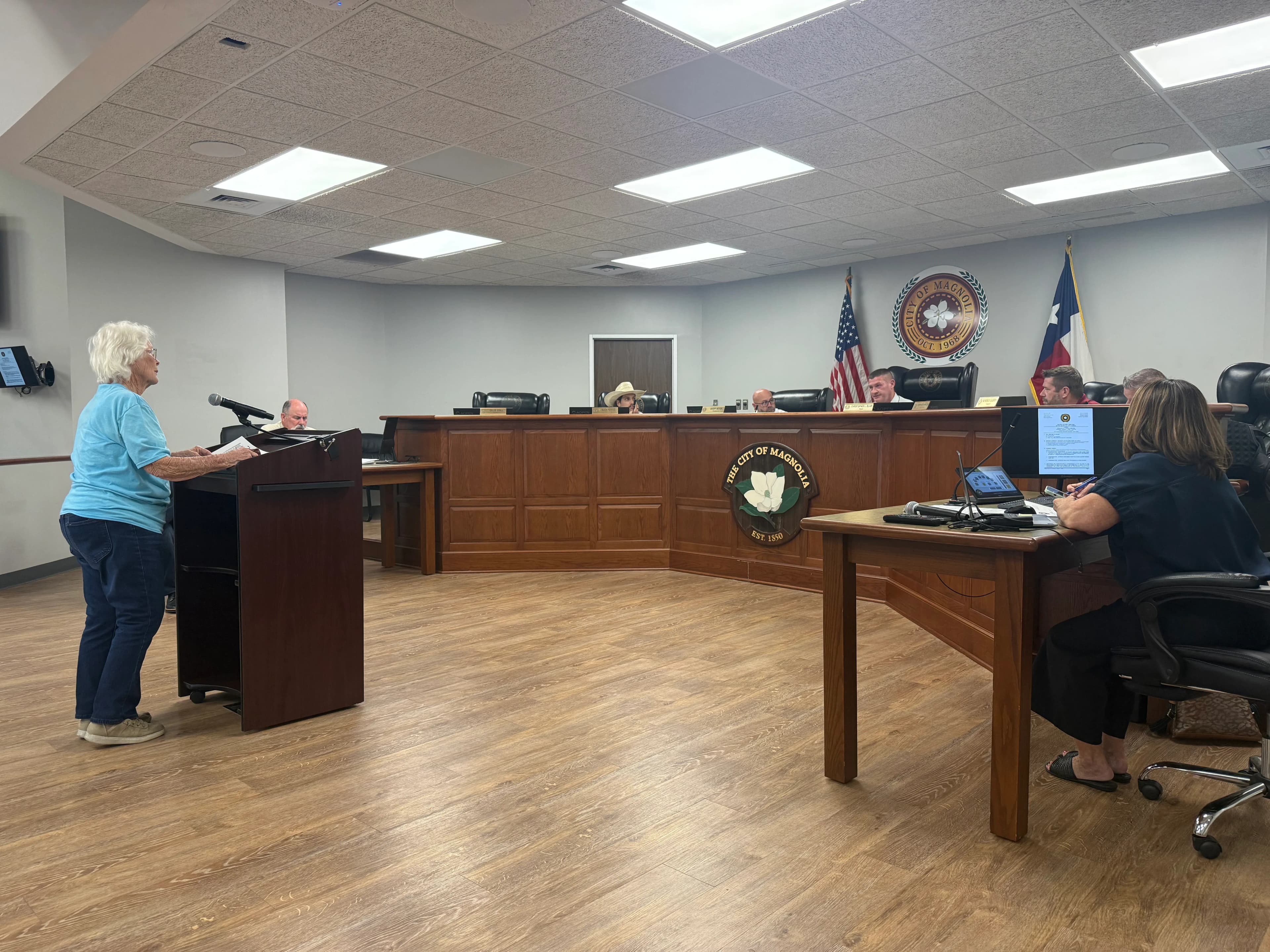
The Magnolia City Council met Tuesday, August 11th, for a meeting that touched on development, changes inside City Hall, appointments to the city's economic development boards and the future of Magnolia's Flock camera system.
Mayor Christopher Blair and four members of City Council were present, with Councilman Caleb Small absent.
Public comments brought a mix of perspectives from Magnolia residents.
Some spoke in favor of continued development and the economic opportunities they believe it can bring. Others raised concerns about development, annexation, traffic and the direction of the city. Several comments also addressed information circulating online, including attempts to distinguish proposed development plans from rumors surrounding them.
Residents weren't the only ones with updates.
City departments also presented reports covering personnel, public works, policing and economic development. Together, those reports offered a look at some of the quieter changes taking place behind the scenes at City Hall.
Personnel Changes Inside Magnolia City Hall
City Administrator Bob Harvey, now in his first full month in the position, told council there has been considerable activity on the personnel side of city government.
Harvey said the city interviewed candidates for its Director of Human Resources position and extended an offer to John Rudd. Rudd has extensive experience in the human resources industry, with over a decade as the Human Resources Director within Converse, TX.
Harvey said one of the first priorities for the new HR director would be meeting personally with city employees, reviewing and updating job descriptions and discussing performance expectations with each staff member.
Harvey also addressed another significant personnel change; City Secretary Christian Gable resigned from the city.
"She gave us two weeks' notice," Harvey told council. "She served out those two weeks, and we're very grateful for that."
The city has started its search for a permanent replacement. In the meantime, Kandice Garrett is serving as Interim City Secretary and performed the secretary duties during Tuesday night's council meeting. Garrett has previously filled in for the city in that role.

Harvey additionally discussed the city's exploration of digital software to help the City organize records and assist staff with administrative work. Harvey named OpenGov Software, which provides software for local governments covering areas including financial management, procurement, permitting and other municipal operations.
Those administrative updates were a lot calmer than the discussion that followed over how the City of Magnolia appoints residents to boards that help oversee its economic development work.
EDC Appointment Debate Raises Questions About How Magnolia Chooses Board Members
The most contentious council discussion of the night centered on two appointments to Magnolia's Economic Development Corporation.
At first, there was even some confusion over exactly which development corporation the appointments involved. Mayor Blair raised questions about whether the presented positions were associated with Magnolia's 4A or 4B corporation, with Councilman Raymond Gaskin raising similar questions during the discussion.
First, What Are 4A and 4B for the City of Magnolia?
Magnolia has two separate development corporations commonly referred to as 4A and 4B.
The simplest explanation is that both use locally approved sales-tax dollars for development projects, but their purposes are somewhat different.
Magnolia's 4A Economic Development Corporation (EDC) is geared primarily toward economic development, including supporting business activity, industrial and commercial development, jobs and related infrastructure.
The city's 4B Community Development Corporation (CDC) has a broader community-development role, with the ability to support economic-development projects while also focusing on projects intended to improve quality of life in Magnolia. Both operate through appointed boards with City Council oversight.
The City of Magnolia's two corporations have supported projects ranging from infrastructure and business development to Unity Park and community planning.
Rachel Steele serves as executive director of Magnolia's economic development operations and presented the related agenda items during Tuesday night's meeting.
However, the discussion that night wasn't really about what those boards do.
It was about how people get appointed to them.

"It's a Poor System"
Gaskin questioned Steele about what information members of City Council receive before they're asked to approve someone for one of the open positions.
His concern was simple: City Council was being asked to appoint people to a board involved in Magnolia's economic-development decisions, but he did not believe councilmembers had enough information about the applicants to make that decision.
"You can't expect us to vote on things when we don't know all the details, right?" Gaskin asked.
"I get a name and an address; and that's it."
Steele disputed that description, explaining that councilmembers receive a two-page application containing more information about each candidate.
"There's a two page sheet; it talks about previous civic involvement, whether or not you've worked in the industry," Steele said.
She said the process wasn't something new.
"This is the standing system that we've used for at least the seven and a half years I've been here," Steele said.
Gaskin wasn't satisfied, "It's a poor system."
Steele also pointed out that councilmembers have another option available if they want to learn more about the applicants.
"Under council rules and procedures, you're entitled to go into executive session and interview these candidates," Steele said.
Gaskin said that was exactly what the council should do.
"I don't feel comfortable voting on 4A or 4B when this is all I have," he said.
From a Discussion to a Vote
After several questions about the process and the amount of information councilmembers had received, Councilman Brandon Jacobs moved to approve the appointments before council.
The discussion moved into a vote with little additional debate, while conversations could be heard among residents seated in the room.
Both motions passed, with Gaskin casting the lone opposing vote.
His frustration was clear.
"This process is f***ing garbage and I am voting no," Gaskin said.
The vote itself may have ended the discussion inside City Hall that night, but it didn't completely answer the questions raised during it.
What We Learned After the Meeting
Following the meeting, Dock Line Magazine reached out for more information about Magnolia's appointment process and gave those involved an opportunity to explain their positions and to provide better context.
Rachel Steele provided the city's Boards, Commissions and Committees application, which is used for several appointed bodies. The form directs applicants through the City Secretary's Office and specifically instructs them not to submit resumes, photographs, business cards or letters of recommendation.
Instead, applicants provide information about their education, relevant experience, community involvement and reasons for seeking an appointment.
"We are just using the process the city has promulgated for all commissions and boards," Steele told Dock Line Magazine.
In other words, Steele's position is that the EDC is working within the system already established by the City of Magnolia.
Councilman Gaskin's frustration is with that same system.
In a follow-up, he said he regretted the language he used during the meeting but stood by his criticism of the process.
"I do wish, as a councilman, I would have chosen a better word or phrase to express my frustration," Gaskin said.
"I believe most people would agree, that when it comes to making personal or business decisions, you would do your due diligence and interview individuals who are going to make decisions on your behalf," he said. "So as a caretaker and elected official of our city, why wouldn't we do the same?"
Additionally, Mayor Chris Blair responded to Dock Line Magazine's inquiry on this topic.
Blair said he is reviewiewing bylaws and consulting with legal counsel regarding the process, citing concerns over the way the appointments were presented and the amount of information available for councilmembers to review candidates and potentially interview them.
The mayor's response suggests Gaskin's concerns have prompted a closer look at how Magnolia handles these appointments.
That being said, the larger question still remains with the remaining members of City Council.
Council members had the ability to seek more information or interview the applicants before appointing, yet the appointments moved forward with little additional discussion after Gaskin raised his concerns during the meeting.
If one council-member believed there wasn't enough information to comfortably make the appointments, why were the other voting members comfortable moving forward without additional interviews or discussion?
Dock Line Magazine emailed each of those who voted in favor of the appointments to ask why they supported moving forward and whether they believe Magnolia's current appointment process gives council members enough information to make those decisions.
As of publication, none had responded. This story will be updated if they do.
Magnolia Says It Will Not Renew Its Flock Camera Contract
Another point of discussion from the night involved Flock Safety cameras, although the city's decision had actually been announced before council convened.
Flock's automated license plate reader system is used by law enforcement agencies, like the Magnolia Police Department, to identify vehicles and assist investigators.
Earlier in the day, Mayor Blair and Chief Montgomery issued a joint statement posted on the mayor's official Facebook account. The post went through the positives of the cameras as well as the potential drawbacks that come with Flock.
"Ultimately, the City of Magnolia has made the decision not to renew the Flock contract," the mayor said in the post.

Providing additional clarity, the official Magnolia Police Department Facebook page also stated that the city is not pursuing any other ALPR, or automatic license plate reader, companies for use within city limits. However, Magnolia PD also noted that other agencies use Flock cameras in the area, including the Montgomery County Sheriff's Office.
Even with that announcement already public, the issue followed city officials into Tuesday night's meeting.
During the public-comment period, one Magnolia resident questioned the city's use of the technology and raised broader concerns about surveillance and public trust.
Mayor Blair's response was direct.
"We aren't renewing our contract with the Flock cameras," Blair said. "Those will go away."
Later that same night, Montgomery gave council an example of exactly why police departments use the technology in the first place.
During his department report, Chief of Police Kyle Montgomery described three recent vehicle thefts involving suspects who came into Magnolia from Houston.
Montgomery noted that Flock technology helped police identify the vehicle-theft suspects, which later led to arrests and the recovery of all three vehicles.
After the meeting, Chief Montgomery spoke with Dock Line Magazine about how he weighs that law-enforcement value against concerns from residents.
Chief Montgomery prefers looking at the broader picture of the situation. “The ROI just isn't there because it has the possibility of undermining trust in the community,” he said.
"It's still a good law enforcement tool," he added.
When asked when Magnolia's current agreement expires, Montgomery said, "I think it's October."
And when asked how quickly the cameras would physically disappear afterward, he said, “I’m not sure - but they repo them when you stop paying. But I’m not sure how long that’s going to take.”
City records show the camera system was funded through the Magnolia Economic Development Corporation, or 4A EDC, as a two-year program beginning in Fiscal Year 2023–24. Magnolia’s economic development project summary describes the program as an effort to improve public safety and reduce theft connected with new commercial development.
Chief Montgomery told Dock Line Magazine that if Magnolia were to renew the Flock program in the future, the funding would instead come directly through the city rather than the EDC.
The discussion in Magnolia reflects the broader argument surrounding automated license plate readers: where the value of a law-enforcement tool ends and concerns over surveillance and privacy begin.
In Magnolia's case, the city appears to have decided that usefulness alone isn't enough to keep the cameras.
For Magnolia, maintaining public trust appears to be playing an important role in what happens in the city.
Seven Residents, Three Minutes Each — and a Reminder of Where Local Government Happens
By the end of the meeting, the night's biggest moments had come from several different directions.
There were personnel changes inside City Hall. There was a sharp disagreement over how Magnolia appoints members to its economic development boards. There was confirmation that the city's Flock camera contract isn't expected to continue.
But looking back at the night, it's also worth returning to where the meeting started.
Seven residents stood up to speak during public comments. They didn't arrive with one shared message.
Some wanted to see Magnolia continue to grow. Others were skeptical of that growth or concerned about where it was headed. Residents discussed development, traffic, annexation, Flock cameras and information circulating throughout the community.
Each person came with his or her own perspective; and each had three minutes.
Local government gives residents something that can sometimes get lost in larger political conversations: regular access to the people actually making decisions.
Residents elect their mayor and councilmembers at the ballot box. Between elections, council meetings give them another opportunity to participate.
They can support what the city is doing, criticize it or bring attention to something they believe isn't getting enough attention.
And they can do it while the people making those decisions are sitting a few feet away listening.
Not every public comment results in immediate action. Not every speaker will persuade the council. And, as Tuesday's meeting demonstrated, residents themselves aren't always going to agree.
That's part of local government, too.
Seven people walked to the podium Tuesday night with seven different reasons for being there.
For three minutes at a time, the floor was theirs. If there's an issue happening in Magnolia that you care about, the conversation doesn't have to end online or at the ballot box. There's a podium at City Hall, too.