Justice for Fort Hood Should Be Done. It Should Not Be Streamed.
The Pentagon said the Fort Hood gunman's execution would be livestreamed. Now officials are reportedly leaning against it, as church leaders, a survivor and top Republicans weigh in.
On Nov. 5, 2009, Army Maj. Nidal Hasan walked into a crowded medical building at Fort Hood, Texas, and opened fire on unarmed soldiers. He killed 13 people and wounded 32. Seventeen years later, the Pentagon says he will die by firing squad on Dec. 3. What the country is now arguing about is not whether he deserves it, but whether Americans should be able to watch it live. As of Tuesday, that was still undecided: the Pentagon said the livestream is going forward, while administration sources told CBS News and ABC News that officials are leaning against it and the president has not made a final call.
What has been decided, and what has not
A Pentagon spokesperson said President Trump approved Defense Secretary Pete Hegseth's recommendation to carry out the execution, the BBC reported. It would be the first military execution in the U.S. since 1961 and the first by firing squad since the end of World War II.
Hegseth said last week on Real America's Voice that Hasan was "going to get a firing squad of soldiers, as it should be." He added, "We'll make sure that people are able to watch it, that it's public, because people need to understand that there's serious consequences for these types of things," CBS News reported. A Defense Department official then told the BBC the execution would be livestreamed.
That may change. By Tuesday evening, administration officials were leaning against a livestream, and the president had not made a final decision, sources told CBS News. Asked about it as he left for Alaska, Trump said, "We're looking at it." The Pentagon has not backed down publicly. "The Secretary is correct. It will be live streamed. Details will follow," a defense official said in a statement Tuesday, ABC News reported. ABC's sources said options under discussion include cutting away before the shots are fired.
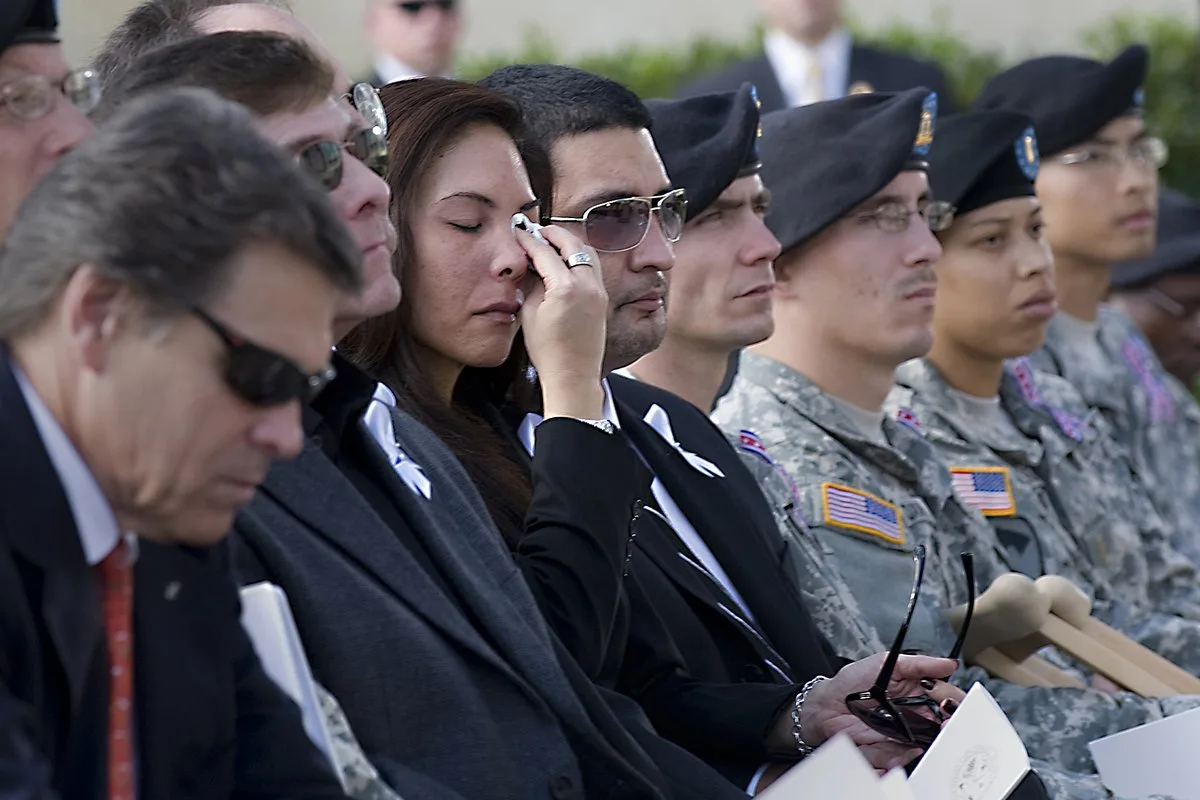
Families and troops at the Nov. 10, 2009, memorial service for the victims of the Fort Hood shooting. Photo: U.S. Army, Public domain.
Pushback from the right, not just the left
The objections have not come only from the usual places. Vice President JD Vance said, "If it's ultimately livestreamed, I'm not gonna be watching it," while urging people not to forget "that this is a guy who brutally murdered a lot of innocent people," according to Religion News Service. House Speaker Mike Johnson told CBS that some colleagues worry "you would create a video that would be a recruiting tool for future terrorists," and said he would not watch.
Hasan told his 2013 court-martial he believed he was protecting Muslims and the Taliban in Afghanistan, the BBC noted. For a man who saw himself as fighting for a cause, a government-made video of his death is the kind of propaganda Johnson's colleagues have in mind.
Church leaders have spoken out too. Archbishop Paul Coakley, president of the U.S. Conference of Catholic Bishops, called the plan "a barbaric promotion of a culture of death," and quoted Romans 12:17: "Do not repay anyone evil for evil." Walter Kim, president of the National Association of Evangelicals, affirmed the "need for justice" but said a livestreamed firing squad "risks turning one of the state's most solemn responsibilities into a public spectacle," RNS reported.
A survivor's view
The voice worth hearing most may be Alonzo Lunsford, a former Army sergeant who was shot seven times that day. He told the BBC he supports the firing squad as "befitting" what Hasan did, and plans to attend. "I want him to know he failed. I'm still here," he said.
But Lunsford drew a line at broadcasting it to everyone, citing the message it could send to young people. "As far as the families of the fallen and the families of the survivors, and the survivors themselves, yes, I think we should be able to look at it uncensored."
Army Regulation 190-55 already limits who may watch a military execution to certain people, such as journalists and relatives, and excludes anyone under 18, the BBC reported. The Pentagon has not said whether it would waive those rules.
Justice is not entertainment
Many Christians, including this writer, believe the state may rightly take the life of a murderer. Genesis 9:6 grounds that authority in the image of God in every person, and Romans 13 says the ruler "does not bear the sword in vain." Two thirds of Americans support the death penalty for murder, according to a July Pew survey cited by the BBC. Hasan murdered 13 people in cold blood and admitted it. If any case warrants the ultimate penalty, this one does.
But the same Scriptures that give the state the sword demand that it be used soberly. An execution is a grave act of judgment carried out on behalf of the people. It is not content. Putting it on a stream next to sports highlights and cat videos cheapens the very justice it is meant to show, and it hands a terrorist the stage he wanted. There is also a practical point. John Mills, a lawyer who represents death-row inmates, told the BBC that Hasan's appeals are not finished and that a federal court review would likely delay the execution. Officials should spend their energy making sure the sentence is carried out lawfully, not planning a broadcast.
The families of the 13 waited 17 years for this. They deserve a solemn end to it, witnessed by those with a right to be there. The rest of the country does not need to watch to know justice was done.
Photos: U.S. Army (Sgt. Ken Scar; U.S. Army), public domain, via Wikimedia Commons.