Montgomery County Pauses Bond Plans After Lengthy Courthouse Discussion
A packed Commissioners Court meeting on August 6th, included 2027 budget discussion and an extended debate over possible bond propositions.
A Packed Courtroom and a Full County Agenda
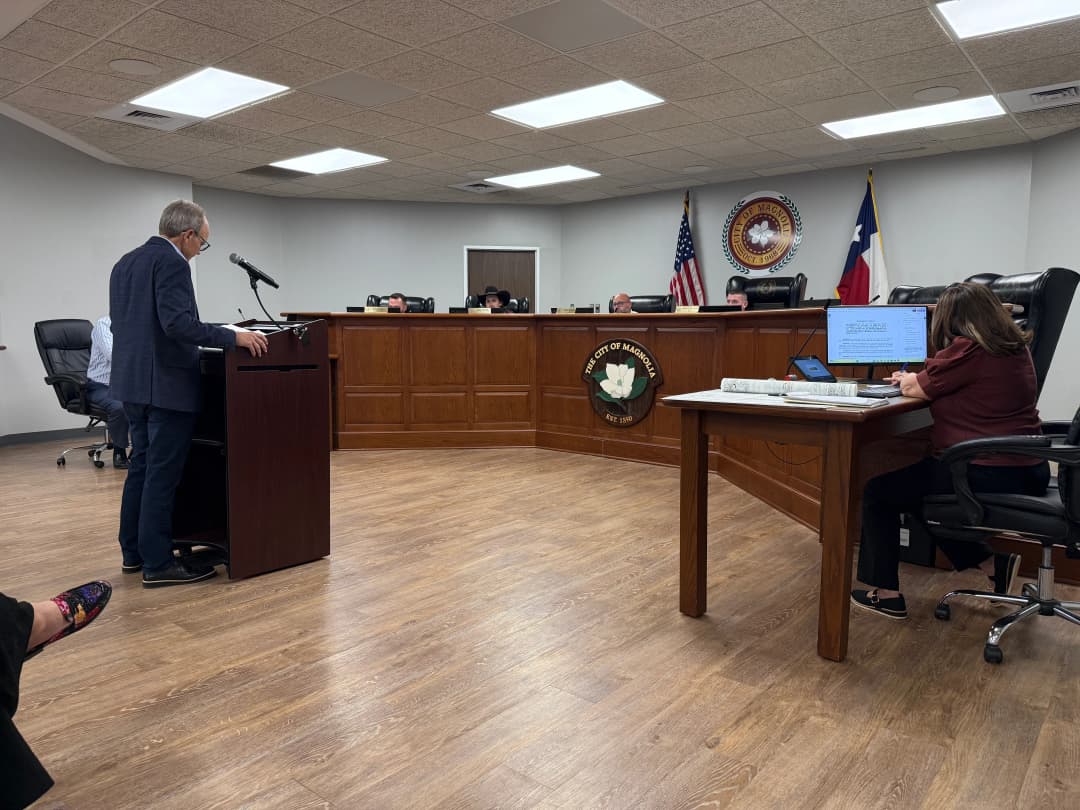
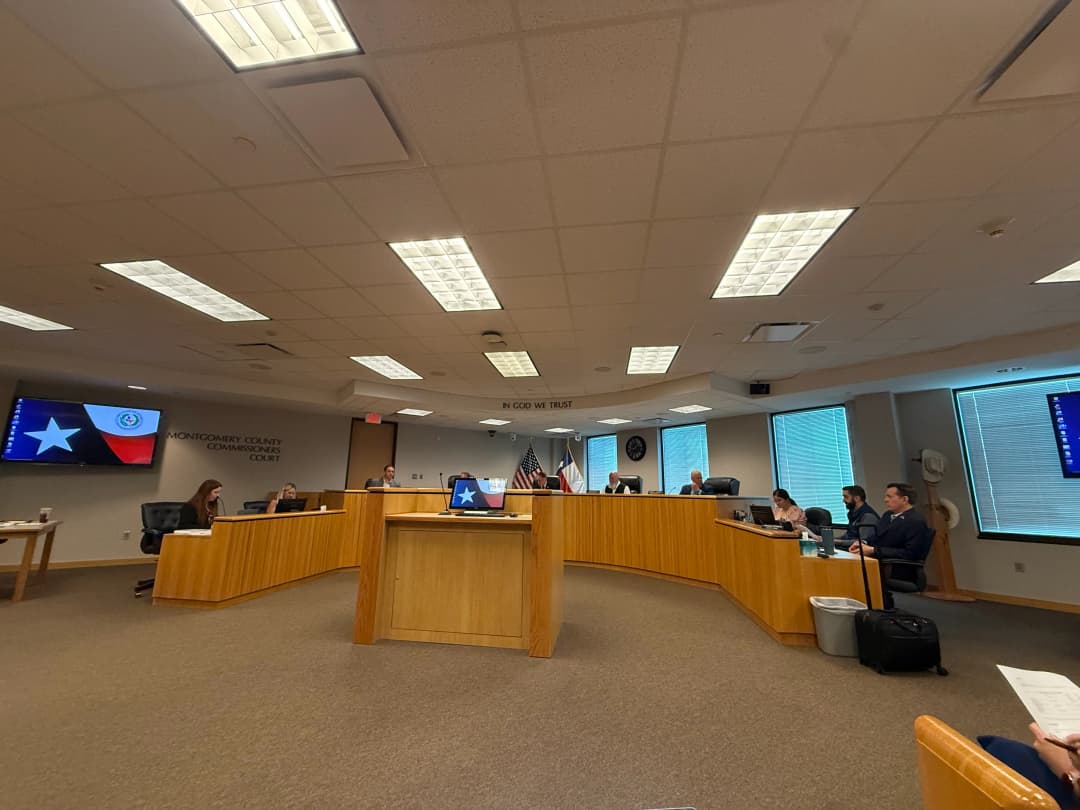
Montgomery County Commissioners Court met Thursday, August 6th 2026, in a packed courtroom at the Alan B. Sadler Commissioners Court Building in Conroe. All five members of the court were present: County Judge Mark Keough, Precinct 1 Commissioner Robert Walker, Precinct 2 Commissioner Charlie Riley, Precinct 3 Commissioner Ritch Wheeler and Precinct 4 Commissioner Matt Gray.
The meeting included the usual mix of public comments, proclamations, consent-agenda business and department updates. Much of the room’s attention, however, centered on a possible November bond election involving several major county facilities.
Public comments at the beginning of the meeting reflected differing views on the courthouse issue. Some speakers urged the county to address courthouse capacity and facility needs, while others questioned the proposed bond approach or whether the county was ready to move forward.

The court also recognized August 2-8th as National Health Center Week and marked the 50th anniversary of the Montgomery County Memorial Library System’s Genealogy and Preservation Center, recognizing August 19th as Genealogy and Preservation Center Day.
Later in the morning, Budget Officer Amanda Carter presented Montgomery County’s preliminary Fiscal Year 2027 budget. According to figures Carter presented to the court, total taxes are projected to increase about 4.9%, from approximately $386 million in Fiscal Year 2026 to $405 million in Fiscal Year 2027.

The presentation also showed the county’s general fund year-end balance rising in recent years, from roughly $58 million in 2023, to $67 million in 2024, and $73 million in 2025.
Carter broke preliminary expenditures down by function:
Law enforcement and corrections: 44.8%
General government: 13.4%
Debt service: 10.3%
Transportation: 10.2%
Legal and judicial: 7.8%
Financial administration: 5.9%
Health and human services: 4.0%
Culture and recreation: 3.7%

The Budget Office was able to accurately answer commissioners’ questions as they worked through the presentation without much commotion. The Budget office provided the full presentation for readers to review. View the presentation, here.
By that point, however, the courtroom looked noticeably different. Much of the audience that had packed the room during the earlier bond discussion had left after commissioners decided not to move the proposals forward that day.
The court later entered executive session, returned after noon and adjourned.
The budget discussion offered residents a look at where county finances stand heading into the next fiscal year. But the most consequential discussion of the morning came earlier, when commissioners began asking whether they had enough information to put hundreds of millions of dollars in potential courthouse, jail and 911 projects before Montgomery County voters.
A Bond Discussion that Changed Direction
The courthouse discussion had already been building for months. By the August 6th meeting, commissioners were considering whether to take the next major step and put a bond proposition before voters.
According to the county’s August 6th agenda, commissioners were considering an order calling a November 3rd bond election along with potential funding scenarios. The proposed election order contained three possible propositions:
Proposition A: New county Justice Center/courthouse, Tax Office and administrative services building
Proposition B: New county jail and criminal justice complex
Proposition C: New 9-1-1 infrastructure and call-center facility

No dollar amounts had been finalized for each proposition. At the beginning of the discussion, County Judge Mark Keough said it was time to stop “kicking the can down the road” on the courthouse issue. “We have worked very hard on the courthouse situation and are ready to, if you will, pull the trigger on that and move on,” Keough said. He also told the room the project would cost taxpayers “about five bucks a month” while discussing a courthouse price range. That per-tax-payer figure was Keough’s estimate during the discussion, as a final bond amount had not been adopted.
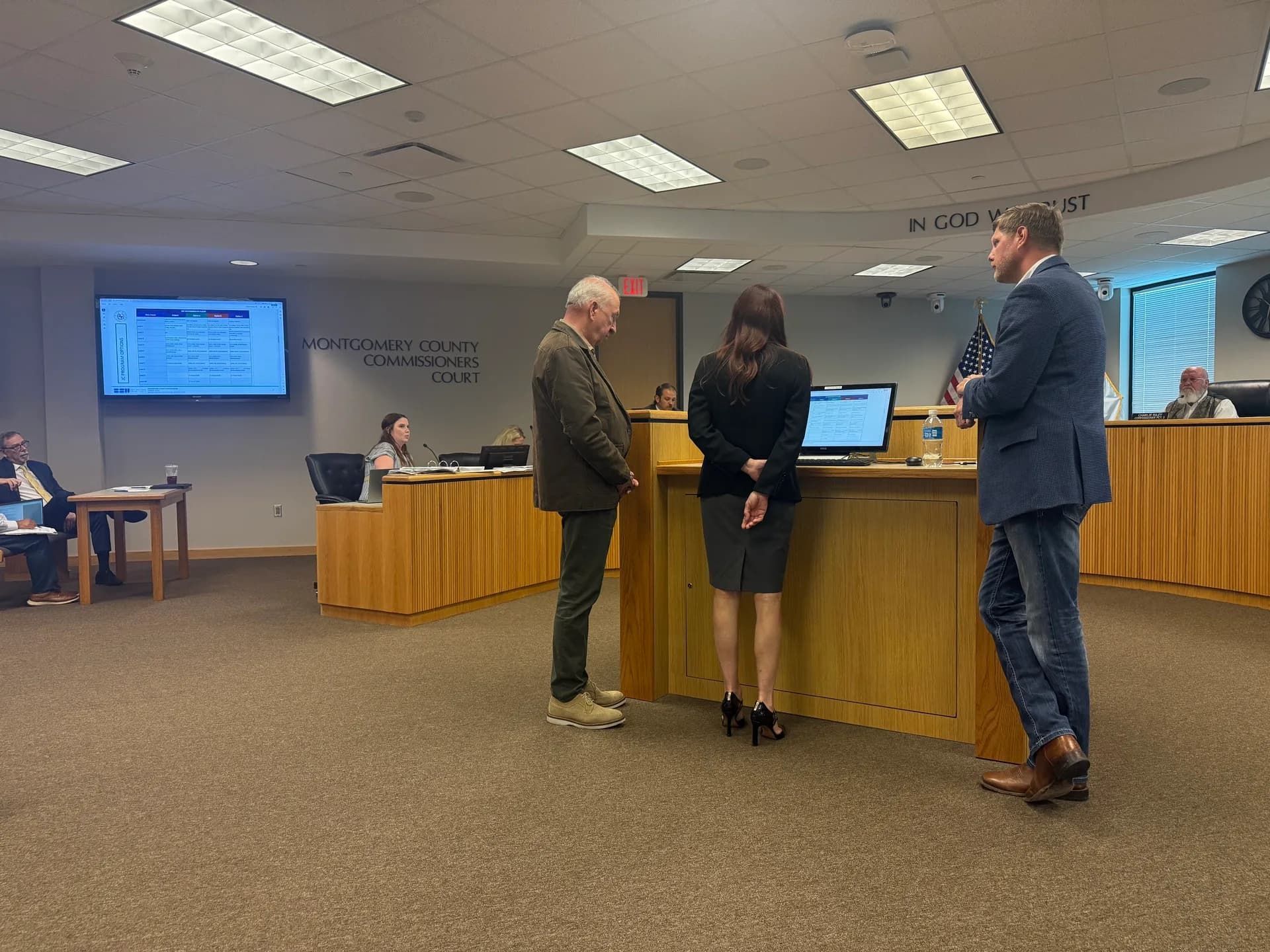
The architects for the project presented revised concepts for the Justice Center. Among the changes were moving from four courtrooms per floor to three, providing larger jury capacity where needed and considering a 10-story configuration with room for future courts. But the presentation also exposed several unresolved questions to the Commissioners. The architects acknowledged they had not yet met with many of the county officials who would use the building, and they had not yet discussed the planned closure of San Jacinto Street, building height or utilities with the City of Conroe government.
Space for the Tax Office quickly became one example. The concept provided about 20,000 square feet, compared with roughly 22,000 square feet currently used by the office. When Precinct 3 Commissioner Ritch Wheeler asked Tax Assessor-Collector Tammy McRae about losing that space, McRae responded, “We don’t have enough room.”
Judge Kristin Bays of the 284th District Court, also raised concerns that the presented plan was inadequate for the judiciary’s needs. Questions about the number of courts needed today and in future years became a major part of the discussion.

As those questions accumulated, Precinct 2 Commissioner Charlie Riley argued the county was moving too quickly. “It is too fast. We don’t have answers, and we’re not going to have answers today. We are moving too fast,” Riley said.
Precinct 4 Commissioner Matt Gray pushed back on the idea that commissioners needed a finished architectural plan before considering a bond, emphasizing that they were deciding whether to ask voters for authorization rather than approving a final building design. Gray also pointed to how long the issue had already been under discussion: “It’s been showing up on the agenda since last February, we’ve been trying to get a plan.” Commissioners also discussed that a bond authorization could establish a maximum amount without requiring the county to ultimately spend every dollar if the finished project cost less.
Eventually, Keough’s position shifted as conflicting estimates about courtroom needs and future capacity continued. “We don’t need to be talking about this right now, and we just need to wait on it,” Keough said. He added, “I don’t think we’re ready to move forward with this at all, I agree with Commissioner Riley.”
The proposed site then came under additional scrutiny. After Bays discussed the judiciary’s needs, Wheeler returned to a concern raised by Precinct 1 Commissioner Robert Walker and said, “We’re on the wrong piece of dirt.” Walker suggested a larger nearby property could give the county more room rather than forcing so much of the project upward.
Near the end of the discussion, Keough summed up the uncertainty: “There’s too many unknowns here,” followed by, “We’re going to defer that right now.” When commissioners considered whether to continue with the other potential bond propositions, Walker said, “It’s too early.” The original motion was ultimately rescinded, and county staff clarified that without an affirmative vote, no bond election was being called.
Commissioners instead agreed that the issues needed a more detailed workshop involving the full court. The workshop was discussed for sometime after September 1 and after the county budget process, but no date was set.
By the end of a discussion that began with talk of finally moving forward, none of the three potential bond propositions had advanced. Commissioners largely agreed that Montgomery County has facility needs to address. The question left unresolved was what should be built, where it should go, how much it should cost and when voters should be asked to pay for it.
What Happens Next?
For now, the bond questions remain unresolved.
Commissioners discussed returning to the issues through a workshop after September 1st and after the county’s budget process, but no date was set. That future discussion could look considerably different from the one residents heard August 6th, particularly if commissioners revisit the proposed Justice Center site, meet further with judges and county departments, or receive revised cost and space estimates.
There is also a much shorter question hanging over the November election. According to the Texas Secretary of State’s 2026 election calendar, August 17 is the deadline for a county to order a bond election for November 3rd. Unless the court meets again and takes action before the state deadline, these bond questions would have to wait for another election.
However, if a bond does reach the ballot, will Montgomery County voters approve it? Will voters view a new Justice Center as a necessary response to county growth, or will the size and cost of the project give them pause? Would a courthouse proposition fare differently from a jail or 9-1-1 proposition? And how much will the answer depend on having a clearer design, location and taxpayer impact before voters are asked to decide?
There is another question commissioners themselves will have to confront: Why, after months of discussion, were so many fundamental details still unsettled? The meeting exposed open questions involving courtroom capacity, the proposed site, San Jacinto Street, discussions with the City of Conroe, future expansion and the overall price tag. The record shows those questions remained unresolved; it does not establish one simple reason why.
That may ultimately be the most important part of what comes next. Before asking voters to approve hundreds of millions of dollars in debt, commissioners will have an opportunity to show residents what the county actually needs, what it plans to build, where it plans to put it and what taxpayers should expect to pay.
For Montgomery County residents, this is also a reminder of where many of the county’s biggest decisions happen. Commissioners Court is the governing body of Montgomery County, with authority touching the county budget, law enforcement, roads, the judicial system and other major county functions. Its discussions can be technical, and sometimes lengthy, but the decisions made there can eventually show up in residents’ tax bills, roads, courts and public services.
Residents who want to follow what happens next can watch the county’s Commissioners Court agendas and records and review meeting recordings through the county’s video archive. Dock Line Magazine will also continue following the potential bond proposals as commissioners revisit them.
This meeting did not settle what Montgomery County should build or what voters may eventually be asked to approve. It did, however, move many of the questions surrounding those decisions out into the open. What happens with those questions next may determine what ultimately reaches the ballot.