Plans We Need Before We Settle the Moon
The next era of lunar exploration will require traffic rules, disposal plans, recycling systems and clear responsibility for every spacecraft, landing site and piece of equipment.
The next era of lunar exploration will require traffic rules, disposal plans, recycling systems and clear responsibility for every spacecraft, landing site and piece of equipment.
"The best time to write the rules for a neighborhood is before the moving trucks fill the street."
For most of human history, the Moon was something we looked at. During the Apollo years, it became a place we visited. Now it is becoming something different: a place where governments, companies, astronauts and robots may work at the same time.
In April 2026, NASA completed the first crewed trip around the Moon in more than half a century. Robotic landers from several nations and private companies have already reached, attempted to reach or operated near the lunar surface. NASA is developing a long-term Moon-to-Mars architecture, while other countries and businesses are planning communications networks, power systems, research stations, rovers and resource experiments.
That does not mean a lunar town will appear next Tuesday. It does mean the old system - launch a mission, complete the job and worry about the leftovers later - will not be good enough for what comes next.
The Moon is not empty in the practical sense anymore. It already contains historic landing sites, scientific instruments, spent stages, crashed vehicles, active spacecraft, abandoned hardware and regions that several future missions may want to use. The south polar area is especially attractive because permanently shadowed locations may hold water ice, while nearby high ground can receive long periods of sunlight.
If we intend to stay, the question is not simply how to land more equipment. It is how to keep one mission from damaging another, how to know where everything is, what happens when a machine stops working and who remains responsible years after a company or program has moved on.
Apollo Was a Visit. The Next Era Is a Neighborhood.
Apollo missions were extraordinary, but they were temporary expeditions. A crew arrived, worked for a few days and left. The lower section of the lunar module, scientific instruments and other equipment remained behind, but there was no nearby settlement, no regular traffic and no other lander preparing to touch down a few miles away.

That is changing. NASA now describes lunar infrastructure that could eventually support continuous robotic and human activity, with government agencies, international partners and private companies using shared systems. Communications, navigation, power, cargo delivery and surface mobility are no longer side issues. They are the roads, utilities and traffic signals of a future lunar community.
On Earth, a town does not wait until the fifth subdivision is built to decide whether streets need names. The Moon should not wait until several operators are competing for the same landing corridor, radio frequency or patch of sunlight before deciding how they will coordinate.
Plan One: Give Every Mission an Exit Plan
Every lunar mission should be required to explain what will happen to each major piece of hardware before it leaves Earth.
Will the spacecraft remain in a stable orbit? Will it be moved into a safer disposal path? Will it be intentionally sent to a designated impact area? Will a lander stay where it finishes, or could future crews repair, reuse or move it? What happens if the mission loses communication before completing the plan?
Intentional impacts are not automatically irresponsible. NASA deliberately sent the LCROSS mission and its spent rocket stage into a permanently shadowed crater in 2009 so instruments could study the material thrown into the air. That impact helped confirm water in the lunar environment. The difference was that the target, timing and scientific purpose were planned.
An uncontrolled object wandering until gravity decides its destination is another matter. Cislunar space - the region between Earth and the Moon - is governed by the combined pull of two large bodies and the Sun. Some paths are difficult to predict far in advance, and small changes can produce large differences later.
The practical rule should be simple: no launch without a realistic end-of-mission plan, enough fuel or capability to carry it out and a backup plan if the spacecraft becomes unresponsive.
Plan Two: Build Lunar Traffic Control Before Traffic Arrives
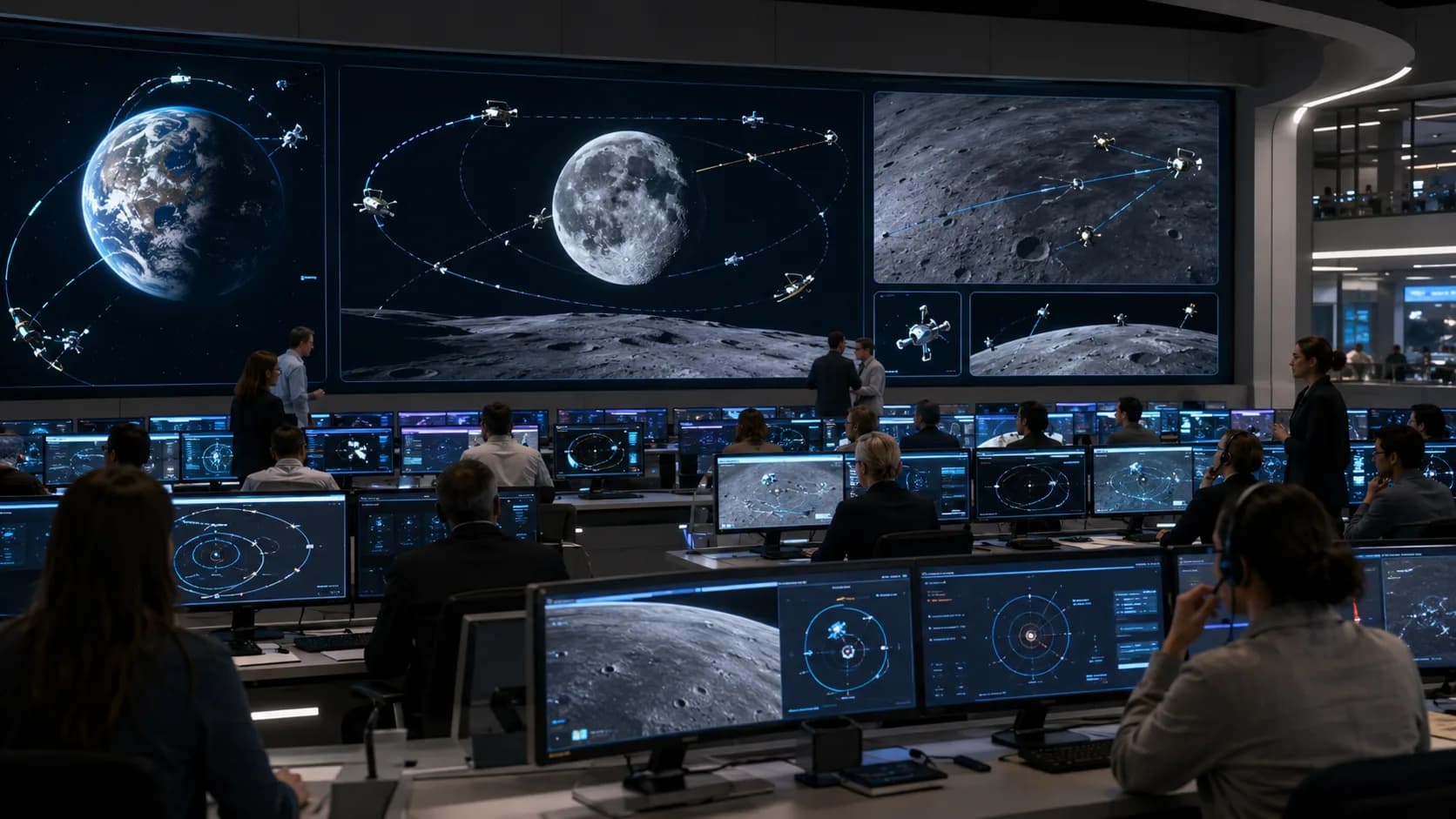
Aircraft do not merely know where they are. They report their positions, follow common procedures and communicate with other users of the same airspace. Lunar operations will need a similar system, although the technology will look very different.

NASA has already demonstrated pieces of that future. The CAPSTONE spacecraft tested an unusual orbit near the Moon and demonstrated autonomous navigation techniques. NASA is also developing lunar communications, positioning, navigation and timing systems intended to support spacecraft in orbit and people and machines on the surface.
But technology alone is not traffic control. Operators also need common reporting formats, reliable contact information and clear expectations for sharing location, trajectory and maneuver data. A private lander should not have to guess whether another nation plans to cross the same route. An orbiter should not discover a collision risk only after communication becomes difficult.
The Moon needs a shared catalog of active and inactive objects, predicted paths, landing locations, planned impacts and hazardous areas. That information should remain available even after a mission ends or a company closes.
Plan Three: Separate Landing Pads From Living Rooms
A lunar landing does not stir up ordinary dust. Rocket exhaust can accelerate sharp, electrically charged particles across long distances. Those particles can sandblast equipment, cover solar panels, interfere with instruments and damage historic sites.
The busier the Moon becomes, the more important landing locations will be. Early missions may land on open ground because little infrastructure exists. Permanent operations will need prepared landing areas, safe approach corridors and minimum distances from habitats, laboratories, power systems and other spacecraft.
Designated impact areas also make sense. Some spent stages or failed vehicles may not be worth recovering. Directing them toward known locations could reduce surprise, protect valuable areas and sometimes create useful scientific observations. The goal is not to prohibit every impact. It is to stop treating the entire Moon as an unmarked disposal zone.
Good lunar planning will eventually look less like planting a flag and more like zoning a small industrial community: landing here, living there, preserving this area and keeping hazardous operations somewhere else.
Plan Four: Protect History - and Science That Has Not Happened Yet
The Apollo landing sites are not simply old machinery. They preserve human footprints, experiments, tools and evidence of the first journeys to another world. NASA already uses recommendations intended to protect those locations from physical contact, exhaust and dust.
Future missions will create their own heritage. The first successful landing by a nation, the first far-side sample-return site and the first long-duration lunar base may all become historically important. A sensible system should identify which places deserve protection before a nearby landing or construction project changes them permanently.
Science needs protection too. Some locations may offer unusually clean records of lunar history. Permanently shadowed craters may preserve ice and other materials that have accumulated for billions of years. Quiet areas on the far side may be valuable for radio astronomy because the Moon blocks much of Earth's radio noise.
Not every interesting location should become a museum, and no nation can claim the Moon as national territory. But free access does not require careless access. We can explore a place while still agreeing not to ruin the very evidence we traveled there to study.
Plan Five: Decide Who Owns, Moves and Reuses Old Equipment
Here is where lunar cleanup becomes legally complicated.
Under the Outer Space Treaty, a nation remains responsible for its national space activities, including work performed by private companies it authorizes. The treaty also says ownership of a space object is not erased simply because the object sits on the Moon.
That means one company cannot automatically walk over to an abandoned rover, remove its batteries and call the parts free for the taking. The machine may be useless, but it still has an owner and a state of registry. The same principle that protects property can also make reuse harder.
Before permanent operations begin, nations need practical agreements for salvage, transfer and abandonment. An operator should be able to declare equipment available for recovery. Ownership could be transferred to another mission. Standard markings and digital records could identify whether an object is active, historically protected, hazardous, reusable or cleared for recycling.
Without that system, the Moon may fill with valuable metal and machinery that nobody is permitted to touch.
Plan Six: Create a Lunar Repair Shop, Not a Lunar Dump
Anything delivered to the Moon is expensive. Throwing away useful material there makes even less sense than throwing it away on Earth.

A long-term base will generate packaging, worn clothing, broken tools, damaged electronics, food containers and replacement parts. It will also receive cargo frames, landing structures, tanks and other hardware that may have completed their original purpose but still contain aluminum, steel, wiring, plastics and usable components.
NASA's LunaRecycle Challenge is already pushing teams to develop ways to process and repurpose non-metabolic waste during long-duration missions. NASA's broader Moon-to-Mars planning also emphasizes maintainability, reuse and recycling when practical.
The goal should not be to carry every wrapper back to Earth. It should be to design equipment so useful pieces can be removed safely, materials can be sorted and machines can be repaired instead of abandoned. Cargo containers might become storage walls. Packaging could become feedstock for manufacturing. Old landing hardware might supply metal for shielding, brackets or replacement parts.
On the Moon, yesterday's delivery crate may be tomorrow's building material.
Plan Seven: Make the Rules Work for Governments and Companies
The basic international framework already exists. The Outer Space Treaty requires peaceful activity, responsibility for national space operations and due regard for the interests of others. The Artemis Accords add voluntary principles involving transparency, interoperability, deconfliction, heritage protection and safe disposal of spacecraft.
Those are important foundations, but they are not a complete lunar building code. The Artemis Accords are political commitments among signatories, not a binding global traffic system. Other nations may follow different approaches. Neither document tells two operators exactly how many miles should separate their landing zones, who maintains a lunar object catalog or what happens when a bankrupt company leaves hazardous equipment behind.
ESA has adopted a Zero Debris approach intended to greatly limit new debris in Earth and lunar orbits by 2030. That is useful leadership, but a clean lunar environment will require broad participation. One careful operator cannot protect an orbit if everyone else treats disposal as somebody else's problem.
The rules must apply through national licensing. Governments authorize private missions, so launch and operating approvals can require disposal plans, tracking, financial responsibility, data sharing and protection of designated sites. Companies should know those expectations before they spend years designing a vehicle, not after it is ready to launch.
The Practical List
Before permanent lunar activity becomes routine, the international community needs at least seven working systems:
1. A shared registry and tracking network for spacecraft, stages, landers, rovers and other major objects in cislunar space and on the surface.
2. Required end-of-mission plans, including controlled disposal, stable storage, reuse or designated impact.
3. Common communications and navigation standards so machines from different nations and companies can exchange essential safety information.
4. Protected landing corridors, prepared landing pads and separation rules for habitats, historic sites, scientific zones and power systems.
5. Clear ownership, transfer, salvage and abandonment procedures for equipment that is no longer operating.
6. Recycling and repair standards that encourage hardware to be reused rather than left where it stops.
7. A process for investigating accidents, assigning responsibility and paying for damage when one mission harms another.
None of these plans requires a single world government for the Moon. Ships follow international rules without every port belonging to the same country. Aircraft cross borders while using common safety procedures. The same kind of cooperation can work beyond Earth.
A Better First Neighborhood
Human beings will leave things on the Moon. Some equipment will become historic. Some will remain useful for years. Some will fail. Some may be deliberately impacted for science or safety. A permanent lunar presence cannot be completely spotless, and pretending otherwise would be dishonest.
The real goal is not a Moon without footprints. It is a Moon where each footprint, machine and landing has a purpose - and where somebody remains responsible when that purpose ends.
We have an unusual opportunity. Near Earth, debris rules were developed after crowded orbits had already become dangerous. On the Moon, the traffic is still light enough to plan ahead.
The Moon may become humanity's first lasting neighborhood beyond Earth. It should also become the first neighborhood we designed before we made the mess.