Pentagon Has Plans to Drop the 'Mother of All Bombs' on Iran, Officials Tell CNN and CBS
CNN and CBS report U.S. strike plans for Iran include the MOAB, the largest non-nuclear bomb in the arsenal. Sources doubt it can reach the deepest targets.
The U.S. military has drawn up plans that could use the largest non-nuclear bomb in the American arsenal against Iran if President Trump orders combat to resume, according to unnamed officials and sources who spoke to CNN and CBS News. The reports have not been officially confirmed, and the White House and Pentagon declined to comment on the plans.
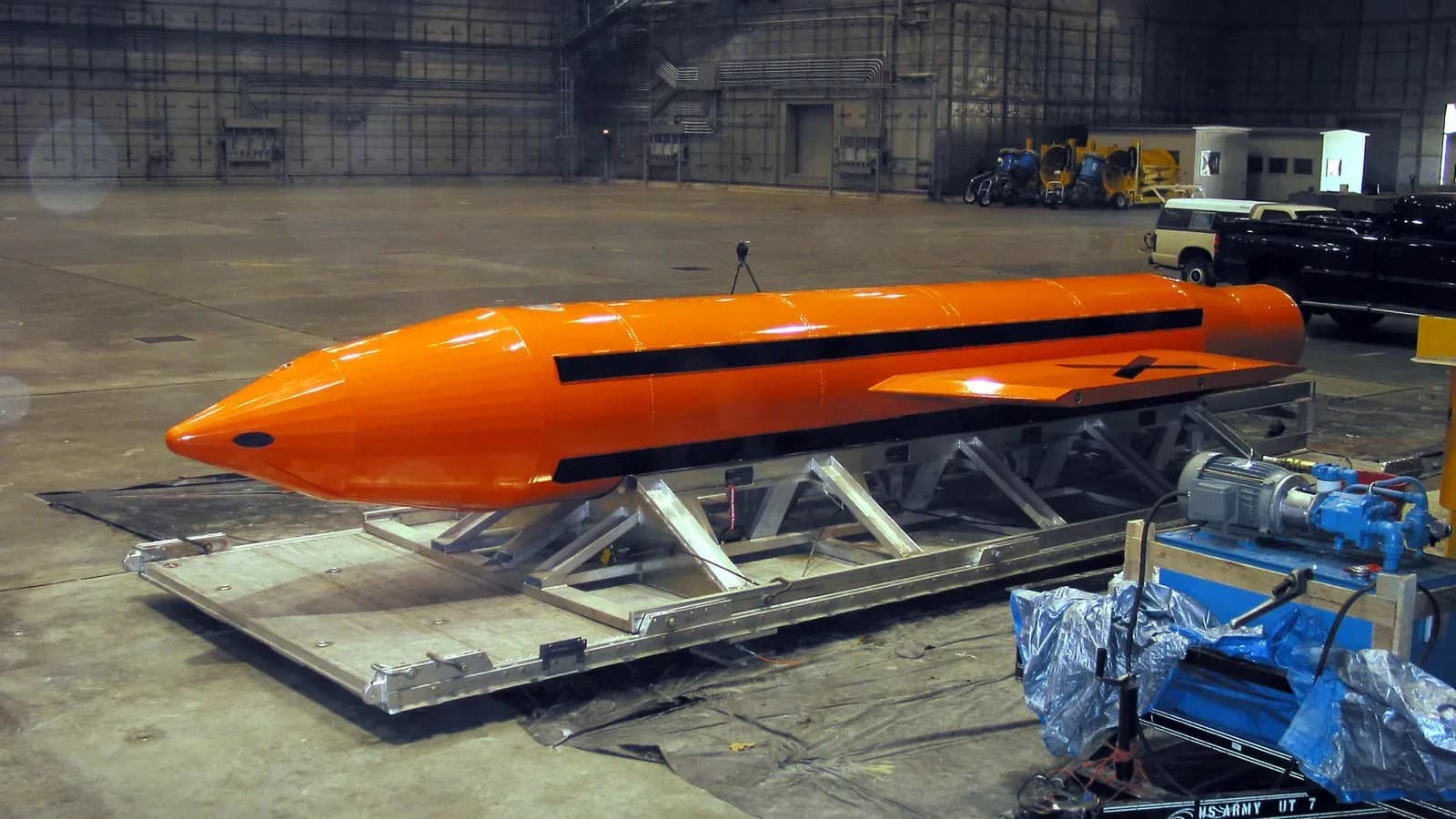
The weapon is the GBU-43/B Massive Ordnance Air Blast bomb, known as the MOAB or the "mother of all bombs." CNN reported, citing multiple unnamed U.S. officials familiar with the matter, that new strike plans include the bomb for Iranian energy infrastructure and nuclear sites, possibly before or after the midterm elections. CBS News reported citing unnamed sources familiar with the matter, that the White House and Pentagon have prepared plans to use it on military sites in Iran if ordered.
What the president said
Trump talked about the bomb himself in a Newsmax interview Thursday. "It's not nuclear at all, this is just an extremely large bomb. It's like a tiny nuclear bomb. But the 'Mother of All Bombs' is one big bomb – but it's not nuclear," he said, according to CNN. "I wouldn't use nuclear, we don't have to."
Neither the White House nor the Pentagon would comment on the plans themselves. A White House spokesperson told CBS, "We do not comment on sensitive military plans that may or may not exist. President Trump keeps all options on the table to ensure that Iran can never have a nuclear weapon." A Pentagon official gave CBS only a general statement: "The Department of War plans for a wide range of operational scenarios."
Last week, Trump said the U.S. would not attack Iran before the midterms, CBS reported. CNN reported that several advisers privately said they did not know whether that statement was final.
Where the war stands
CNN describes a war that is "deeply unpopular" after more than six months of U.S. bombing, with no sign of a negotiated end. The two countries have largely held off striking each other in recent weeks, according to CBS, but the U.S. is enforcing a blockade of Iranian ports while Iran continues to threaten and strike ships in the Strait of Hormuz, keeping oil prices high. At the United Nations last month, CBS reported, Trump said he had a "big decision to make" on whether to strike a deal or "annihilate the Islamic Republic."
One source told CNN that Trump ordered additional strike packages including "a lot of energy infrastructure" and that the plans described an attack "prior to US retrograde" in the region, suggesting the administration could strike, declare victory and pull forces out. A second source said plans for hitting nuclear sites, including the deeply buried Pickaxe Mountain, explicitly call for the MOAB.
Will it work?
Several sources told CNN there are serious doubts. The MOAB is an air-burst weapon that explodes above ground. It can destroy an area equal to nine city blocks, CNN reported, but likely cannot reach facilities like Pickaxe, believed to be protected by layers of granite. "It is definitely not designed as a deep penetration warhead," one source said, calling it "a massive information operation type weapon that is great for huge area clearance but not much else."
Another source was blunter: "POTUS has unfortunately put himself in a situation where he is almost compelled to do something." A fourth source told CNN that planners had developed options amounting to a "fireworks show" to give the president an off-ramp even if those strikes do not achieve his goals.
Trump has used the MOAB before. In 2017, during his first term, the military dropped one on an ISIS tunnel complex in Afghanistan. Afghan officials said it killed 36 ISIS fighters, and officials said no civilians were hurt, according to CNN.
The questions Americans should ask
Iran's rulers are a real threat. Keeping Iran from a nuclear weapon, the goal the White House cites, is legitimate. Wanting to end a war quickly is a good goal too.
But the reports raise hard questions. If military planners themselves doubt this bomb can reach its targets, what is it for? CNN's sources said its blast radius would almost certainly raise concerns about civilian casualties if used near populated areas. A bomb dropped mainly to send a message, or to cover a withdrawal, should trouble anyone who takes the moral weight of war seriously.
The Christian tradition of just war has always asked not only whether a cause is just, but whether force is proportionate, whether it can succeed, and whether it spares the innocent. Those questions are not liberal or conservative. They are the questions a free people should ask before their government drops the biggest bomb it has. "Righteousness exalteth a nation: but sin is a reproach to any people" (Proverbs 14:34).
Congress, which has a constitutional role in war, should be asking them too. Sixty-four years ago this week, as Dock Line recalled in its look at the Cuban Missile Crisis, a president chose restraint over the advice to bomb first. And Christians should pray for the president, for the men and women in uniform who would carry out the orders, and for the ordinary Iranians caught in the middle. "Seek peace, and pursue it" (Psalm 34:14).
Hero photo: U.S. Department of Defense via Wikimedia Commons, public domain (U.S. government work), cropped and resized.