
Wildlife Myths and Facts: Separating Truth from Fiction
We live in a world overflowing with information, and much of what we believe about wildlife comes from things we have heard repeatedly rather than things we have actually explored for ourselves.
Over time, ideas can become accepted as fact simply because they have been passed along enough times. Sometimes what we think we know turns out to be incorrect, misunderstood, or simply untrue.
In this article, we will take a closer look at some commonly accepted beliefs about the natural world and separate fact from fiction. You may discover that nature still has a few surprises left.
Myth: Mother birds will abandon their babies if touched by humans.
Fact: Mother birds do not abandon their offspring simply because they have been touched by a human. Contrary to popular belief, many birds rely more on sight and sound than smell when identifying and caring for their young.
If you find a baby bird, it is often best to place it back in the nest if it is safe to do so, or contact a wildlife rehabilitator for guidance.
Myth: If you see a raccoon out during the day, it has rabies.
Fact: Raccoons are primarily nocturnal, but they may be active during the day, especially in spring and summer when mothers are gathering food for young or juveniles are exploring.
Daytime activity alone does not mean a raccoon has rabies. Contact a wildlife rehabilitator or animal control only if the animal appears sick, injured, staggering, unusually aggressive, disoriented, or is acting abnormally.
Myth: Raccoons wash their food.
Fact: Raccoons do not actually wash their food in the way people often imagine. Their paws are highly sensitive, and dipping food in water may help them gather information about what they are eating.
They may also use water to soften dry food, making it easier to handle and consume.
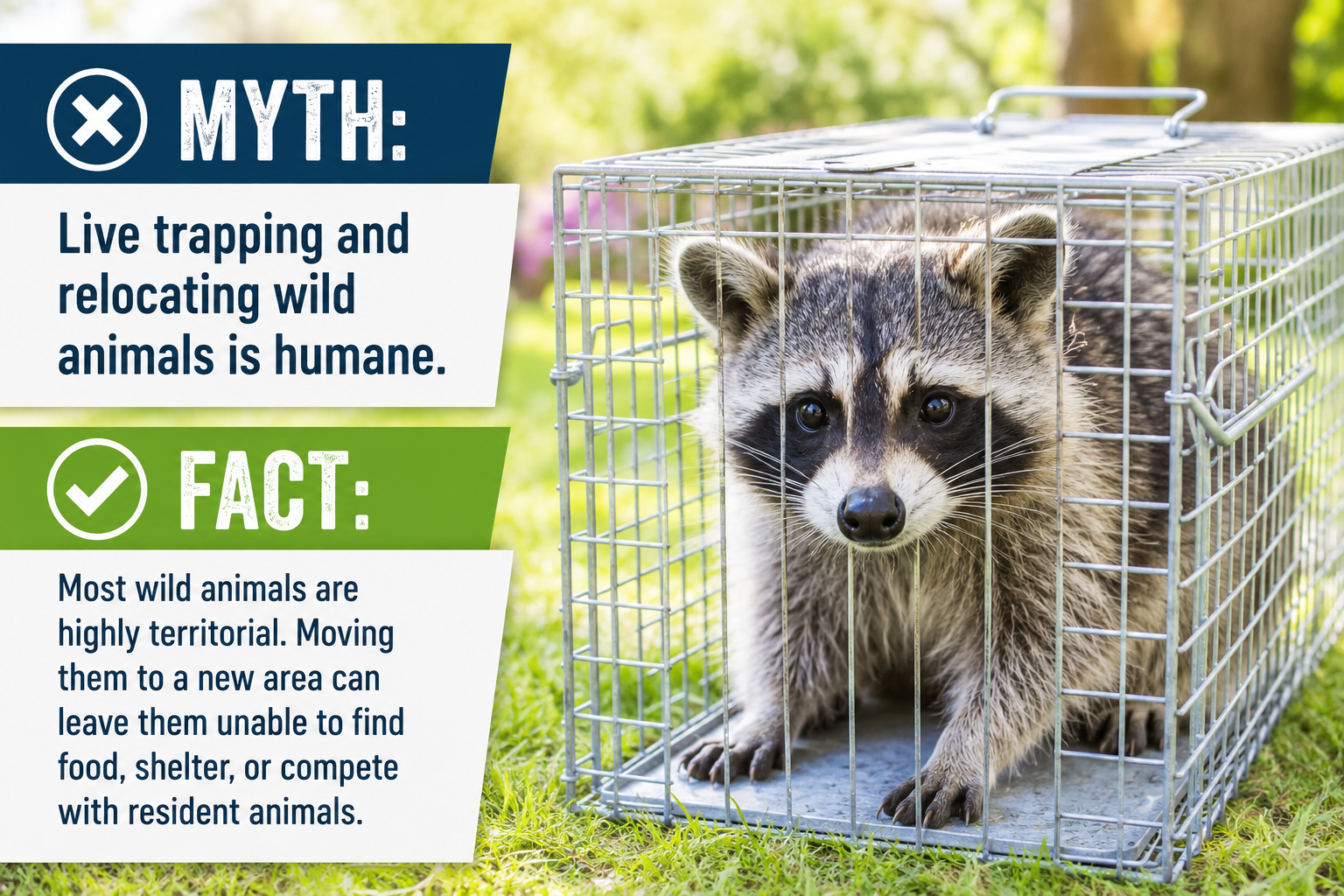
Myth: Live trapping and relocating wild animals is humane.
Fact: Most wild animals are highly territorial. Moving them to a new area can leave them unable to find food, shelter, or compete with animals already living there.
Relocation can also separate mothers from their young or place animals in unfamiliar and dangerous conditions. In many cases, prevention and exclusion are better solutions than trapping and relocating.
Myth: “Possum” and “opossum” are the same word.
Fact: Opossums and possums are different animals. Opossums live in North and South America, while possums are native to Australia and nearby regions.
In casual conversation, many Americans shorten “opossum” to “possum,” but technically they are not the same animal.
Myth: Opossums hang by their tails.
Fact: Opossums can briefly use their tails to help with balance and climbing, but their tails are not strong enough to support their full body weight for long periods.
The image of an opossum hanging upside down from a tree by its tail is more myth than reality.
Myth: Opossums are dirty and vicious animals.
Fact: Opossums are actually very clean animals and groom themselves frequently.
They are generally shy and prefer to avoid conflict. When threatened, they may show their teeth, hiss, or appear intimidating, but this is usually a defensive behavior rather than true aggression.
Myth: If an animal is foaming at the mouth, it has rabies.
Fact: Rabies is only one possible cause of foaming at the mouth.
Other causes can include distemper, toxins, choking, dental disease, seizures, dehydration, or other illnesses. Any wild animal showing unusual symptoms should be treated with caution, and local animal control or a wildlife professional should be contacted.
Myth: If you find a fawn alone, it has been abandoned.
Fact: Mother deer often leave their fawns alone for hours while they feed, returning periodically to nurse and care for them.
In most cases, a fawn found alone has not been abandoned and should be left where it is unless it appears injured, is crying continuously, or is in immediate danger.
Myth: Bats are blind.
Fact: Bats are not blind. Most bats have good eyesight and also use echolocation to navigate and find food.
The phrase “blind as a bat” may be common, but it is not accurate.
Myth: Owls can turn their heads all the way around.
Fact: Owls cannot rotate their heads 360 degrees, but they can turn them up to about 270 degrees.
This ability helps them see their surroundings without moving their entire body, which is especially useful when hunting.
Myth: Touching a toad will give you warts.
Fact: Warts are caused by viruses, not toads.
Some toads can produce substances that may irritate human skin, so it is still a good idea to wash your hands after handling one.
Myth: Porcupines can shoot their quills.
Fact: Porcupines cannot shoot their quills.
Their quills detach easily when touched, which is why predators often end up with quills embedded after making contact with a porcupine.
Nature Still Has Plenty to Teach Us
Nature is full of surprises, and sometimes the things we have repeated for years turn out not to be true at all.
That does not mean anyone was foolish for believing them. It simply means there is always more to learn.
The next time you hear an interesting “fact” about wildlife, take a moment to question it and dig a little deeper. You may discover that the truth is every bit as fascinating as the myth.