What Does It Cost to Keep a Downtown Alive?
Conroe's street-closure debate began with a permit fee. The larger question is how a city prices the small events that help an old downtown stay useful.
Conroe's street-closure debate began with a permit fee. The larger question is how a city prices the small events that help an old downtown stay useful.
On a market morning in downtown Conroe, the arithmetic looks simple. A city street is closed. White tents go up. Vendors unload bread, plants, jewelry, soap and the hundred other things people make before they can afford a storefront. Shoppers wander between tables, then drift toward a restaurant, a coffee counter or a shop they might not have visited otherwise.
Then comes the other arithmetic.
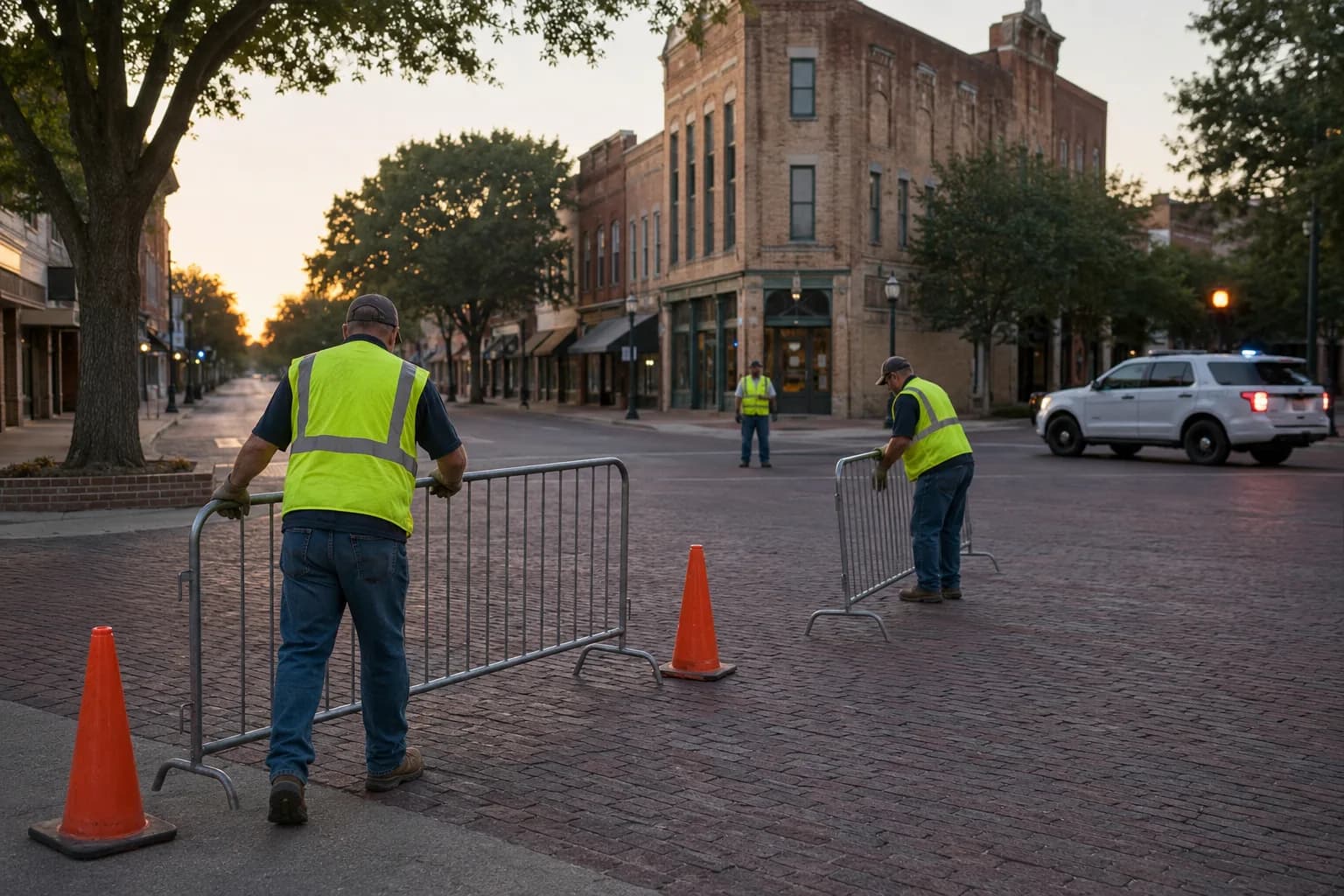
A street closure needs barricades, a traffic plan and people willing to accept responsibility if something goes wrong. Police, insurance, staff time and cleanup are not imaginary expenses. City government cannot pay every public cost with good feelings and a canvas tote bag.
That tension became unusually visible this year when Conroe's Main Street Market paused operations. The city's street-closure application fee had risen from $35 to $1,300 in late 2025. Council later settled on $500, along with other event requirements, before temporarily returning the fee to $35 in May while the city reworked the policy. The market resumed in June and was scheduled through August, with a possible fall extension pending permits.
The amounts changed. The deeper question did not.
What should a city charge the people who are trying to make downtown worth visiting?
A Street Closure Is Not Free
Start with the part that is easiest to skip when the argument gets loud: the city has a legitimate concern.
Closing a public street shifts traffic and temporarily limits access to space that belongs to everyone. A poorly planned event can create safety problems, strand a business behind barricades or leave taxpayers covering overtime and cleanup. Insurance matters because accidents do not become less expensive merely because an event has a wholesome name.
Conroe officials said the higher fee was intended to recover city costs rather than turn events into a revenue source. That principle is not unreasonable. A private organizer should not be handed an unlimited claim on police time, equipment and public labor without accountability.
But cost recovery sounds more precise than it is. The city can count an officer's hours. It can price a barricade and process an application. What it cannot easily place on the same invoice is the value created when several hundred people choose to spend part of a Saturday downtown.
Neither Is an Empty Street
Downtowns do not stay alive simply because the buildings are old and the sidewalks are swept. They need reasons for people to arrive, slow down and walk through a door.

A market creates one of those reasons. It may occupy only a block for a few hours, but it changes how the entire area feels. Empty pavement becomes a place to browse. A stranger becomes a customer. A business someone has passed twenty times finally gets noticed because the person is already out of the car and moving at walking speed.
That value is scattered. One sale belongs to the vendor. Another belongs to the restaurant down the block. A future sale may happen online next month. A family may return for a play, a concert or dinner because the market gave them their first comfortable reason to explore downtown.
None of that appears as a line item on a street-closure permit. It is still real.
The Smallest Door Into Business
The Main Street Market normally gathers about 40 to 70 artisans and vendors. Its organizer has said the market has served as a starting place for more than 100 businesses during its five-year run.

That claim matters because markets are not only shopping events. They are one of the cheapest ways to test whether an idea has a customer.
A new baker can learn which loaf sells without signing a five-year lease. A maker can discover that the product everyone compliments is not the one anyone buys. A customer can meet the person behind an unfamiliar business, ask a question and take a chance on something local. The table is small, but the experiment is serious.
Some vendors will remain weekend businesses. Some will fail, as businesses do. A few will grow into catering companies, online shops, wholesale accounts or permanent storefronts. A healthy downtown needs that entry ramp because today's established merchant was once somebody with an uncertain idea and a folding table.
When the cost of producing a small event rises sharply, the fee is not absorbed by a mysterious institution called 'the market.' It lands on an organizer with a limited budget, then works its way toward vendor fees, fewer dates, fewer participants or cancellation. The people least able to absorb it are often the businesses closest to the starting line.
The Price of Friction
The permit fee also cannot be judged alone. Event organizers may face insurance, security, application deadlines, traffic plans, equipment costs and uncertainty about whether the rules will change before the event happens. Each requirement may have a defensible purpose. Together they create friction.
Large festivals can spread that friction across sponsors, ticket revenue and thousands of visitors. A recurring market cannot. Its advantage is frequency: it gives people a reason to return, not once a year but often enough to develop a habit. Its weakness is the same frequency. A cost that looks manageable for one annual event becomes a different number when multiplied across a season.
That is why a flat fee can be administratively clean and economically clumsy. A four-hour market with modest attendance is not the same public operation as a festival filling several blocks. Treating them identically may be simple at the permit counter while producing exactly the wrong result on the street.
What Cost Recovery Cannot Count
Cities routinely invest in downtowns because active downtowns produce public value. They improve the city's identity, support tourism, make existing infrastructure useful and give residents a gathering place that does not require buying a ticket. Conroe itself identifies downtown as a cultural district and maintains a downtown development plan. In other words, activity is already part of the public goal.
That does not mean every event deserves free services forever. It means the calculation should include more than the direct cost of closing a street.
A useful policy could distinguish between commercial promotions and community-serving events, between a single block and a large footprint, and between a first-time experiment and an established operation. It could charge actual extraordinary costs where they occur while keeping the basic path predictable. It could reward organizers who coordinate dates, share equipment, carry appropriate insurance and demonstrate that nearby businesses are benefiting rather than merely being blocked.
Most important, the rules should be stable enough for people to plan. A low fee with unclear requirements can be as damaging as a high fee if an organizer cannot know six months ahead what approval will require.
A Downtown Is an Ecosystem
Downtown really is an ecosystem. The theater helps the restaurant. The restaurant helps the shop. The market introduces a new vendor, and that vendor may eventually need a storefront, an accountant, a printer or a commercial kitchen.

No single piece keeps the whole thing alive. Remove enough small pieces, though, and the district can remain attractive while becoming strangely empty—a nice place to photograph on the way to somewhere else.
That is the risk in treating parking, permits, street closures and enforcement as separate transactions. A little more friction in several places can quietly outweigh a large downtown investment announced at a podium.
Conroe's temporary return to the $35 fee did more than revive a market date. It created time to ask a better question before the permanent policy is written.
The answer does not have to be free streets or free city labor. It has to be a system that knows the difference between a cost and an investment—and can recognize when one becomes the other.
The question is not whether a street closure costs money.
It is whether an empty street costs more.