The Homes Didn't Stop Selling. The Frenzy Did.
Lake Conroe, Conroe and The Woodlands are not watching one housing market collapse. They are watching three different markets learn how to behave after years when almost nothing about housing was normal.
Lake Conroe, Conroe and The Woodlands are not watching one housing market collapse. They are watching three different markets learn how to behave after years when almost nothing about housing was normal.
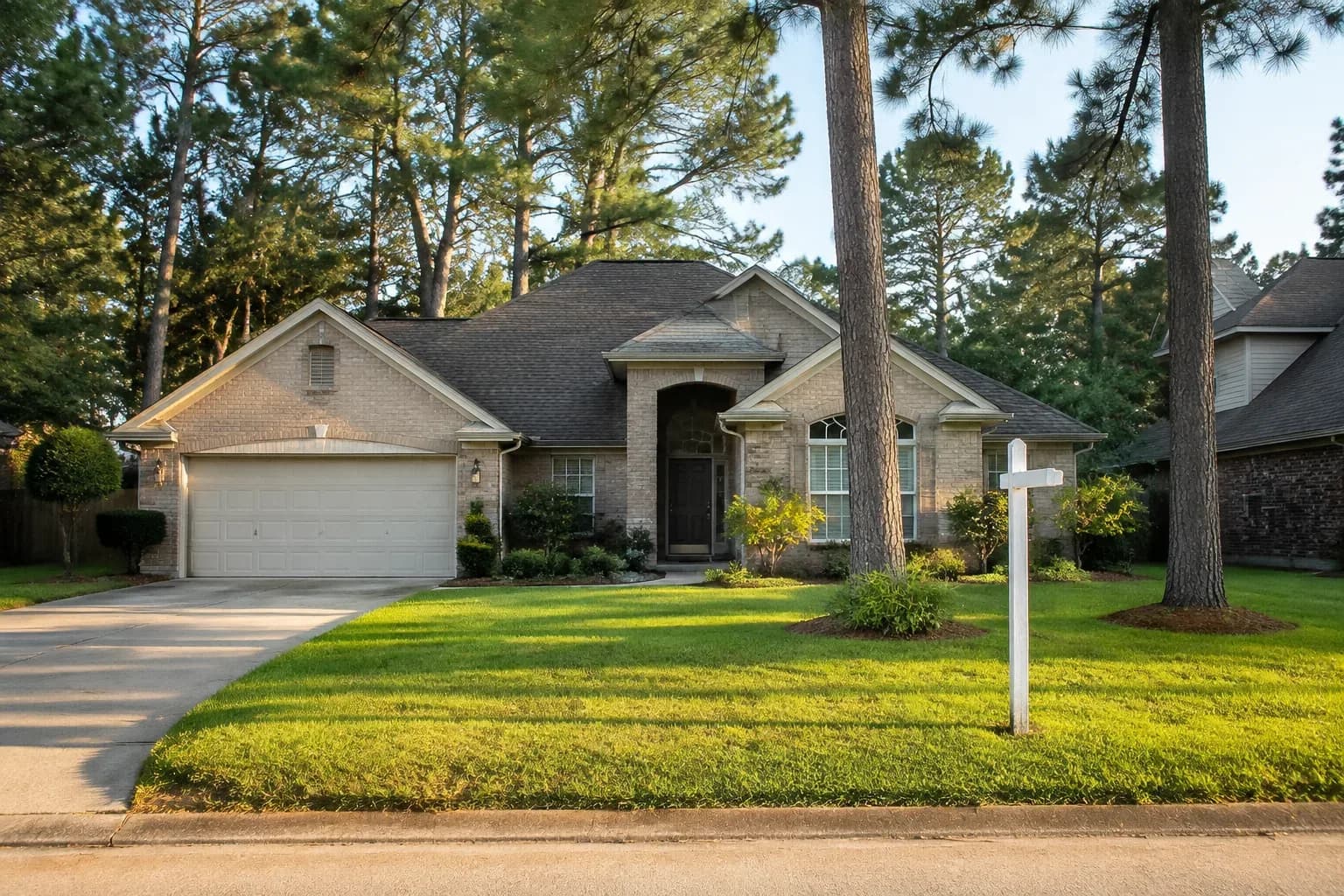
A FOR SALE sign looks different after the third Saturday. The grass has been cut again. The lights are on for another showing. The seller has already lowered the price once, and a model home down the road is advertising a financing offer an ordinary homeowner cannot match. Then somebody opens a phone and finds a podcast thumbnail announcing that the housing market is finished.
That story is tempting because it has a villain, a victim and a red arrow pointing down. It is also too simple for what is happening between The Woodlands and Lake Conroe.
Homes are taking longer to sell. Buyers have more choices. Price reductions are common, and mortgage rates are keeping people from stretching as far as they once could. Some sellers really are stuck—especially those competing with new construction or asking a price the market stopped paying two years ago. But homes did not stop selling. The frenzy did.
The Perfect Number for a Bad Thumbnail
Housing produces enough numbers to support almost any mood. In July, sales of previously occupied homes across the country fell 1.7 percent from June. That makes an excellent slowdown headline. The same report showed sales up 0.7 percent from July of last year and the median price up 2 percent. That makes an equally defensible resilience headline. Neither number is false. Neither number tells the whole story.
A person can choose month-over-month instead of year-over-year. A median price can rise because more expensive homes sold, even if the value of an individual house did not. Days on market can double from 12 to 24 and sound catastrophic even though a properly priced home still sold in less than a month. A report can use Conroe city limits, Montgomery County, a group of ZIP codes or a real-estate market area called Lake Conroe—and produce four different answers to one innocent question.
The easiest way to bend housing data is not to invent anything. It is to select the boundary, time period and measurement that already agree with the story you wanted to tell.
Three Markets Wearing One Name
People often talk about this part of Montgomery County as though it were a single housing market. It is not.
The Woodlands is largely established, heavily wooded and constrained by how much undeveloped single-family land remains inside the original community. Conroe contains older neighborhoods, new subdivisions, rural edges and a wide range of prices. Lake Conroe adds waterfront premiums, second homes, retirement buyers, flood questions, docks, septic systems, insurance and short-term-rental considerations that can change a property's appeal before anyone discusses the kitchen.
Move the map a few miles and the buyer changes. Move the price $100,000 and the competition changes. Move from a resale neighborhood into a builder-controlled community and even the financing changes. That is why a regional average can be accurate while being nearly useless to the family standing in one particular living room.
Conroe Slowed. It Did Not Stop.

Redfin's three-month view ending in May placed Conroe's median sale price at about $305,000, down 1.5 percent from a year earlier. Homes took about 112 days to sell, compared with 86 days the year before. Those are real signs of a slower market.
The same data showed 625 sales in May, up 7.2 percent from the prior year. That is not a market in which nothing sells. It is a market in which more homes sold while the typical transaction took longer and the median price softened slightly. The buyers did not disappear. They stopped rushing.
Montgomery County's broader numbers make the distinction clearer. Over the same period, the county's median price was about $343,000, up 2.3 percent, and sales were up 3.3 percent. Homes still took longer to move—55 days instead of 46—but the county was not sharing Conroe's modest price decline. One city can soften while the county surrounding it grows. Both statements can be true at once.
The Woodlands Is Not Following the Same Script

The Woodlands remains the strongest of the three broad markets, but even strength looks different now. Redfin's three-month measure ending in May put the median price near $640,000, up 10.3 percent from a year earlier. Sales volume was essentially unchanged, and the typical home sold in about 23 days—nearly twice the 12-day pace of the previous year but still fast by any ordinary standard.
Sellers were not receiving every dollar they imagined. The average sale was about 2 percent below list price, and nearly 30 percent of listings had a price reduction. Meanwhile, a ZIP-code analysis published by Community Impact found May prices down in more than half of the broader Woodlands-area ZIP codes it tracked, even as sales rose in five of eight.
That apparent disagreement is useful. Redfin's community boundary and rolling time period are not the same as a one-month, eight-ZIP comparison. A different mix of luxury closings can move a median sharply. The lesson is not that one source must be wrong. The lesson is to ask what was counted before repeating the percentage.
The Woodlands did not become immune to interest rates or buyer caution. Its established character, schools, amenities and limited supply simply give it a different starting position from a new subdivision still releasing lots in phases.
The Lake Keeps Its Own Clock

Lake Conroe may be the easiest market to misread because the label covers properties that are not truly comparable. A recent analysis of HAR MLS data placed the area's median price near $337,500, only 0.7 percent higher than a year earlier. June sales were up 3 percent. At the same time, the average property was taking about 134 days to sell—26 days longer than the year before—and pending sales were down 3 percent.
That combination is neither boom nor collapse. Closings continued, prices were broadly steady and the next wave of sales looked softer.
Waterfront also complicates the clock. The right view, usable shoreline, dock, elevation and neighborhood can protect demand. A high-priced house with an aging bulkhead, expensive insurance or an optimistic seller can sit through an entire season. Put those properties into one average with interior homes several minutes from the water and the resulting number may describe none of them particularly well.
The Builder Across the Street Has Another Lever
Resale sellers are not only competing with other resale sellers. North of Houston, they are competing with builders that can adjust a deal without lowering the number printed as the base price. A builder can contribute closing costs, pay to reduce the mortgage rate, include upgrades or waive a lot premium.
Converde, a new 55-plus community in the Conroe area, opened presales this spring with an early-buyer incentive worth 6 percent off the total purchase price for its first tier of buyers. Offers vary by builder and month, but the mechanism matters: a company controlling many houses can protect its advertised prices while changing the buyer's actual cost. The owner of one house cannot spread that expense across a subdivision.
To compete, that owner usually has three tools: price, condition and patience. This is one reason price reductions are more visible now. They are not always evidence that the value of every home is collapsing. Sometimes they are evidence that a seller entered the market using yesterday's comparison while the builder down the road entered it with a financing department.
The Payment Became the Price
During the pandemic-era rush, a 30-year mortgage near 3 percent allowed buyers to concentrate on the price of the house. In early August, the average rate was near 6.7 percent. On a $350,000 house with 20 percent down, the principal-and-interest payment on a $280,000 loan is roughly $1,180 at 3 percent. At 6.7 percent it is about $1,805—a difference of roughly $625 every month before property taxes, insurance or homeowners-association dues enter the conversation.
The house did not become larger. The kitchen did not improve. The buyer simply arrived with less room in the monthly budget.
That pressure is especially sharp in Texas, where the mortgage is only part of the carrying cost. A buyer may love the sale price and still walk away after adding taxes, insurance, maintenance and commuting. Sellers experience that decision as weak demand. Buyers experience it as arithmetic.
Normal Feels Broken After a Frenzy
The strangest thing about the current market may be how quickly an abnormal period became the standard in people's minds. A house listed on Friday, crowded on Saturday and under contract above asking on Monday was never a healthy permanent baseline. It was the product of unusually cheap money, thin inventory, rapid migration and buyers afraid that waiting one week would cost them the house.
Now a buyer can inspect the roof, compare three neighborhoods, ask for repairs and sleep before making an offer. A seller may need to mow the yard more than once. That feels like a collapse only when the comparison point was a panic.
None of this guarantees that prices cannot decline further in a particular subdivision or price range. Mortgage rates remain heavy. New construction continues adding competition, with more than 2,700 additional homes announced across several Montgomery County developments and expansions this year. Sellers who must move quickly may have to accept a number they do not like.
But the evidence does not support one funeral for the entire market. It supports a slower Conroe, a steadier but selective Lake Conroe and an established Woodlands market that still commands a premium while giving buyers more room than it once did.
The red arrows are not entirely imaginary. They are simply being asked to carry more meaning than the numbers can hold. The homes did not stop selling. The frenzy did—and after the frenzy, the price has to make sense again.