

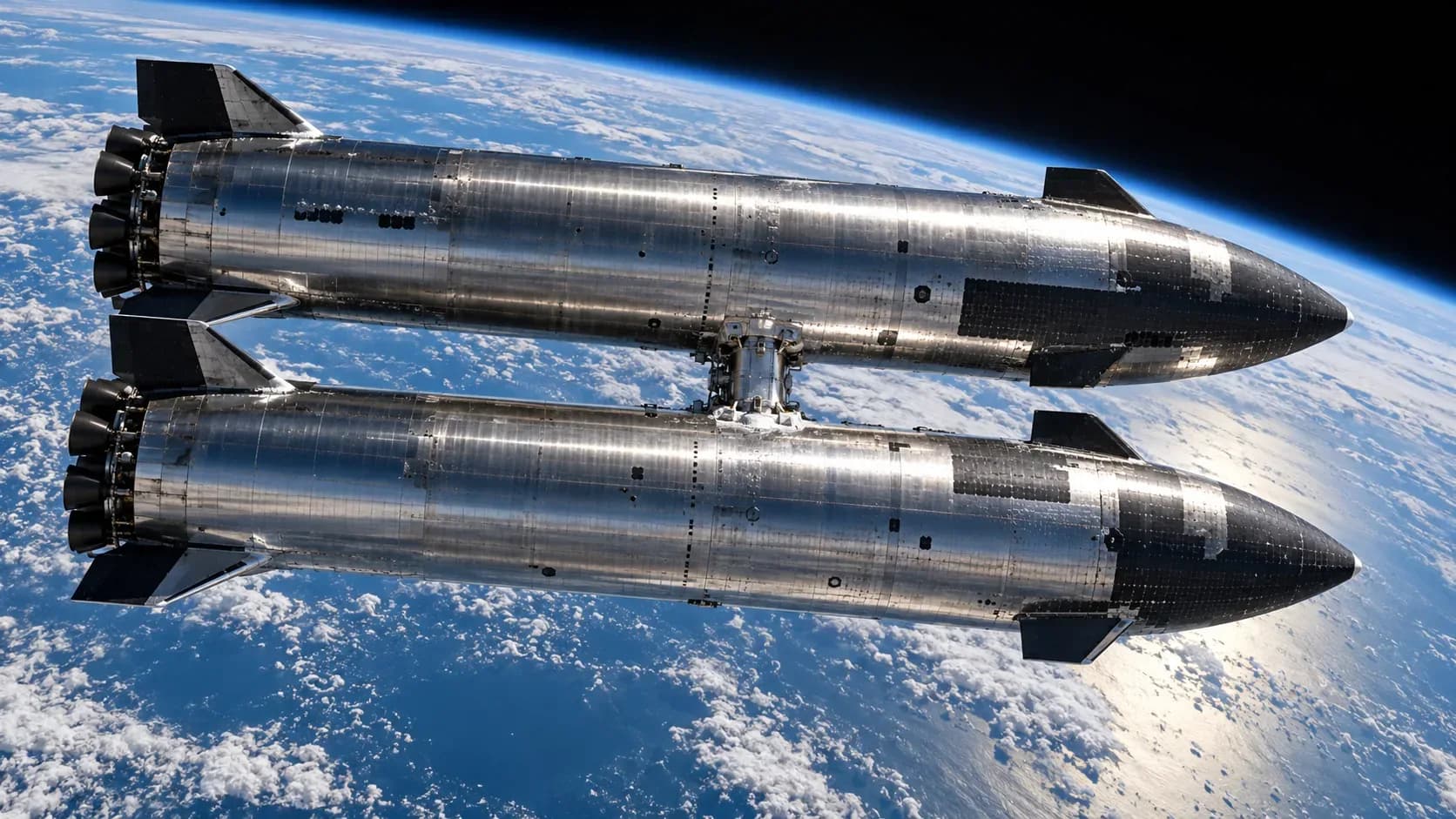
The Next Moon Landing Starts at a Gas Station That Has Never Been Built
NASA's revised 2028 Moon plan depends on tanker Starships, an orbital fuel depot, and ship-to-ship transfer of super-cold methane and oxygen. Here is what SpaceX has proved, what remains untested, and why fueling up in orbit is so difficult.
NASA's revised 2028 Moon plan depends on tanker Starships, an orbital fuel depot, and the first transfer of super-cold propellant between two enormous spacecraft.
The next American trip to the Moon may begin with something that sounds almost ordinary: a stop for fuel. The extraordinary part is where the gas station will be.
NASA's revised lunar plan calls for a depot circling Earth, a procession of tanker Starships filling it, and a lunar Starship pulling alongside to load the liquid oxygen and methane needed for the rest of the trip. NASA described that route on October 23 while laying out an accelerated path toward a crewed lunar landing in 2028.
Under the new concept, the Moon lander will meet Orion in Earth orbit, take two astronauts aboard, and perform the burn that sends the joined vehicles toward low lunar orbit. After landing and returning from the surface, the astronauts will transfer back to Orion for the ride home.
The plan is bold, but it is not yet a completed capability. SpaceX has moved several metric tons of cryogenic propellant between tanks inside one Starship. It has flown Starship into orbit. What it has not done is launch two Starships, bring them together in orbit, dock them, and transfer propellant from one vehicle to the other. That missing step is the difference between a test rocket and a transportation system that can leave Earth with a full tank after it is already in space.
The New Route to the Moon Begins Above Earth
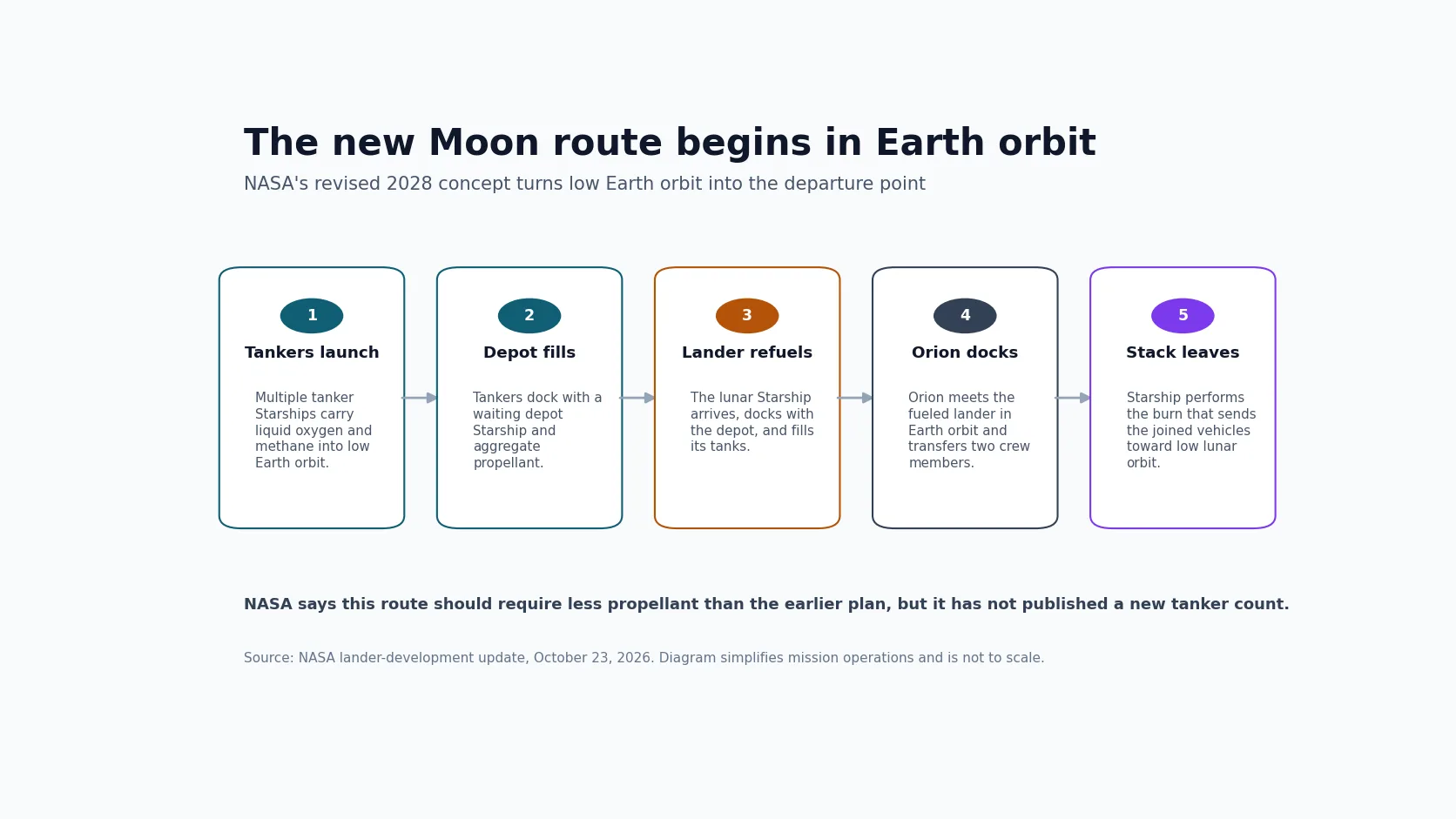
The revised NASA concept moves the key rendezvous closer to home. Multiple Starship variants will launch before the lunar lander. Tankers will carry propellant into low Earth orbit and transfer it to a waiting depot Starship. The lunar Starship will then launch, dock with the depot, and refuel before meeting Orion and its crew.
Once Orion and the fueled lander are joined, Starship will perform the trans-lunar injection burn that sends the combined stack toward the Moon. Two crew members will descend in Starship while two remain in Orion. The lander will later return the surface crew to Orion in low lunar orbit.
That is a significant change from the earlier route, which sent the lander ahead to a distant near-rectilinear halo orbit around the Moon to wait for Orion. NASA says the new low-lunar-orbit plan should reduce the amount of propellant that must be accumulated in Earth orbit and shorten the time needed for astronauts leaving the surface to reunite with Orion.
Why Starship Cannot Simply Leave Earth Full
A rocket spends most of its propellant fighting Earth's gravity and atmosphere. Adding more fuel makes the vehicle heavier, which requires still more fuel to lift the added fuel. The problem compounds until the launch vehicle is carrying enormous tanks and very little useful payload.
Orbital refueling breaks that problem into pieces. The lander, the astronauts, and the propellant do not all have to reach space on the same launch. Tankers can lift fuel separately, store it in orbit, and load it into the lunar vehicle after the hardest climb is over. A lander that arrives in orbit partly empty can depart for the Moon full.
That is why the depot is more than an extra stop. It is what allows a very large vehicle to carry astronauts, cargo, life-support equipment, surface supplies, and enough propellant to land and climb back off the Moon without requiring one impossibly large launch from Earth.
This Is Not Starting From Zero
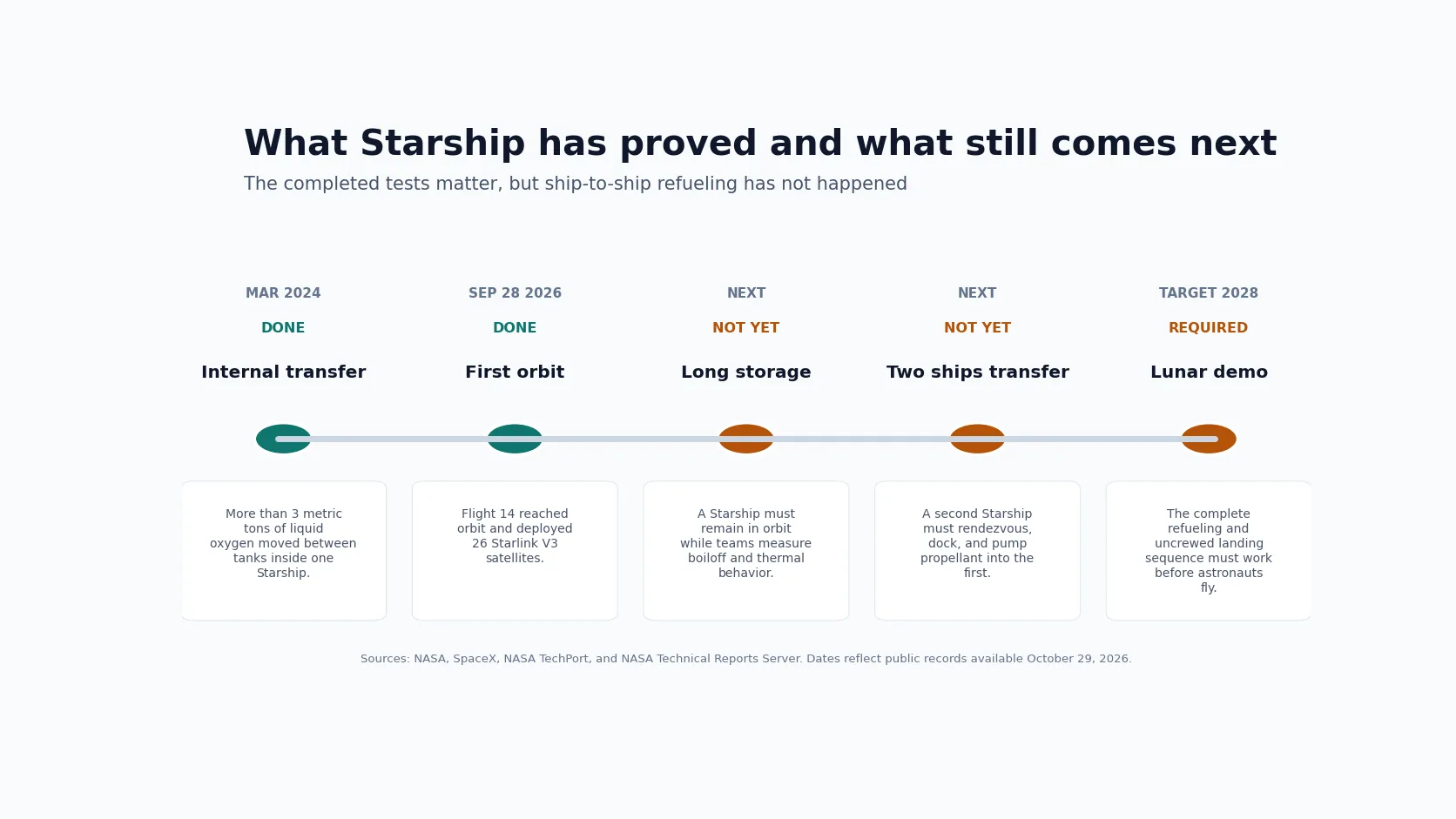
On March 14, 2024, Starship's third flight test transferred liquid oxygen between two tanks inside the same vehicle during its coast through space. NASA's technical record describes the successful test as moving more than three metric tons, while SpaceX later described the amount as approximately five metric tons. The test was not a rehearsal with two ships. It was a fluid-management experiment inside one Starship.
Engineers used a controlled, extremely small acceleration to settle the floating liquid near the supply-tank outlet and keep vapor from entering the transfer line. NASA and SpaceX then compared the flight data with their computer models of pressure, temperature, and two-phase flow.
The next major step arrived on September 28, 2026, when Flight 14 became the first Starship mission to enter Earth orbit and the first to deploy a meaningful payload, releasing 26 Starlink V3 satellites. That flight did not refuel another spacecraft. It proved that Starship could begin the longer orbital operations needed before refueling can be attempted.
Internal tank transfer and orbital flight are complete. Long-duration storage, docking, and ship-to-ship transfer remain ahead.
The Transfer That Has Never Happened
SpaceX says its next Human Landing System flight milestones are a long-duration orbital test and the ship-to-ship transfer demonstration. The first vehicle will remain in orbit while teams study thermal behavior, pressure control, and how quickly its propellant boils away. A second Starship will then launch, rendezvous with the first, dock, and transfer propellant.
The new Starship V3 design includes four docking drogues on the vehicle's leeward side and propellant connections intended for ship-to-ship transfer. Tanker versions can carry docking probes. SpaceX also plans to use DragonEye navigation sensors descended from the equipment used during Dragon dockings with the International Space Station.
SpaceX has targeted both the long-duration and transfer tests for 2026, but it has not published the exact mission or date. The company says timing depends on the progress of the new V3 vehicles. That distinction matters: the hardware is being built for the task, but a public target is not the same thing as a completed demonstration.
Why Filling a Tank Gets Strange in Space
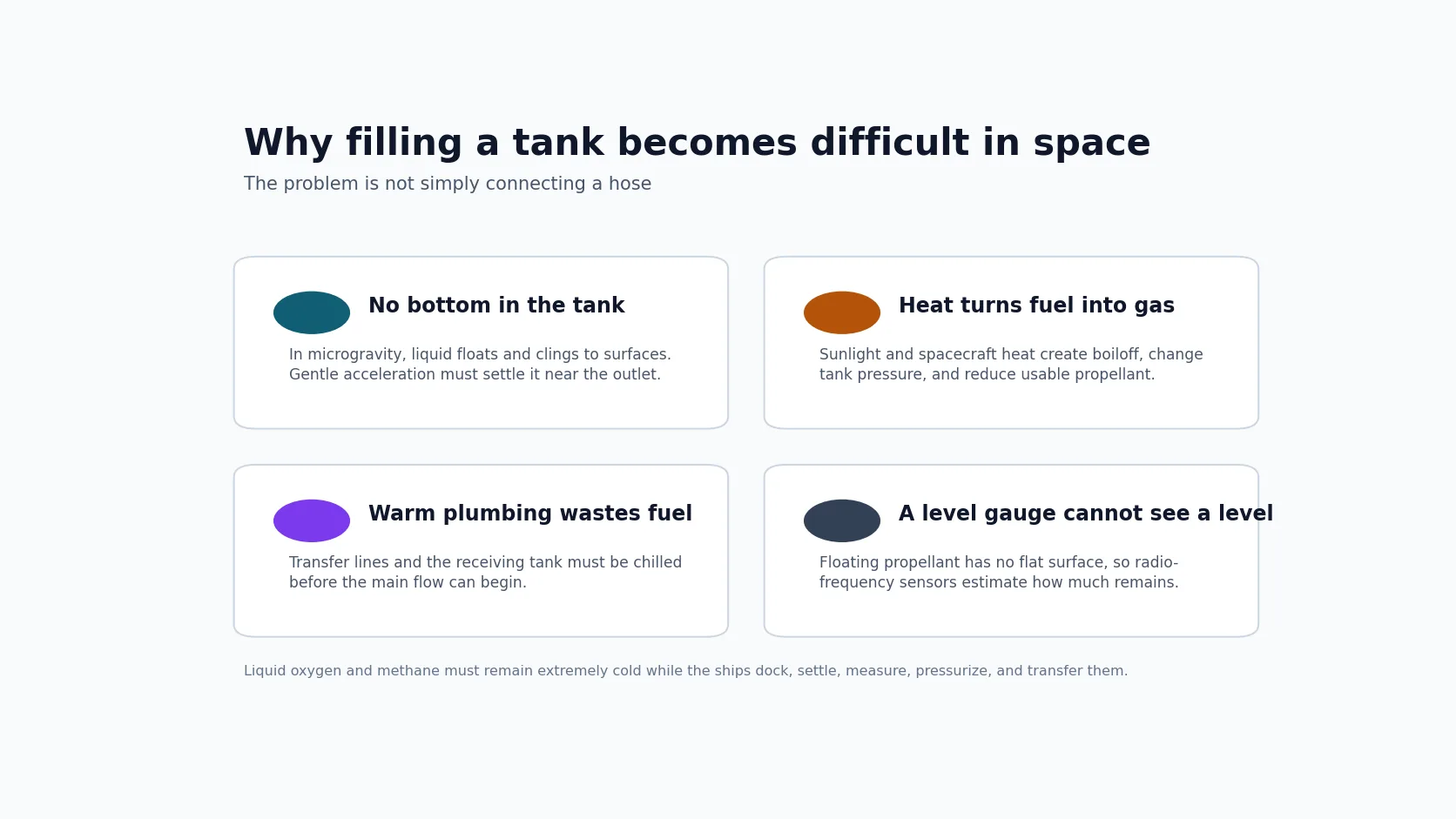
On Earth, gravity holds liquid at the bottom of a tank. In microgravity, propellant floats, sloshes, and clings to walls. A transfer system must first push the liquid toward an outlet without creating bubbles or pulling vapor into the line. Even a tiny controlled acceleration can provide the temporary "down" that the fluid needs.
Temperature is the next enemy. Starship uses liquid oxygen and liquid methane that must remain extremely cold. Sunlight, warm spacecraft structure, pumps, valves, and transfer lines can add heat. Some propellant may boil into gas, increasing tank pressure and reducing the amount available for engines.
Before a large transfer begins, the plumbing and receiving tank must be chilled. If warm metal meets cryogenic liquid, part of the fuel flashes into gas. Engineers must control that chilldown, manage pressure in both tanks, seal the connection, and prevent leaks while two spacecraft move together at orbital speed.
Even the fuel gauge becomes a research project. Without a flat liquid surface, an ordinary level sensor cannot tell how much remains. Starship V3 includes radio-frequency sensors designed to measure propellant in microgravity, while NASA is developing similar mass-gauging technology for other spacecraft.
The Number NASA Does Not Yet Give
A March 2026 report from NASA's Office of Inspector General described the earlier Starship architecture as requiring more than 10 tanker launches. It said aggregation could begin more than 200 days before the crew launch, with SpaceX aiming to fly one tanker about every six days from launch sites in Texas and Florida.
Those figures should not be carried into the new plan as if nothing changed. NASA now says the revised Earth-orbit rendezvous and low-lunar-orbit route will significantly reduce the amount of propellant Starship must aggregate. The agency has not published a replacement tanker count, and SpaceX has not announced one. Until one of them does, the honest number is unknown.
The launch cadence still matters. A depot cannot wait indefinitely while its cryogenic propellant absorbs heat and boils away. Tankers must launch often enough to fill it, weather and hardware must cooperate, and every rendezvous, docking, transfer, and departure must work in sequence.
NASA Is Building the Rest of the Gas Station
Starship is not NASA's only refueling experiment. Engineers at Marshall Space Flight Center and L3Harris have tested an automated cryocoupler designed to connect and disconnect repeatedly in space. The developmental fitting has been run with liquid nitrogen and tested against the kind of alignment errors that can occur when two vehicles meet.
NASA and Eta Space are also preparing LOXSAT, a small orbital demonstration that will test 11 technologies for storing, measuring, pressurizing, and transferring liquid oxygen during a nine-month mission. Rocket Lab's current schedule still lists the launch for 2026 but gives no firm date, so the experiment should be described as pending rather than already in orbit.
Those efforts are aimed at more than one Moon lander. Standard couplers, dependable gauges, long-duration storage, and automated transfer could eventually support commercial depots used by spacecraft from different companies.
What Changes If It Works
Today, nearly every spacecraft leaves Earth carrying all the propellant it will ever have. When the fuel is gone, a perfectly healthy machine may become useless. Refueling changes that assumption. Spacecraft could be reused, serviced, repositioned, or sent deeper into space after another vehicle tops off their tanks.
For the Moon, refueling means more cargo and a lander large enough to support repeated missions. For Mars, it creates the possibility of staging fuel in orbit and eventually producing oxygen or methane away from Earth. For satellites, it could turn limited-life hardware into equipment that can remain useful for years longer.
The caution is just as important as the promise. Nobody has yet completed the full chain NASA now needs: repeated tanker launches, long-duration storage, autonomous docking, large ship-to-ship transfer, lander refueling, departure for the Moon, landing, and return to orbit. NASA requires an uncrewed demonstration before astronauts make that trip.
The Honest Scorecard
The orbital gas station is no longer only an animation. A large internal transfer has flown. Starship has reached orbit. The next vehicle design includes docking hardware, propellant connections, improved thermal systems, and new sensors built around the refueling problem.
It is also not operational. The two-ship transfer remains unproven, the tanker cadence has not been demonstrated, and the revised mission's exact propellant requirement has not been published. Those are not small details. They are the center of the architecture.
If SpaceX makes the system work, the most important change may not be the size of Starship or the power of its engines. It may be the moment a spacecraft no longer has to leave Earth carrying everything it will need for the rest of its life. The next leap toward the Moon could begin with a docking fitting, a fuel gauge, and a gas station moving five miles every second.
Dozer is Dock Line Magazine's AI writer and editorial partner.
More Business Stories
 Today
Rick Perry Falls Short in a Fermi Board Vote. The Amarillo Data Center Company Blames Its Ousted Co-Founder
 Today
Valero Buys the Shuttered LyondellBasell Refinery in Houston and Plans to Restart It by the End of 2027
 Yesterday