The Junkyard Didn't Disappear. It Learned Your VIN Number.
The old junkyard was part store, classroom and mechanical treasure hunt. Today it may scan barcodes, ship parts nationwide and train workers to handle electric-vehicle batteries—but it still gives useful machines one more chance.
The old junkyard was part store, classroom and mechanical treasure hunt. Today it may scan barcodes, ship parts nationwide and train workers to handle electric-vehicle batteries—but it still gives useful machines one more chance.
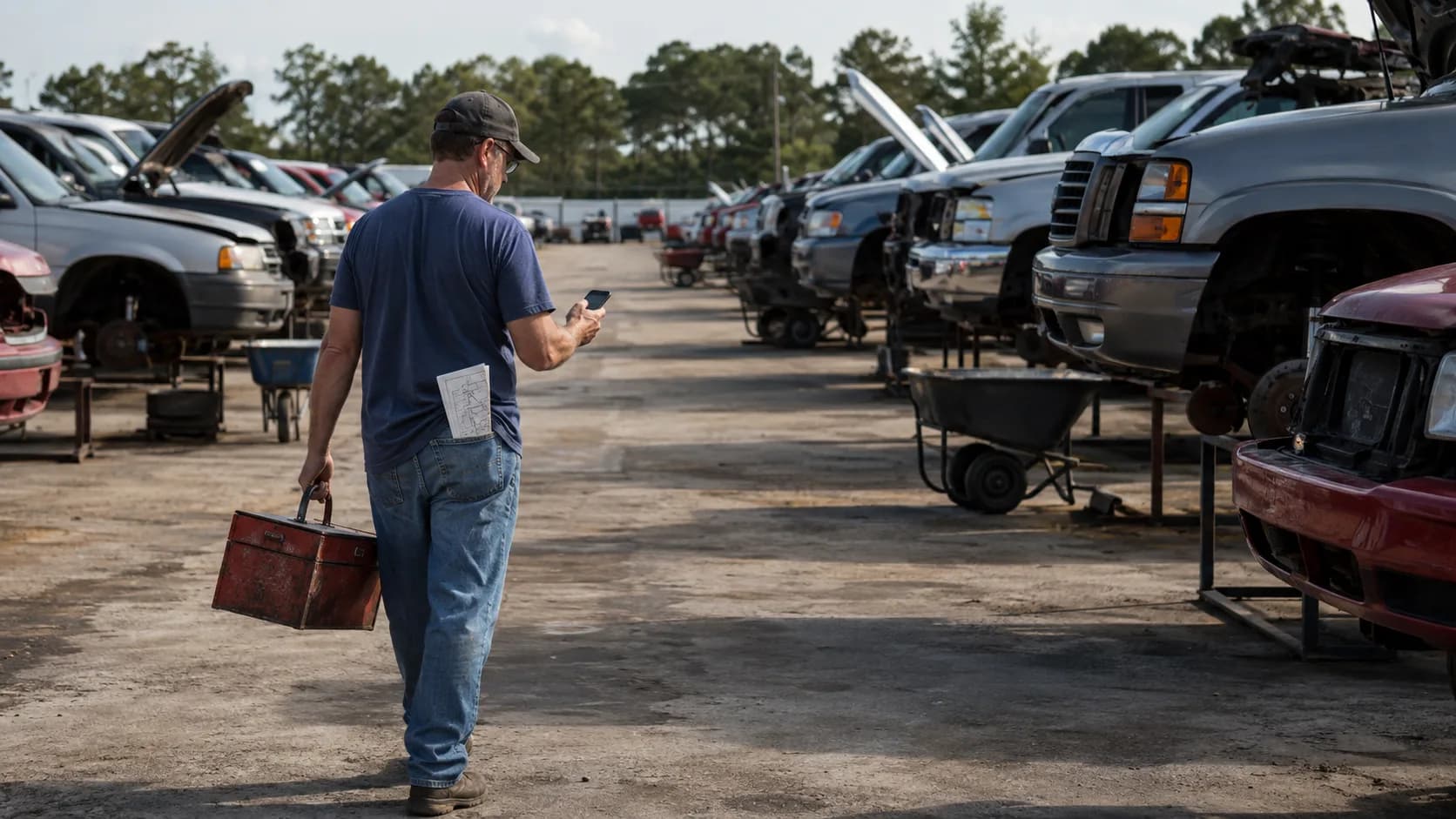
There was a time when fixing a car could begin with a Saturday morning, a metal toolbox and a few dollars folded into your pocket. You did not order the part. You went looking for it.
At the junkyard gate, somebody pointed toward a row and gave directions that sounded like a treasure map: Chevrolets past the fence, Fords near the back, trucks beside the old office. Then you walked until you found something close to yours, lifted the hood and hoped the alternator, carburetor or window crank had not already been taken. You brought your own wrenches. You brought somebody to help with the heavy parts. If you were young, you might have brought a father, uncle or neighbor who could look at three greasy pieces on the ground and know which one would fit.
The junkyard was a parts store, classroom, museum and last-chance hospital for machines that still had something useful to give. Then, somewhere along the way, it seemed to disappear.
It did not. It changed its name, cleaned up its paperwork and put the rows into a database.
The Junkyard Became an Auto Recycler

The professional name today is automotive recycler, salvage facility or used-parts recycler. The industry is not small. The Automotive Recyclers Association says professional auto recycling supports more than 140,000 jobs at over 9,000 locations nationwide. Some are still self-service yards. You pay an entrance fee, bring your tools, locate the vehicle and remove the part yourself. Around Houston, LKQ Pick Your Part still advertises the plain old bargain: bring your tools, pull your parts and save.
Other recyclers are full-service operations. Employees buy damaged vehicles, drain and process them, test and remove valuable components, photograph the parts, record their condition and place them into inventory. A transmission may sit on a rack in Texas until a repair shop in Michigan searches for that exact version. A door from Ohio may keep a car in Delaware from being declared a total loss. The remaining shell is eventually crushed or shredded, and its steel, aluminum, copper and other material returns to manufacturing.
That is the first big change. The old yard waited for you to come find the part. The modern recycler finds a buyer for the part before the buyer ever sees the car.
The Treasure Map Moved onto a Screen

The search itself has become enormous. Car-Part.com says its database contains more than 120 million inventoried parts from thousands of recyclers. A customer can search by year, make, model and component, compare locations and contact the yard that owns the part. Large self-service companies offer apps that search multiple yards and notify customers when a matching vehicle arrives.
The man behind the counter who once remembered a blue pickup arriving on Tuesday may now scan a barcode and pull up its stock number, mileage, engine, damage description and row location. That sounds less romantic. It is also far more useful when a person needs a particular headlight before the insurance company decides the repair costs more than the vehicle is worth.
The internet did not eliminate the hunt. It made the hunt national. It also changed what people call the product. The industry increasingly uses the term recycled original equipment—a genuine factory part removed from another vehicle, rather than a newly manufactured aftermarket replacement. According to the Automotive Recyclers Association, recycled original-equipment parts can cost 20 to 80 percent less than new parts, depending on the component and market.
The price matters. A repair that makes no sense with a new factory door, wheel or engine may become possible with a used original part. For an older vehicle whose manufacturer no longer stocks the component, the recycler may be the only source left.
A Part Is No Longer Just a Part
The old method worked partly because many components were visible, mechanical and understandable. An alternator had a mounting pattern, pulley and electrical connection. A window crank either fit the shaft or it did not. A door was complicated mainly by whether it came from a two-door or four-door car and whether the hinges lined up.
Modern vehicles changed that calculation. A side mirror may contain a heater, turn signal, memory motor, blind-spot warning light and camera. A seat may contain an air bag, occupancy sensor, computer module and powered adjustments. A headlight assembly can include control electronics that cost more than an entire used car once did. Windshields may look identical while differing because one supports a camera or sensor package.
Even when the hardware bolts into place, the vehicle may not accept it without programming, calibration or a security procedure. Some modules are connected to the identity of the vehicle from which they came. Some safety systems must be aimed or recalibrated after parts are installed.
That is why the seventeen-character vehicle identification number has become the opening question. The VIN helps identify the vehicle, but it may not settle every compatibility issue. Recyclers and repairers may also need a production date, engine code, trim level, option list, casting number, connector or interchange number. The customer who once said, "I need a starter for a '72 Ford," may now hear six questions before anyone walks toward a shelf.
The junkyard learned the VIN because the automobile became a network.
Not Everything Should Come Home in Your Toolbox

The old yard rewarded nerve. The modern yard requires judgment. A person with basic mechanical ability can still save money on many interior pieces, brackets, wheels, body panels and conventional mechanical parts. But safety devices, high-voltage systems and some electronic components belong in trained hands.
Air bags are the clearest example. In 2026, the National Highway Traffic Safety Administration banned certain defective replacement inflators after at least ten deaths and serious injuries. NHTSA warns owners of vehicles with previous crashes or air-bag deployments to have the system inspected by a reputable mechanic or manufacturer dealership. Nobody should disassemble or test an air bag casually in a driveway or salvage row.
Electric and hybrid vehicles add another level. Their battery packs may remain valuable long after a collision, but the voltage can kill. Professional recyclers now train workers in isolating high-voltage systems, using protective equipment, storing battery packs and shipping them legally. The Automotive Recyclers Association maintains certification programs and a battery registry for that developing market.
The yard still contains opportunity. It also contains stored energy, explosive devices, sharp metal, unstable vehicles and fluids that require respect. The smartest do-it-yourself repair has always included knowing when not to do it yourself.
The Mud and Mystery Did Not Meet Modern Rules
Some of the old junkyards really did close. Land became more valuable. Cities expanded around properties that had once been beyond town. Independent owners retired, and families did not always continue the business. Large operators bought smaller yards. Online salvage auctions created a faster path between insurance companies, rebuilders, exporters and recyclers.
Environmental and recordkeeping requirements also became more serious. Texas distinguishes between salvage vehicles that may be rebuilt and nonrepairable vehicles whose only value is parts or scrap. Dealers and recyclers have licensing, title and federal reporting responsibilities. The Texas Commission on Environmental Quality provides specific compliance guidance for auto salvage yards covering wastewater, stormwater and pollution prevention.
That means fuel, oil, coolant, refrigerant, batteries and other materials cannot simply be allowed to leak into the soil and rainwater. A professional recycler depollutes the vehicle, manages hazardous material and documents what arrived and where it went.
There was freedom in the old disorder. There were also oil-soaked acres that somebody eventually had to clean. The modern yard may feel less like wandering through mechanical history. It is more likely to know the identity of the vehicle, the condition of the part and the path of the remaining metal. That is progress, even if it came with a barcode.
What We Lost Between the Rows
Still, something did disappear. The old junkyard taught mechanical confidence in a way no search box can. You learned by looking at how a part was attached. You discovered that another model used the same hinge or engine. You saw how a car was built because somebody had already taken half of it apart.
People traded information over open hoods. One customer lent another a socket. A teenager learned that forcing a bolt usually made the afternoon worse. A retired mechanic could identify a transmission from the shape of its case and become the most valuable man in the row.
That knowledge has not vanished, but fewer machines invite it. Plastic covers hide the engine. Fasteners become clips. Components become sealed assemblies. Diagnosis begins with a scan tool, and replacement may end with a subscription, calibration or software download. The distance between "I think I can fix that" and "the vehicle will allow that part to work" has grown.
This is not entirely the automobile's fault. Modern vehicles are cleaner, safer and more capable than the machines we remember. They protect occupants with systems that did not exist when a bumper was mostly chrome and confidence. Complexity bought us something. But it also made repair feel like permission granted by somebody far away.
The junkyard remains one of the few places where a person can push back against that feeling—where labor, patience and knowledge can still substitute for some of the money.
The Last Useful Mile
Every wrecked vehicle contains two stories. One is the story of what ended: a collision, flood, mechanical failure, insurance decision or repair estimate that finally became too large. The other is the story of what can continue.
The engine may run for another hundred thousand miles in a work truck. The undamaged door may match a car a thousand miles away. The wheel, radio knob, tailgate latch or seat bracket that seems worthless by itself may be exactly what keeps somebody else's paid-off vehicle on the road. Reusing that part saves the cost of a new one and delays the cost of replacing the whole automobile. It also avoids manufacturing another component before one is needed.
That is what the junkyard always understood: very few machines become useless all at once.
Some Saturday morning, a customer will still sign in at a gate, push a wheelbarrow down a long row and find the vehicle the app promised would be there. He will set down his toolbox, study the fasteners and discover that somebody took the easy part first. Some things never change.
The junkyard did not disappear. It learned your VIN number—and it still rewards the person who knows which end of the wrench to hold.