The Map Knows Where You Are. Does It Decide Where You Go?
Digital maps do more than give directions. They influence what we notice, where we stop, and which places remain unseen.
Digital maps do more than give directions. They influence what we notice, where we stop, and which places remain unseen.
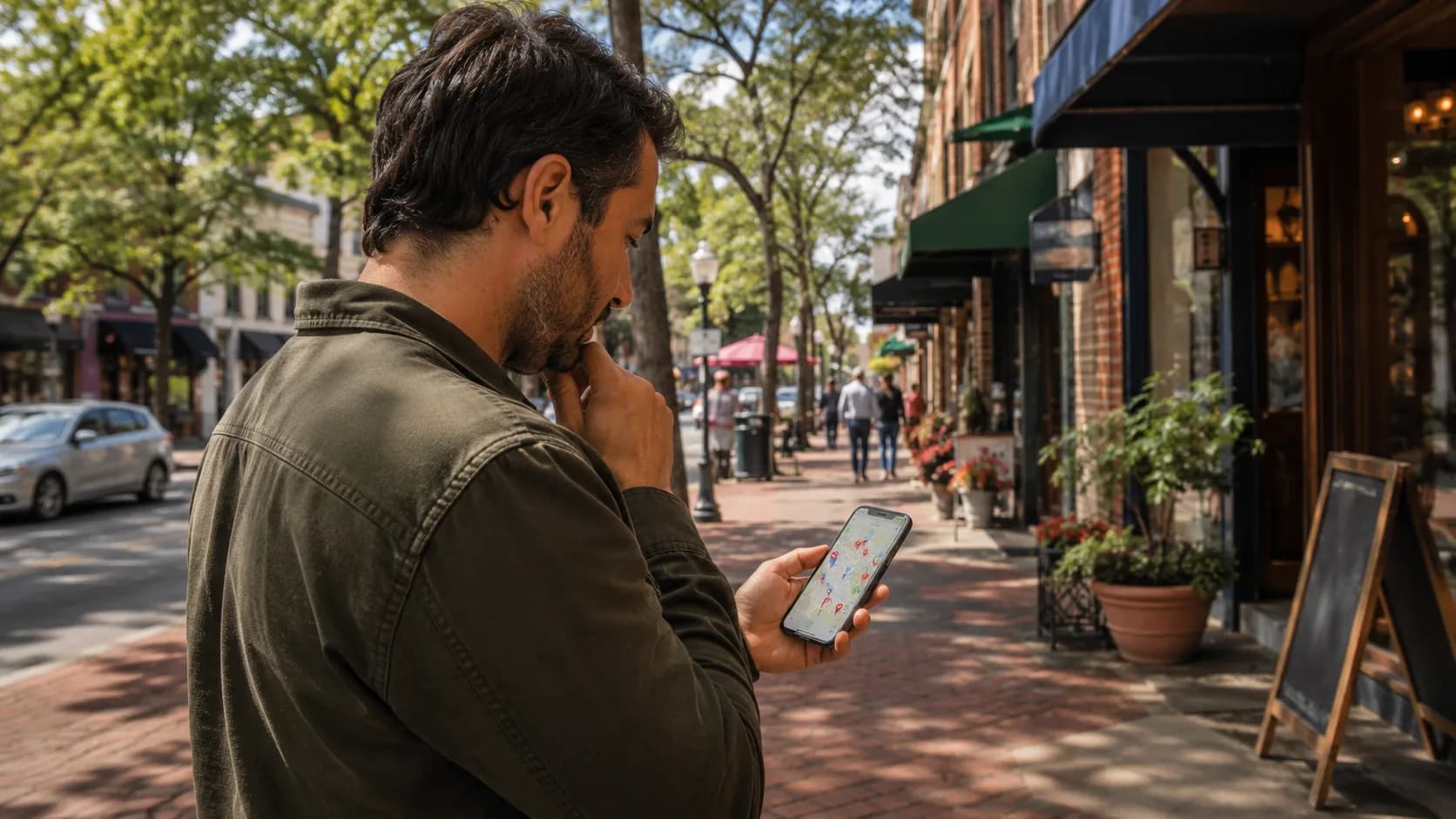
Open Google Maps. The first thing it tries to establish is not where you want to go. It is where you are.
Then search for restaurants. In a few seconds, the neighborhood around you is rearranged into a list of choices. Some places are familiar. Some are places you have visited. Others may be businesses you have passed for years without noticing. A favorite local spot may appear near the top - or may barely appear at all.
Nothing outside changed when the map opened. The roads, buildings, kitchens, parking lots, and people were already there. What changed was the order in which the community was presented to you.
That raises a question most of us rarely ask: When a map shows us where to go, are we making the decision - or choosing from decisions that have already been placed in front of us?
Try It Where You Are
Before going any farther, turn this article into a small experiment.

Open Google Maps at your current location.
Then search for restaurants near you.
Google Maps may use your device location if it is available. Look at the first screen of results before scrolling very far.
Which places do you recognize? Which ones have you never heard of? Are the nearest businesses listed first? Do larger chains appear beside small independent places? Is there a restaurant you know is nearby that does not appear until you search for it by name?
There is no correct result. The point is simply to notice what happened. The map did not show you everything. It showed you a useful selection, arranged in an order.
A Map Used to Answer Where
A paper map answered a fairly simple question: Where is the road?
It showed highways, towns, rivers, county lines, and whatever landmarks the mapmaker had room to print. Even paper maps made choices about what to include, but they mostly waited for the traveler to decide what mattered.
A digital map is far more active. It can locate us, warn us about traffic, estimate arrival time, display business hours, show photographs, collect reviews, suggest routes, and offer places to eat before we have decided what sounds good.
That is tremendously useful. It is also a quiet shift in power. The map no longer merely describes the world around us. It sorts the world and places certain parts of it closer to our attention.
How the Choices Are Arranged
Google says local search results are based mainly on relevance, distance, and prominence.
Relevance asks how closely a business matches the search. Distance considers how far the place is from the person searching. Prominence considers how well known a place appears to be, using signals that can include links, reviews, ratings, and information available across the web.
Those factors make sense. A map cannot display every restaurant, mechanic, park, coffee shop, and hardware store with equal importance. It has to organize the choices somehow. Google even notes that a business farther away may appear above a closer one when the system believes it is a better match.
That does not mean the map is secretly plotting against the diner around the corner. It means the order is the result of a system - and systems have consequences even when the goal is simply to be helpful.
When Visibility Becomes Foot Traffic
Imagine two restaurants serving equally good food.

One has accurate hours, recent photographs, a complete business profile, a working website, and plenty of reviews. The other has been feeding local families for twenty years but still shows an old phone number, an outdated photograph, and a pin that lands at the wrong end of the shopping center.
To the people who already know both places, the difference may not matter. To a traveler, a new resident, or someone deciding where to eat in the next ten minutes, the difference can be enormous.
The first restaurant looks easy to trust. The second looks uncertain. It may be only two blocks away, but two blocks beyond the first screen can feel like another county.
That is why appearing on the map is no longer a small technical matter for a local business. Physical location still matters, but digital visibility helps determine whether people ever discover the physical location in the first place.
The Map Is Not the Neighborhood
Digital maps are impressive, but they are not the neighborhood itself.
They can contain old business names, incorrect hours, missing roads, misplaced entrances, and places that closed months ago. A new restaurant may be packed every weekend while still appearing unfinished online. A tiny family business may be famous among nearby residents and almost nonexistent to strangers.
The map knows what has been supplied, collected, reviewed, linked, photographed, and updated. It does not automatically know every local truth.
That matters because people can easily mistake what appears on the screen for everything that exists. The map feels complete. The neighborhood rarely is.
We Still Make the Decision
The map does not take away human choice. It cannot force us to turn right, order barbecue, visit a chain restaurant, or ignore the little place beside the feed store. We can scroll farther, move the map, change the search, ask a neighbor, or shut the phone off and follow our nose.
But there is a difference between making a choice and arranging the choices.
A restaurant menu does not decide what we will eat, either. Still, somebody chose which dish would appear first, which one would receive a photograph, and which special would be printed in bold.
We still choose where to go. Increasingly, an algorithm arranges the menu.

Look Beyond the First Screen
The answer is not to abandon digital maps. They save time, prevent wrong turns, connect travelers with businesses, and make unfamiliar places easier to explore.
The answer is to use the map without confusing it for the entire world.
Scroll past the first few results. Move the map and search the area again. Read reviews for useful details instead of treating the star rating as a final verdict. Check the business website. Ask someone who lives nearby. Notice the places you pass even when the blue line does not tell you to stop.
For business owners, the lesson is equally practical: keep the information accurate. Google advises businesses that complete and current information can improve how often they appear in relevant local searches. A wonderful place cannot benefit from being discovered if the map sends people to the wrong door.
Where the Map Ends
The blue dot is one of the most useful little symbols modern life has given us. It can tell us where we are when the road signs, buildings, and our own sense of direction have failed.
But knowing where we are is not the same as deciding where we should go.
The next time you search for a restaurant, park, store, or mechanic, pause before tapping the first result. Notice which choices were placed in front of you. Notice what may be missing. Then decide whether the easiest answer is the one you actually want.
The map knows where you are. Curiosity decides how much of the place around you you actually see.