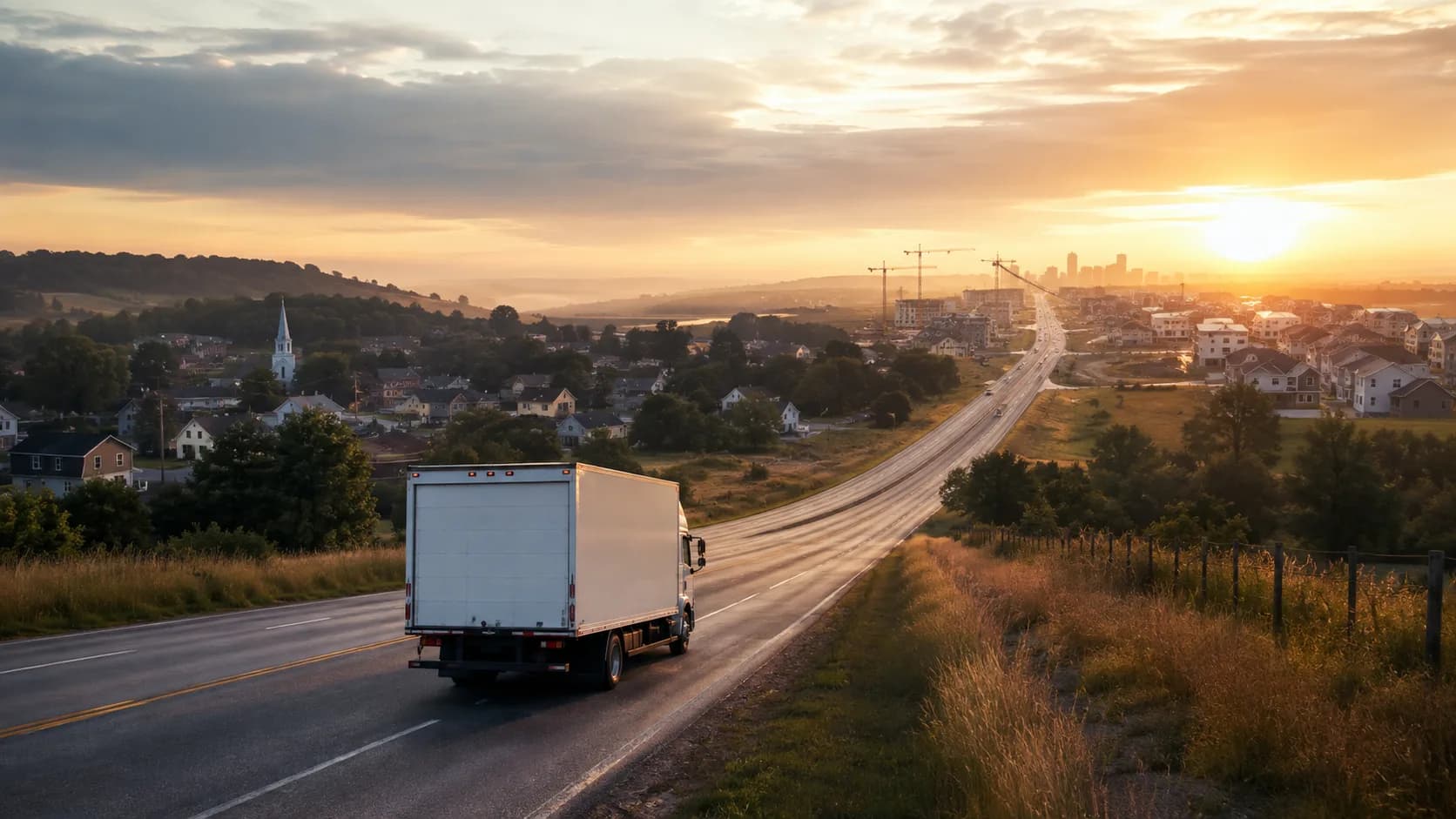
A Tale of Two Towns
One wonders where everybody went. The other wonders where everybody came from.
In one American town, a moving truck backs into a driveway just after sunrise.
A family carries boxes past the front porch while a neighbor watches from across the street. By lunchtime, two children will be gone from the local school, one customer will be missing from the grocery store, and another house will begin waiting for its next owner.
Hundreds of miles away, perhaps more than a thousand, another town wakes to the sound of nail guns, bulldozers, and backup alarms. New roofs appear where fields stood a few years ago. School hallways fill. Traffic thickens. License plates from half the country crowd the parking lot, each one silently accused of causing the traffic jam it is sitting in.
One town asks, “Where did everybody go?”
The other asks, “Where did everybody come from?”
The same moving truck connects them.
A Country Large Enough To Migrate Within
Americans usually call this moving, not migration. Legally, that is correct. A family crossing from one state into another has not entered a new country. They do not need a visa, a passport, or permission to work. They keep the same citizenship, currency, federal government, and national identity.
But the United States is large enough for an interstate move to cover the distance of several European countries. The climate can change. The economy can change. Taxes, housing costs, schools, laws, politics, accents, and local customs can change. Even the barbecue may require a period of adjustment.
The U.S. Census Bureau reported that 11.8 percent of U.S. residents lived in a different residence in 2024 than they had one year earlier. Most moved within the same state, but 2.1 percent had crossed a state line. That sounds small until we remember that one person out of every fifty is still a very large procession of moving trucks.
The movement does not happen evenly. Some states and communities gain residents while others lose them. The direction can also change with jobs, housing prices, family needs, retirement patterns, disasters, and the broader economy. Migration is not a single river flowing forever in one direction. It is more like weather: there are strong patterns, but the map keeps moving.

One town asks where everybody went. The other asks where everybody came from.
The Town People Leave
For the town being left behind, population loss rarely arrives as one dramatic event. It happens one family at a time.
A graduating class gets smaller. A Little League team struggles to fill its roster. A restaurant loses enough regular customers to close on Mondays, then Tuesdays, and eventually for good. Churches, volunteer fire departments, civic clubs, and local boards begin depending on the same shrinking group of people to do everything.
The most painful loss is often young adults. When people leave for work, education, or opportunity, the town does not merely lose its present population. It loses future parents, business owners, taxpayers, coaches, nurses, customers, and neighbors.
Housing may remain affordable, but affordability is less comforting when there are few buyers. Traffic may disappear, but so may the doctor, the grocery store, and the employer that once made the town viable. A place can become wonderfully quiet right around the time everyone starts worrying that it has become too quiet.
Those who stay are sometimes described as resistant to change. That is not always fair. They may be keeping businesses open, caring for older relatives, maintaining family land, serving local institutions, and trying to preserve a community that still matters deeply to them.
When enough people leave, the remaining residents may begin asking an uncomfortable question: Are we loyal, or were we simply the ones who could not leave?
Still, decline is not automatically death. Lower costs can attract new industries, remote workers, artists, retirees, or families who have been priced out elsewhere. Empty buildings can become workshops, apartments, clinics, or small businesses. A town with room to breathe may get another chance—provided somebody notices the opportunity before the roof starts leaking.

The same moving truck connects them.
The Town People Choose
At the receiving end, the problem is almost the reverse.
New residents bring workers, customers, skills, businesses, tax revenue, and demand. Stores open. Hospitals expand. Restaurants multiply. Construction crews stay busy. Property owners may watch values rise and briefly feel like financial geniuses for having bought a house before everyone else discovered the zip code.
Then the bills for growth begin arriving.
Roads built for yesterday’s population carry tomorrow’s traffic. Schools need classrooms, buses, teachers, and land. Water systems, police departments, fire stations, hospitals, and utilities must expand. Housing construction can race forward while infrastructure limps behind waving paperwork.
Growth also changes the physical character of a place. Open land becomes subdivisions. Familiar landmarks disappear behind shopping centers. A road that once required directions such as “turn left where the old feed store used to be” may now require three traffic lights and the patience of a saint.
Longtime residents are not wrong to grieve those changes. A place can gain opportunity while losing part of what made it feel like home. Newcomers are not wrong either. They may have moved for work, family, safety, affordability, climate, or the simple hope that life could be better somewhere else.
The tension comes from a strange contradiction: newcomers often arrive because they admire what a community offers, while longtime residents worry that enough newcomers will change the very thing everyone came to find.
That does not make the newcomers invaders or the old-timers cranks. It makes both groups human. One is trying to belong. The other is trying not to lose the place where it already belonged.

Every move has two ends — and both places change.
What Europe Shows Us
The comparison with Europe makes America’s internal movement easier to see.
In 2024, Eurostat reported that about 1.5 million people moved from one European Union country to another. At the beginning of 2025, roughly 14 million EU citizens were living in a different EU member country from the one whose citizenship they held.
European Union citizens generally have broad rights to live and work across member countries, but they still cross national borders. A move may involve a new language, tax system, school system, health system, bureaucracy, and national culture.
An American moving from one state to another does not face that same legal transition. There is no immigration status to secure, no asylum claim to prove, and no threat of deportation simply because the move did not work out. International migrants may also face language barriers, family separation, discrimination, dangerous journeys, or years of legal uncertainty. Those differences are too important to blur.
Yet the community-level effects can rhyme.
A destination sees more people competing for housing, using roads, enrolling children in schools, opening businesses, joining churches, and influencing local politics. A place of departure loses some of those same people, skills, customers, and traditions.
The paperwork is different. The human geography is not completely different.
The Moving Truck Has Two Ends
Every arrival is also a departure from somewhere else.
The new taxpayer in one town may be the lost customer in another. The child filling a desk in a crowded school may have left an empty desk behind. A house selling above asking price in one community may be connected, indirectly, to a house sitting for months without an offer somewhere else.
That does not mean one town wins everything and the other loses everything. Growth can overwhelm a community. Decline can create affordability and room for reinvention. People bring fresh ideas to the places they enter, and they carry memories, habits, recipes, expectations, and voting preferences from the places they left.
Migration creates change at both ends, and change is rarely polite enough to bring only benefits or only problems.
This is where America’s internal migration may help us understand migration around the world. Communities often talk about population movement as though it were a debate about numbers. The people inside the moving truck are usually thinking about something much more ordinary: a job, a mortgage, aging parents, children, weather, safety, bills, or whether they made the right decision.
They are not trying to become a demographic trend. They are trying to build a life.
Two Towns At Dusk
By evening, the truck has disappeared down the highway.
In the town it left, the neighbors see taillights and another empty driveway. In the town ahead, different neighbors see headlights and wonder who is moving in.
One place may need help holding on to people. The other may need help absorbing them without paving over everything that made it worth choosing. Neither community is foolish for caring about what it is losing, and neither family is selfish for searching for something better.
We spend enormous amounts of time discussing migration at national borders. We spend far less time noticing how dramatically Americans are rearranging the country from the inside—and how every move changes both the place being entered and the place being left.
Perhaps that is the lesson of the two towns.
Migration is not only a border story. It is a story about what happens on both ends of the same moving truck.
EDITORIAL NOTE
Statistics referenced in this article come from the U.S. Census Bureau and Eurostat. An editorial source sheet accompanies this file.
Dock Line Tip — When you hear about growth or decline, remember every moving truck has two ends — one town loses a family while another gains one.