Lockhart, Texas: From Plum Creek and the Chisholm Trail to Austin Next Door
Lockhart began as a surveyor's land grant and became a Chisholm Trail starting point, a railroad and cotton town, and a community that worked to bring jobs home as Austin grew.
Lockhart's story runs through a battle that opened the country to settlers, a cattle trail and three railroads, and a long effort to remain its own town as Austin grew next door.
Lockhart, the county seat of Caldwell County, sits where U.S. Highway 183 meets State Highway 142, about 30 miles southeast of Austin. This account draws on the Handbook of Texas entry for Lockhart from the Texas State Historical Association. The entry was first published in 1976 and last revised in 1995.
A surveyor's land and a battle at Plum Creek
The town is named for Byrd Lockhart. In 1831 the Mexican government gave him the land that later became the townsite, as partial payment for his surveying work. Through the 1830s, the threat of Indian raids kept settlement light. After the battle of Plum Creek in 1840, more settlers came.
By the mid-1840s, several families lived near Lockhart Springs. When Caldwell County was established in 1848, the new town of Lockhart became the county seat, and the Plum Creek post office, opened the year before, moved there.
Schools and churches came early
Lockhart was incorporated in 1852 with a mayor-council government. By then it already had the basics of a settled town. Isabel Stewart began publishing a weekly newspaper in 1849 or 1850. Lockhart Academy opened in 1850. A Masonic lodge built that same year served as meeting space for both school and church. By 1855, at least five churches had been organized. An 1858 census of incorporated towns counted 423 residents.
Cattle trail, then the railroads
In the late 1860s, Lockhart became a starting point for the Chisholm Trail and grew into a regional trading center in the early 1870s. Then the railroad went somewhere else. In 1874, the Galveston, Harrisburg and San Antonio Railway reached the southern part of the county, the town of Luling grew up along it, and business in Lockhart slowed for several years.
Lockhart regained its lead in the county economy after 1887, when the Missouri, Kansas and Texas line finished its Lockhart-San Marcos section. The San Antonio and Aransas Pass line connected Lockhart with Shiner by way of Luling in 1889, and the Missouri, Kansas and Texas extended track from Lockhart to Smithville in 1892.
By 1890, the town of 1,233 had electricity, a waterworks, streetcars, four schools, seven churches and a national bank. A cottonseed oil mill opened in 1893 and a cotton compress in 1901, making Lockhart an important center for processing the region's cotton. By 1900, the population had nearly doubled, to 2,306.
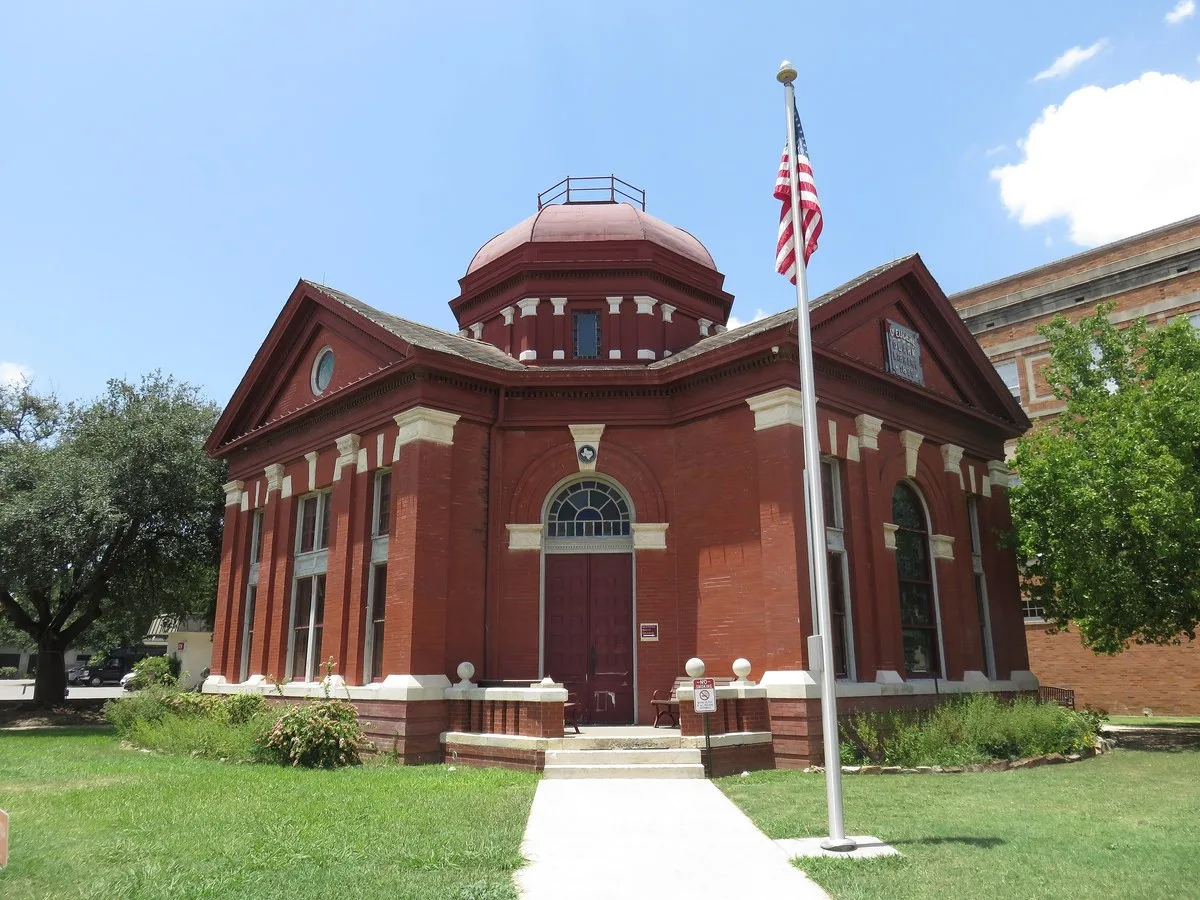
The Dr. Eugene Clark Library in Lockhart in July 2018. Photo: Antony-22 / Wikimedia Commons, CC BY-SA 4.0.
The turn of the century brought two institutions the town is still known for. The Dr. Eugene Clark Library was established then. The Handbook says it is said to be the oldest continuously operating city library in Texas. So was Kreuz's Market, and the entry notes it was still selling barbecue in the early 1990s.
Oil next door and a town that kept growing
When the Luling oilfield was discovered in 1920, Lockhart again became the county's second economy, though some of its citizens did well investing in the field. The town grew steadily, from 3,731 people in 1920 to 5,018 in the early 1940s. During World War II, the Lockhart-to-Luling rail branch was abandoned in 1942 for the war effort. Both towns had another rail line, so neither was badly hurt.
In those years, Lockhart's main businesses reflected a farm economy. It had cotton gins and compresses, a creamery, a poultry-dressing plant, a peanut processing plant, and livestock marketing and shipping.
Choosing not to be a bedroom town
By the 1960s, the population had leveled off at a little over 6,000. In the early 1970s, residents worried that Lockhart could become a bedroom community for Austin commuters. In 1973, a group of residents formed the Lockhart Industrial Foundation to recruit employers. One of the first was Kewaunee Scientific Corporation, which at one point employed 160 to 180 people. The foundation later helped bring Wackenhut Corrections Corporation, which leased city-owned space for a private prison and added 135 jobs.
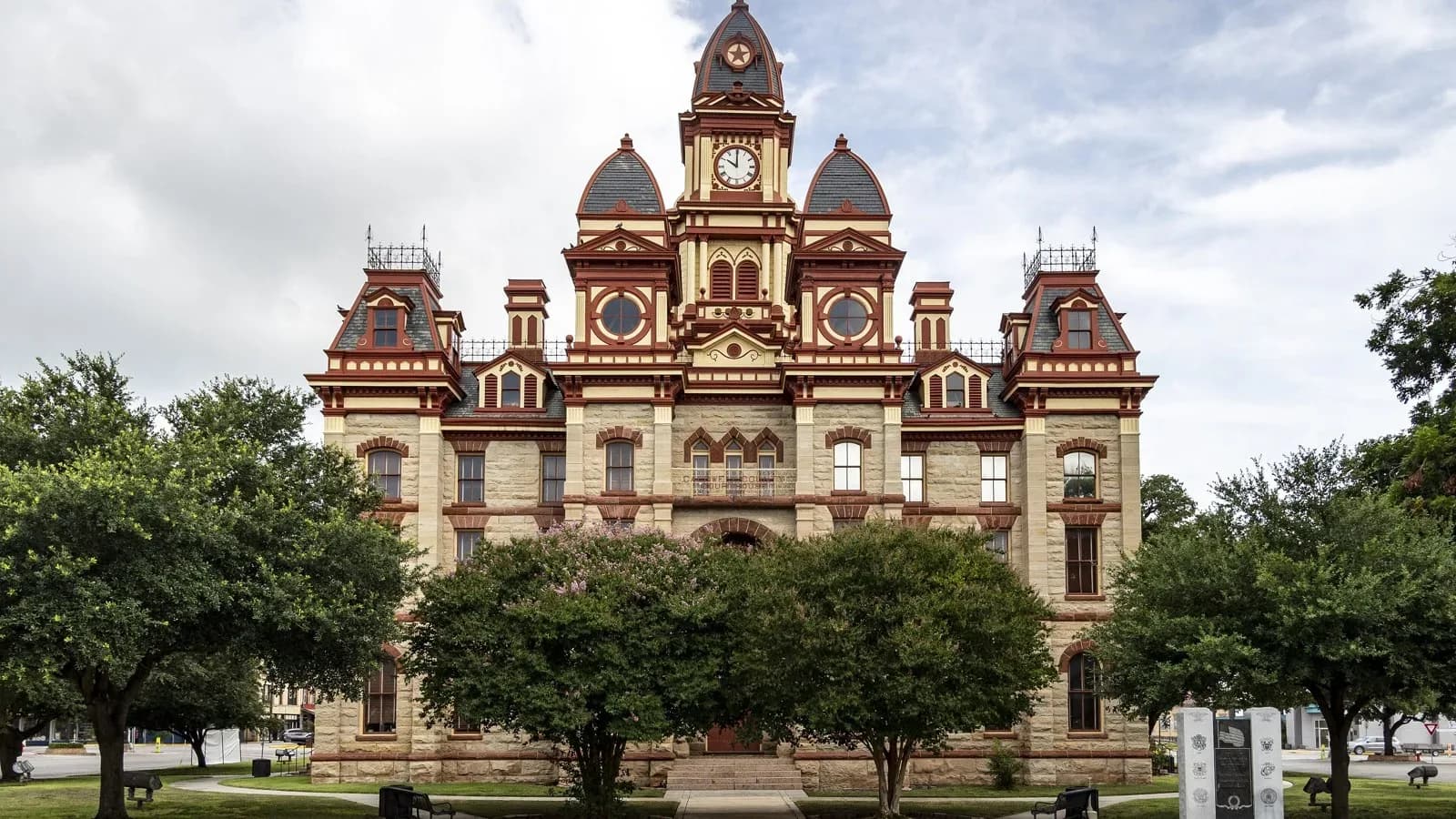
In 1978, the courthouse and several blocks of downtown were listed on the National Register of Historic Places. The population reached 7,953 in 1980, 9,205 in 1990 and 11,615 in 2000. The Handbook's population table lists 14,379 for 2020. In the early 2000s, visitors came for a reenactment of the battle of Plum Creek at the annual Chisholm Trail Roundup, the Caldwell County Museum and Lockhart State Park.
Our view
Lockhart's story shows what a town can do on purpose. Early settlers built schools and churches almost as soon as they built houses. When the railroad went to Luling, they did not give up. When residents worried in the 1970s about becoming a commuter town for Austin, they organized to bring jobs home rather than let the town become a place people only slept in.
That is a good example for every small Texas town facing growth today. Dock Line has also told the stories of Castroville and Fort Davis. A town that knows its history is better prepared to decide what it wants to become.