

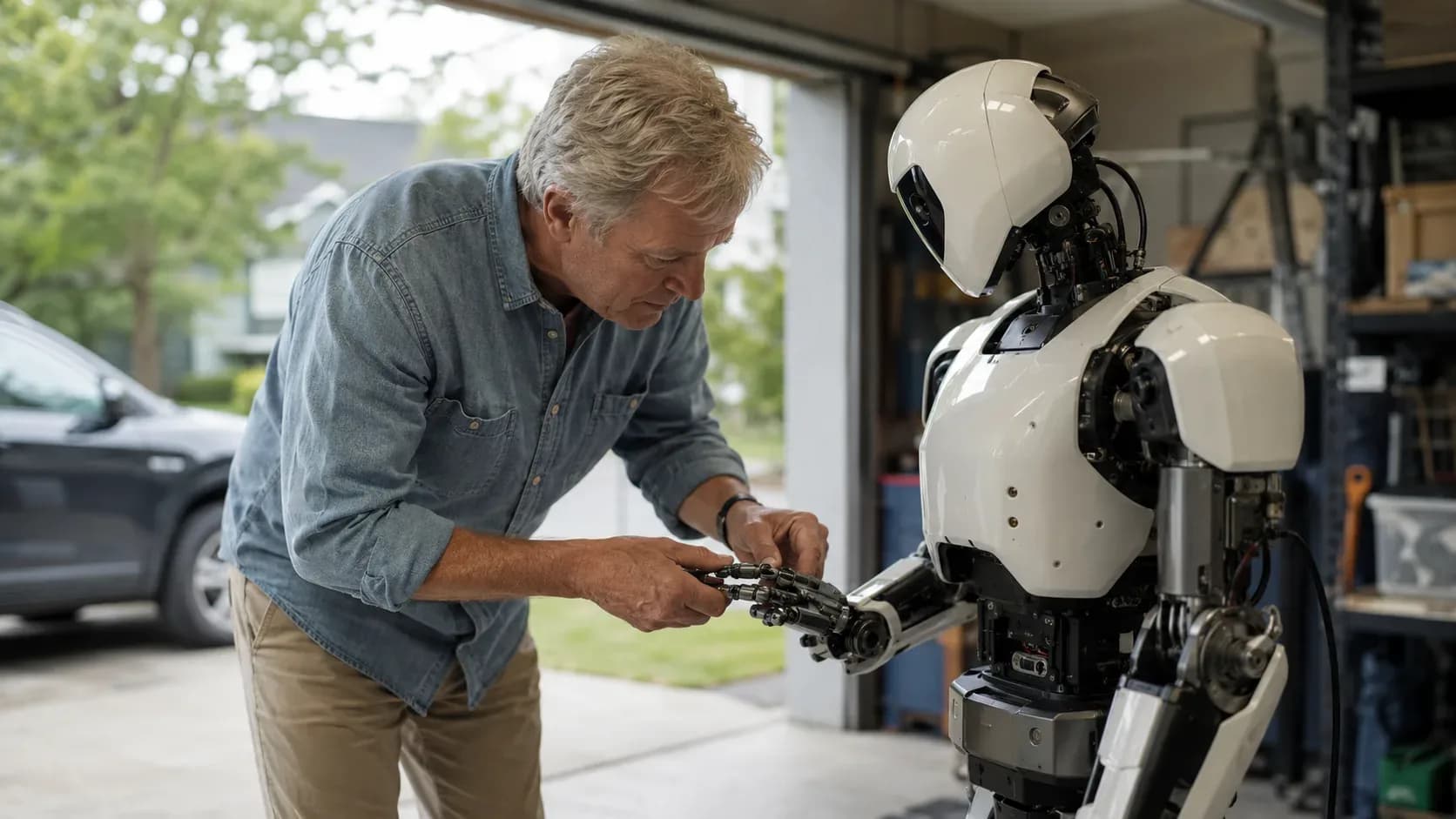
Kick the Tires Before the Future Parks in Your Driveway
You may not get to decide whether the future arrives. You do get to decide whether it catches you completely unprepared. AI is the test drive ordinary people can take today.
You may not get to decide whether the future arrives. You do get to decide whether it catches you completely unprepared. AI is the test drive ordinary people can take today.
Artificial intelligence and robots. Two subjects that can start an argument before the coffee finishes brewing. Depending on who is talking, AI is about to cure disease, eliminate jobs, write every book, destroy education, run our businesses, steal our identities, become our personal assistant—or somehow manage all of that by Thursday.
That is a lot to put on technology many people have never actually tried. So maybe there is a simpler place to begin: stop standing at a distance while other people tell you what to think. Pay attention. Learn. Try things. Ask questions. Kick the tires.
You may not get to decide whether the future arrives. You do get to decide whether it catches you completely unprepared.
History's Pattern Is Hard to Miss
History never repeats neatly, but the pattern is familiar. Electricity, automobiles, machinery, telephones, television, computers and the internet all arrived surrounded by wild promises and equally wild fears. Nobody correctly predicted every consequence. The good changes, the bad changes and the strange changes usually became obvious only after millions of ordinary people had started living with the new thing.
The people who took time to understand how a new technology worked were better prepared to decide where it belonged in their lives. They did not have to become engineers. They simply had enough experience to recognize the difference between a useful tool, an empty sales pitch and a bad idea wearing a shiny new suit.
We are at that kind of moment again.
We Cannot Stop the Train—But We Do Not Have to Be Helpless Passengers
The train-track comparison fits, with one important correction. We cannot stand on the tracks and stop a technological shift this large. But that does not make us helpless passengers. We can learn where the train is going. We can question who is driving it. We can demand safety rules. We can decide whether a particular car is worth boarding. We can also get off when something is not working the way we were promised.
That is a healthier position than blind excitement or automatic fear. Some of what is coming will be genuinely useful. Some of it will be expensive nonsense. Some products will look amazing for five minutes and spend the next five years asking for updates. Others may help people work, communicate, stay independent or solve problems in ways we have not imagined yet.
The goal is not to clap for everything new. The goal is not to reject everything new. The goal is to know enough that somebody cannot sell you a future you do not understand.
AI Is the Test Drive We Can Take Today

The household robot may not be sitting in the showroom yet, but the artificial intelligence people are learning to use on phones and computers gives us a test drive right now. Do not merely watch somebody demonstrate it. Use it. Give it a real problem. Ask it something you already know so you can see how it behaves. Ask something you do not know, then check the answer. Question it when something sounds wrong. Learn what it does well, where it struggles and how much the quality of your question changes the quality of its answer.
Start with ordinary life. Ask it to explain a confusing letter in plain English. Have it organize scattered notes. Ask for comparison questions before you buy something expensive. Have it help plan a trip. Use it to build a list of questions for a contractor, mechanic, accountant or doctor. Give it a rough draft and see whether it can help you make the point more clearly.
Then push back. Where did you get that? How current is it? What part of your answer are you least certain about? What did you leave out? Explain it again without the fancy words.
That matters because an AI answer can sound polished even when it is incomplete or wrong. NIST's current Generative AI Profile for its AI Risk Management Framework treats trustworthiness as something that has to be evaluated and managed—not simply assumed. The better habit is simple: use the speed, keep the judgment.
And keep private information private. Passwords, bank numbers and other sensitive details do not belong in casual experiments. The Federal Trade Commission has also warned that voice-cloning tools can make family-emergency scams sound frighteningly convincing. If a familiar voice suddenly demands money, verify the story through a number or person you already trust.
Learn While AI Is Learning
That phrase deserves one technical note. Most AI systems do not retrain themselves from scratch during every individual conversation. "Learn while AI is learning" means something broader: the models, products, interfaces and rules around artificial intelligence are still changing rapidly while the rest of us are learning how to use them. We are early enough that ordinary users can build experience alongside the technology instead of being introduced to it after every important decision has already been made.
Pew Research Center's 2026 work shows clear age differences in how Americans use AI, while AARP's recent research shows that many older adults are open to AI when it solves practical problems and the job it is being asked to do makes sense. Age may change which tools someone tries first. It does not erase judgment.
A person who has spent 40 years running a business, repairing equipment, caring for patients, raising a family or solving problems has something an AI system does not automatically receive with an update: lived context.
Kick the Tires on What You See

The same habit should follow us when AI moves from a screen into a machine that can walk, lift, carry, open, close and touch things in the physical world. Do not watch a robot dance on a stage and decide you have seen the future. Look at the hands. Look at the wrist movement. Look at the grip. Watch what happens when the object is fragile, awkward or not placed exactly where the demonstration expects it to be.
NIST has spent years developing ways to measure robotic grasping, manipulation and contact safety because "it picked something up" is not the same as knowing how reliably or safely it can do the job. That is exactly the kind of thinking consumers should bring to household robots.
The Questions Worth Asking
Before a robot, smart device or AI-powered machine earns a place in your home, ask practical questions:
Is the demonstration real, staged, scripted, remotely controlled or heavily supervised?
What happens if the internet or power goes out?
What information does the machine collect inside the home, where is it stored and who can use it?
Can it recognize when it is using too much force around a person, pet or breakable object?
Who repairs it, who updates it and who remains responsible when it makes a mistake?
Is it genuinely useful—or merely impressive for five minutes?
Those are not anti-technology questions. They are buyer questions. If you buy a truck, you want to know what it can haul, how safe it is, what it costs to maintain and whether somebody will answer the phone when it breaks. A robot should not receive a free pass because the sales video has better music.
Experience Still Matters
One of the stranger assumptions around new technology is that the youngest person in the room must automatically understand it best. Younger people may be quicker to try a new interface. That is useful. But comfort with a tool and judgment about a result are not the same thing.
A contractor may notice that an AI explanation skipped the ugly step that determines whether the job actually works. A retired nurse may hear a medical explanation and immediately spot the part that is oversimplified. A mechanic can often hear one sentence and know the machine is describing a problem the way a brochure writer would, not the way a shop would.
Artificial intelligence can bring speed, access and enormous amounts of information to the table. Human beings still bring priorities, experience, skepticism and the ability to say, "Wait a minute. That does not make sense." As the machines get smoother, the people using them may need to get sharper.
This Is Not Fear. It Is Not Blind Enthusiasm Either.
There is a lazy habit in public arguments now. Ask a hard question and somebody decides you are afraid of progress. Show curiosity and somebody else decides you have joined the robot cheering section.
The middle position is still available. You can be interested without being naïve. You can be cautious without being scared. You can explore the future without surrendering common sense. In fact, that may be exactly what this moment needs: more informed users and fewer spectators. Less shouting from the sidelines. More people willing to put the technology through ordinary life and see how it behaves.
The Bottom Line

The future is coming. That part is largely out of our hands. Preparation is not.
If artificial intelligence is the test drive we can take today, then take it. Not to worship it. Not to fear it. Not to let it make every decision. Use it long enough to learn where it helps, where it fails and what questions you ought to ask before you trust it with anything important.
By the time a robot actually parks in somebody's driveway, the smartest buyers will not be the people who were promised the future. They will be the people who took time to understand it.
Kick the tires before the future parks in your driveway. Learn while AI is learning.
Reader Links & Editorial Sources
The links below go directly to the research and consumer guidance used to ground this story.
Pew Research Center — Americans and AI 2026: Chatbots, Smart Devices and Views on Impact (June 17, 2026). Current national survey background on chatbot use, smart devices and public views of AI.
Pew Research Center — How Opinions and Use of AI Differ by Age (June 17, 2026). Supports the article's discussion of age differences in AI use and familiarity.
AARP Research — How Older Adults Want to Use Artificial Intelligence Technology (January 13, 2026). Supports the point that many adults 50-plus are open to practical AI uses, depending on the job AI is being asked to do.
National Institute of Standards and Technology (NIST) — Artificial Intelligence Risk Management Framework: Generative Artificial Intelligence Profile (Updated April 8, 2026). Supports the article's emphasis on evaluating AI trustworthiness and managing generative-AI risks rather than assuming reliability.
NIST — Grasping, Manipulation, and Contact Safety Performance of Robotic Systems (current project page). Supports the discussion of robot hands, dexterity, manipulation, grip performance and contact safety as measurable capabilities.
Federal Trade Commission — Scammers Use AI to Enhance Their Family Emergency Schemes (March 20, 2023). Supports the warning that AI voice cloning can make family-emergency scams sound like a real relative and should be independently verified.
More Community Stories
 Today
TodayTexas SNAP Enrollment Hits a 17-Year Low as Work Rules Tighten and Applications Pile Up
 Yesterday
Floods Tear Through Southwest Colorado. Polis Declares a 12-County Emergency as Rescuers Pull People From the Water.
 Last Week