Mason: A Hill Country Seat That Rebuilt Its 1909 Courthouse
Mason grew around an 1851 frontier fort, lost its 1909 courthouse interior to a 2021 arson fire, and rededicated the $17 million restoration in July 2024.
Mason: A Hill Country Seat That Rebuilt Its 1909 Courthouse
Mason, the seat of Mason County in the Texas Hill Country along Comanche Creek, is again conducting county business in its 1909 courthouse after a $17 million restoration. The official Mason County contact page lists the county address as 201 Ft. McKavitt St., Mason, TX 76856. The County Judge page gives the same location as 201 Fort McKavitt Street, with mailing address P.O. Box 1726, and names County Judge Shannon Worrell, at 325-347-5556. A 1988 Recorded Texas Historic Landmark marker in the Texas Historical Commission Atlas places the courthouse grounds on the north side of that street, which the marker also identifies as State Highway 29 and U.S. 87.
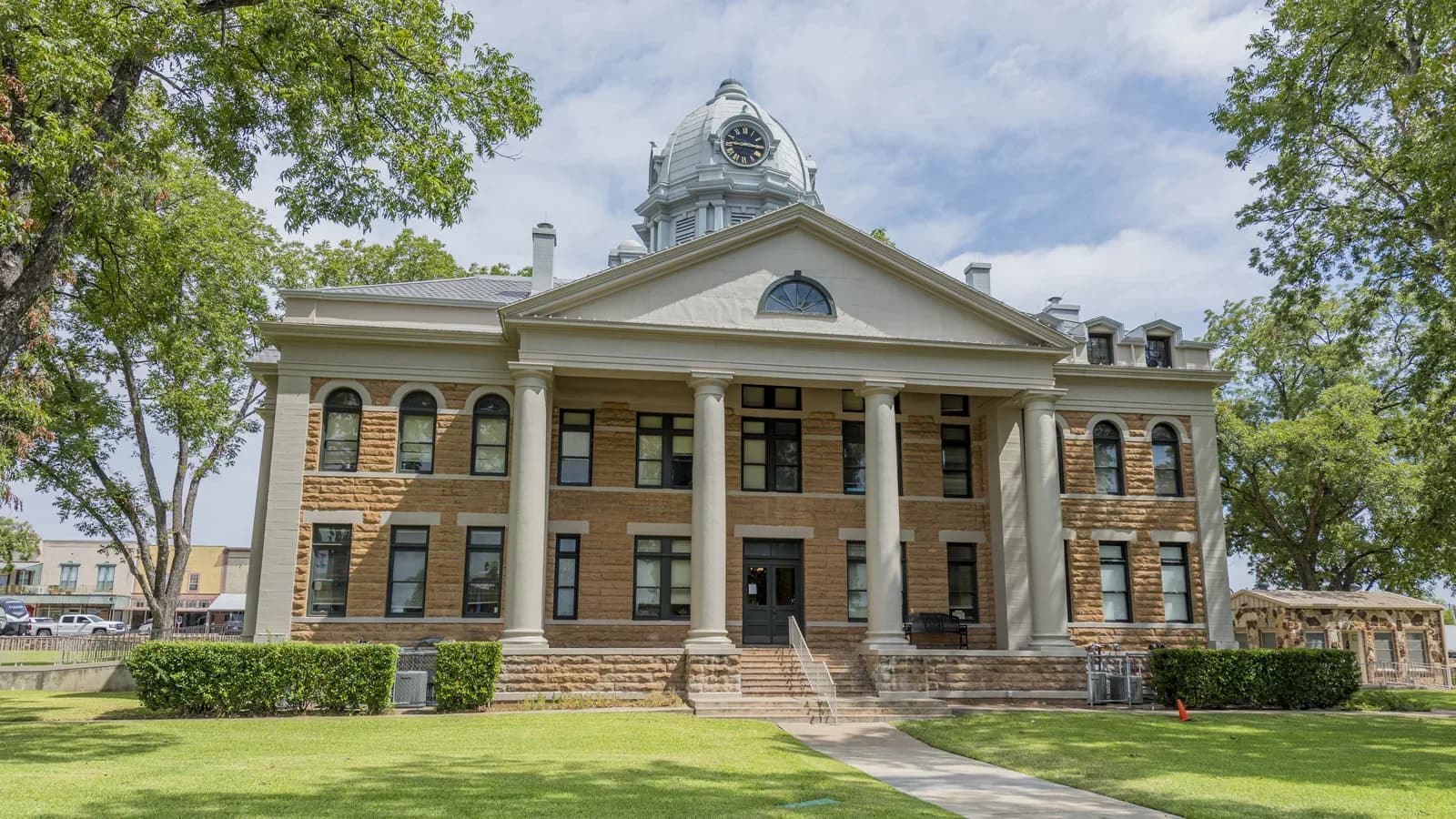
In a July 23, 2026, article in the agency's journal, The Medallion, Texas Historical Commission writer Andy Rhodes wrote that a fire on the night of February 4, 2021, destroyed most of the interior and left the exterior walls standing. The State Fire Marshal's Office later determined the fire was arson, and a McCulloch County jury in January 2024 found Nicholas Miller guilty of starting it, the Texas Department of Insurance said in a Feb. 1, 2024, news release. Rhodes wrote that the building had already been scheduled for work under the Texas Historic Courthouse Preservation Program, so furnishings and records had been moved out and the structure documented, and that in July 2024 the county held a rededication after a $17 million restoration overseen and funded in part by that program. The restored work includes a new cupola with a reconstructed clock tower, a Classical Revival pediment and columns at the entrance, and white floor tile that dates to the original 1909 building.
The earlier history of the town is set out by Alice J. Rhoades in the Handbook of Texas entry on Mason, published in 1952 and revised as recently as November 30, 2019. Mason grew up around Fort Mason, which the U.S. Army established in 1851. A Texas Historical Commission account agrees on that year and says the post was meant to protect German immigrants settling in the nearby hills and valleys. Rhoades wrote that some people were already living in the area; William S. Gamel is thought to have arrived around 1846. Near the later townsite is Gamel Spring, where, she wrote, John O. Meusebach is thought to have signed a treaty with Comanche chief Ketemoczy in 1847. The spring later supplied water to the fort.
Settlers collected at the post for work and for protection, and some remained after their enlistments ended. A sutler's store and a blacksmith shop, moved down from the fort on Post Hill, became the beginning of the town. In March 1858 George W. Todd opened a post office about three miles from the fort under the name Fort Mason; it was renamed Mason that June and was later moved into the community. Around 1860 James E. Ranck opened a store there.
In March 1861 the fort was surrendered to Confederate authorities. Rhoades and the Historical Commission both record that it sat nearly empty during the Civil War. Rhoades wrote that settlers suffered severe Indian attacks in those years and that most families gathered in or near the fort for protection. Voters made Mason the county seat on May 20, 1861. Federal troops reoccupied the fort in 1866, she wrote, and it was abandoned for good in 1868; neighbors carried off lumber and fittings until almost nothing of the post remained. Voters confirmed Mason as the county seat on August 26, 1869. On July 13, 1870, William and Caroline Lockhart and John and Kate Gamel donated land in town for county use. The Fort Mason Museum now stands less than a mile south of the courthouse, the Historical Commission says, with a replica of the officers' quarters and a commission centennial marker.
After the war, cheap cattle were often killed for their hides before eastern demand lifted prices, and by the 1870s Mason was a ranch town. Rhoades wrote that the first stone houses went up in 1869 and that by 1890 almost every building in town was stone. A Lutheran congregation organized on February 15, 1872, by Rev. H. Huber is described as probably the oldest church in Mason; a Baptist church formed the same year. In 1923, she wrote, Mason was the largest town in Texas still without a railroad. The city incorporated in 1945. From 1900 onward, the Handbook generally places the population between about 1,200 and 2,000.
The courthouse on the square has burned more than once. Rhoades dated the first courthouse and jail to 1869 and wrote that, before then, court sat under a live oak near the town well at the northeast corner of the square. The 1988 landmark marker says commissioners probably met in other places until a first courthouse was built in 1872. Both accounts agree the building burned in 1877 — Rhoades gives the date as January 21 and says the county's records burned with it — and that a replacement went up quickly, the marker calling it a red sandstone courthouse finished the same year. The present building, the marker says, is the third: designed by E. C. Hosford, built for $39,796, and completed in 1909 in the Beaux Arts style, with a center dome and clock tower, gable-front porticoes with two-story Doric columns, and rusticated stonework with contrasting lintels. It was designated a Recorded Texas Historic Landmark in 1988. After the 2021 fire and the July 2024 rededication, that same building again anchors the square.
Another Texas county-seat story, farther north along U.S. 287, is told in Quanah: A Hardeman County Seat Named for Quanah Parker. South of Mason is Coleman: A County Seat Raised Along the Western Trail.