Quanah: A Hardeman County Seat Named for Quanah Parker
Named for Comanche chief Quanah Parker, Quanah won the Hardeman County seat in 1890, survived a flood and a fire the next year, and later built the 1908 courthouse still on Main Street.
Quanah is Hardeman County's seat, along U.S. 287 between the Red River and the Pease. It takes its name from Quanah Parker, whom a separate Handbook of Texas biography identifies as the last chief of the Quahada Comanche, the son of Peta Nocona and Cynthia Ann Parker, born about 1845. The town history that follows comes mainly from William R. Hunt's Handbook entry on the town, originally published in 1952 and last revised March 1, 1995. The official City of Quanah City Hall page lists city offices at 109 King St, Quanah, TX 79252, with P.O. Box 629, and the phone number 940-663-5336. The city's contact page says City Hall is open Monday through Friday, 8 a.m. to 5 p.m. Hardeman County's official contact page lists the courthouse at 300 S Main St, Quanah, TX 79252, phone (940) 663-2911.
Hunt wrote that the first settler was W. J. Jones, arriving in 1884, and that the Fort Worth and Denver City Railway ran a survey of the site that same year and started selling lots the next. A post office opened in 1886, and J. A. Johnson served as the first postmaster; growth was slow until the rails themselves arrived in 1887. The first school opened in 1886, with Edith McCann as teacher, and Baptist and Methodist churches formed in 1888. The first stone commercial buildings went up in 1890.
The county seat had been at Margaret, Hunt wrote, until Quanah won the seat in an 1890 election. A 2001 Recorded Texas Historic Landmark marker on the 300 block of Main Street adds that Hardeman County was formed in 1858 and took its name from early Texas lawmakers Bailey Hardeman and Thomas Jones Hardeman, but was not organized until 1884, once enough people lived there to support a formal county government. Margaret, now in Foard County, was the first seat; after the Fort Worth and Denver City Railway laid out Quanah along its line, voters moved the seat there in 1890.
Disaster followed quickly. The Handbook says that on June 4, 1891, fourteen inches of rain fell in four hours, ruining the town and the wheat crop, and that a fire less than three months later burned many stores. Quanah rebuilt and kept its role as the county market town. W. W. West printed the town's first paper, the Eagle, from a dugout. The Chief appeared in 1890 and, four years later, combined with Harry Koch's Tribune, also begun in 1890. For a time three railroads served the town, among them the St. Louis and San Francisco and the Quanah, Acme and Pacific.
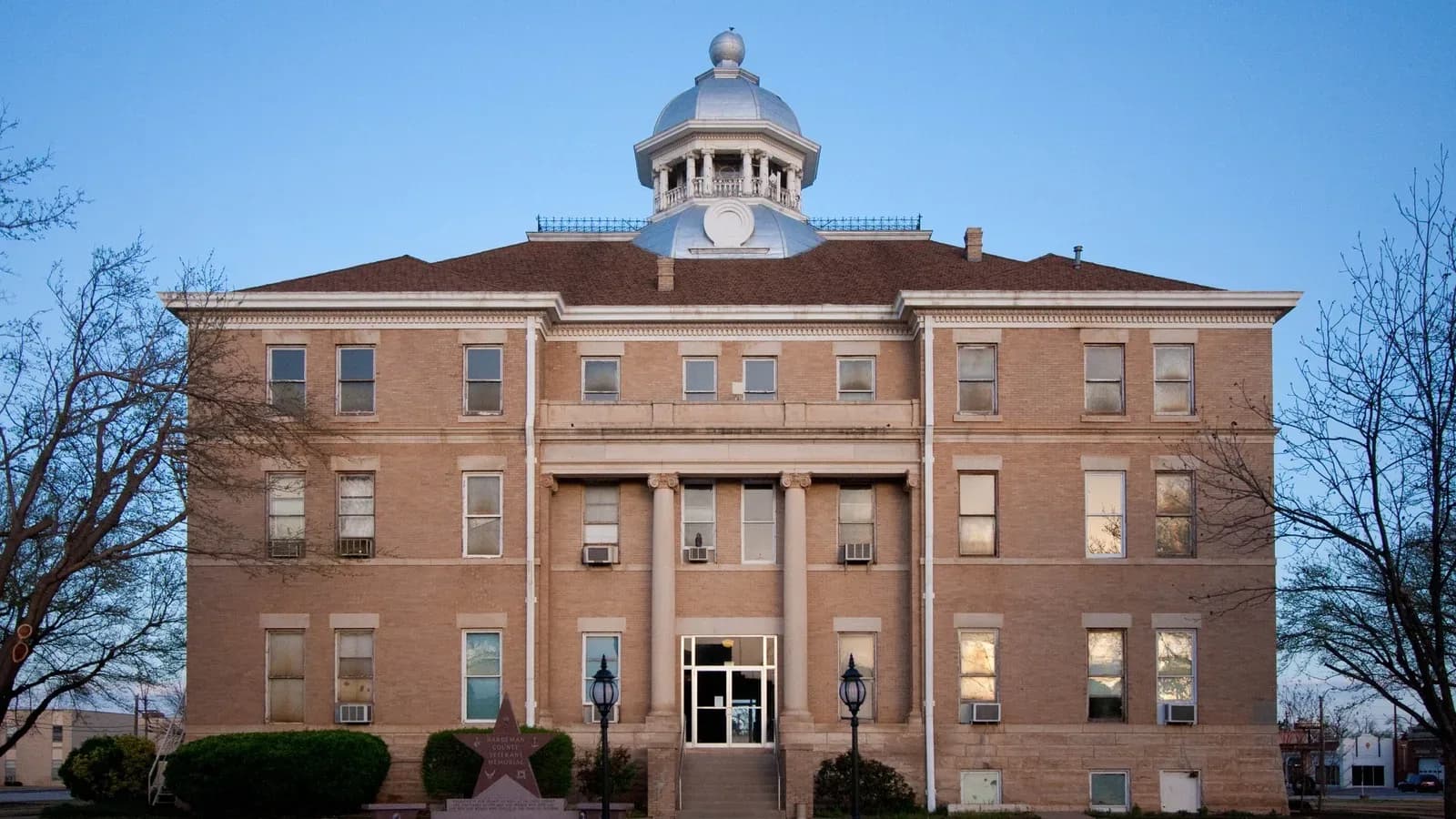
The 1890 courthouse was replaced after voters approved a 1906 bond issue, the 2001 marker says. County commissioners hired R. H. Stuckey, an architect from Chillicothe, and the Denton firm Tom Lovell & Sons as builder. His design, the marker says, put a dome and cupola on the roof, stone lintels above the windows, and Ionic columns at the doors, in the Neoclassical style. The marker describes glazed tan brick above a raised Indiana limestone basement, finished in 1908. It has housed county government ever since, the marker says, and it calls the building “an anchor in Quanah's downtown historic district.”
The Handbook notes that oil was found in 1959 at the Conley field, southwest of town, and it describes manufacturers and a shipping trade in cattle and in cotton, wheat, oats, and barley as of 1980. Those 1980 sketches, and a 1980s count of local businesses, are not treated here as a current directory. Hunt's narrative gives 1,477 people for 1890, then 3,127 two decades later, 4,464 in 1930, a high of 4,589 in 1950, 3,890 in 1980, and 3,022 in 2000, figures that match the Handbook's census table for those years. A 1991 narrative figure of 3,721 does not match the table's 3,413 for 1990; this report uses the table for census years: 1,477 in 1890, 1,651 in 1900, 3,127 in 1910, 3,691 in 1920, 4,464 in 1930, 3,767 in 1940, 4,589 in 1950, 4,564 in 1960, 3,948 in 1970, 3,890 in 1980, 3,413 in 1990, 3,022 in 2000, 2,641 in 2010, 2,279 in 2020, and 2,272 in 2021. The 2021 table figure is not a 2026 census.
Related: Coleman: A County Seat Raised Along the Western Trail.