Hallettsville: A Lavaca County Seat Won After a Long Courthouse Fight
Hallettsville won a contested 1852 fight to become Lavaca County's seat and later raised the sandstone courthouse that still stands on the square.
Hallettsville is Lavaca County's seat, on the Lavaca River, where U.S. 77 meets Alternate 90A, according to Mary Ramsey's entry in the Handbook of Texas, originally published in 1952 and last revised Oct. 19, 2023. The official City of Hallettsville website lists City Hall at 101 N. Main Street, Hallettsville, Texas 77964, phone (361) 798-3681. The city's FAQ page says that office stands on the historic square, with the lobby open 9 a.m.–4 p.m. and phones staffed 8 a.m.–4:30 p.m. on weekdays, holidays excepted. Lavaca County's official contact page lists the courthouse at 109 North LaGrange, Hallettsville, Texas 77964.
Ramsey wrote that John Hallett was among the first settlers, receiving acreage in 1831 from Stephen F. Austin, and that after his death in 1836 his widow, Margaret L. Hallett, gave land for a townsite. A post office opened in 1849. The Handbook says the community was selected as the seat when La Baca was formed as a county in 1842, then that county was abolished. After statehood, the present county was organized in 1846, and Hallettsville and nearby Petersburg both sought the seat. On June 14, 1852, most of the ballots went to Hallettsville, but Petersburg residents challenged the result. The town was formally declared the seat on Aug. 28, 1852, Ramsey wrote, yet charges of fraud and legal fights were not fully settled in the courts until 1860.
A 1972 Texas Historical Commission marker on the courthouse square, at Main and 3rd streets, calls the present building the fifth structure to serve as the county's seat of justice. It says the Republic of Texas created “La Baca” as a judicial county in 1842, that the arrangement was struck down with other judicial counties, and that the First Legislature of the state created the county anew on April 6, 1846, and organized it on July 13, 1846. The earliest courthouse, the marker says, was built of logs; once that log building burned, sessions were held beneath a live oak in old Petersburg. This is the third courthouse on the present square since the seat moved to Hallettsville in 1852.
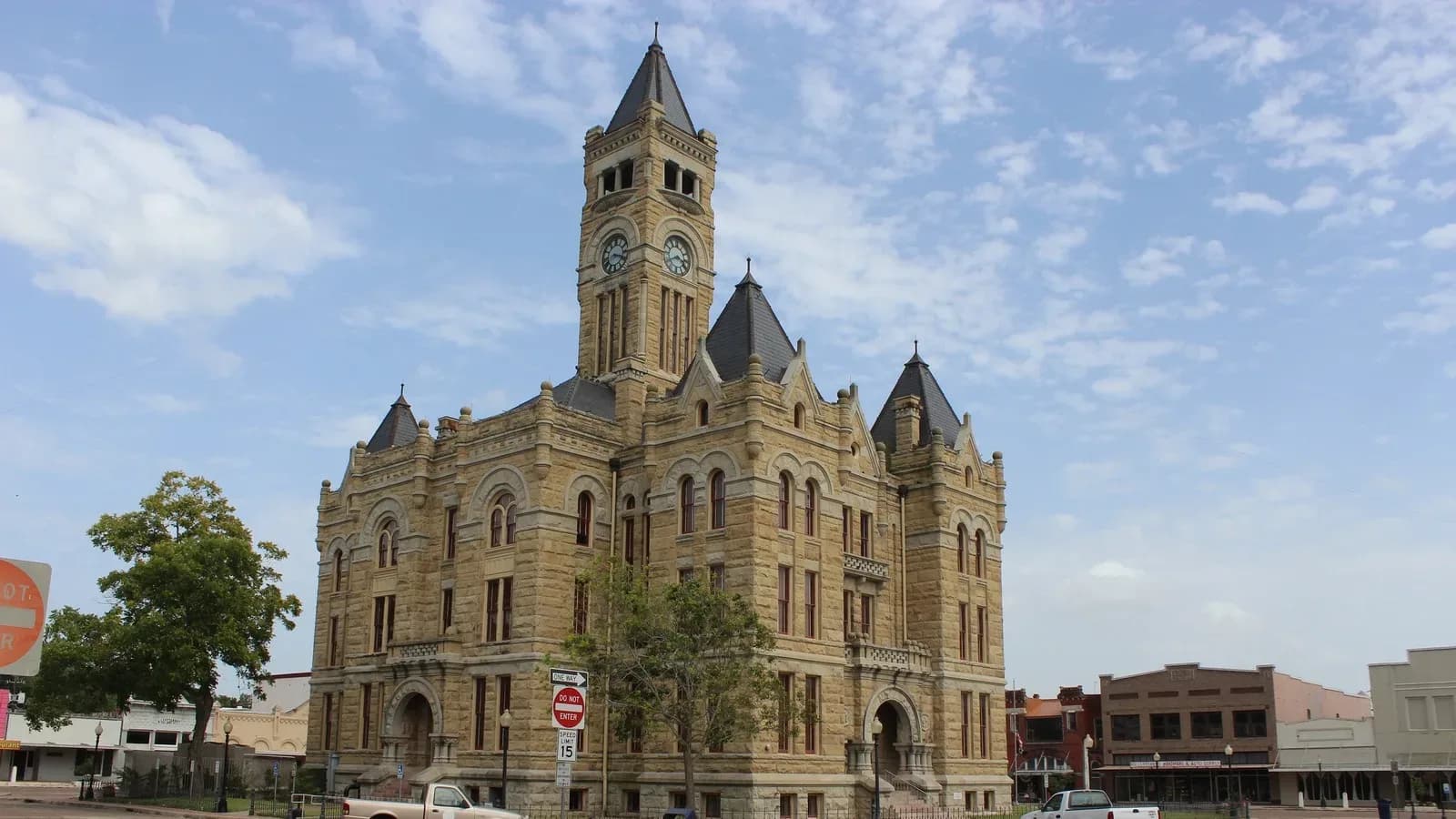
The Handbook dates the first courthouse in Hallettsville to 1853, says it fell short of the county's needs and gave way to a new building in 1875, and dates the courthouse now standing to 1897, listing it on the National Register of Historic Places. The 1972 marker says contractors A. T. Lucas and C. H. and J. Stadtler erected the present building in 1897-1899, and that the county dedicated it on July 4, 1899, with Judge P. H. Green giving the main address, in a ceremony led by the Hallettsville Schuetzen Verein, the Silver Cornet Band, the fire department, the Sons of Hermann, and other orders. The official Texas Historical Commission courthouse record lists the construction year as 1899, names Eugene T. Heiner as architect and A. T. Lucas as contractor, and describes a Romanesque Revival building of yellow and gray limestone with a tall central clock tower, a portico between square towers, and pyramidal slate roofs. The 1972 marker calls the style Richardsonian and the stone Mineral Wells brown sandstone with Mills County grey stone at the base and trim. This report leaves those descriptions with their sources. The courthouse record also lists National Register status in 1971, a Recorded Texas Historic Landmark designation, a State Antiquities Landmark in 1981, and a preservation easement executed Jan. 12, 2001, in perpetuity.
Hallettsville voted to incorporate on Aug. 13, 1870, surrendered its charter in 1875, and incorporated again on June 29, 1888, the Handbook says. Many late-nineteenth-century settlers came from Czechoslovakia and Germany. The San Antonio and Aransas Pass line came through in 1887, and by 1892 the city had an electric plant and a waterworks fed by artesian wells. Ramsey wrote that the first Lavaca County newspaper, the Lone Star, began in 1860 and folded when the Civil War started; the Herald appeared in 1871; Czech and German weeklies began in the 1890s; and by 1913 the town, then figured at about 1,300 people, was home to thirteen papers whose combined circulation reached 25,000, including the Rebel, the Socialist party's state paper from 1911 to 1917. Those press figures, and the Handbook's notes on late-1980s employers, are historical, not a current business listing.
The Handbook's narrative estimates about 600 people in 1875 and 1,700 in 1890. This report uses the Handbook's census table for census years: 1,011 in 1890, 1,457 in 1900, 1,379 in 1910, 1,444 in 1920, 1,406 in 1930, 1,581 in 1940, 2,000 in 1950, 2,808 in 1960, 2,712 in 1970, 2,865 in 1980, 2,718 in 1990, 2,345 in 2000, 2,550 in 2010, 2,731 in 2020, and 2,742 in 2021. The 2021 table figure is not a 2026 census. The narrative's 1,700 for 1890 does not match the table, and the table is used for that year.
Related: Hondo: A Railroad Town That Became Medina County's Seat.