The Meteors Burned Up. Their Dust Is Still Messing With Our Signals.
Meteors vanish in seconds, but some of the metals they leave behind can gather into invisible layers high above Earth. New NASA research shows those layers are more turbulent than scientists thought — and capable of bending the signals we use every day.
Meteors vanish in seconds, but some of the metals they leave behind can gather into invisible layers high above Earth. New NASA research shows those layers are more turbulent than scientists thought — and capable of bending the signals we use every day.
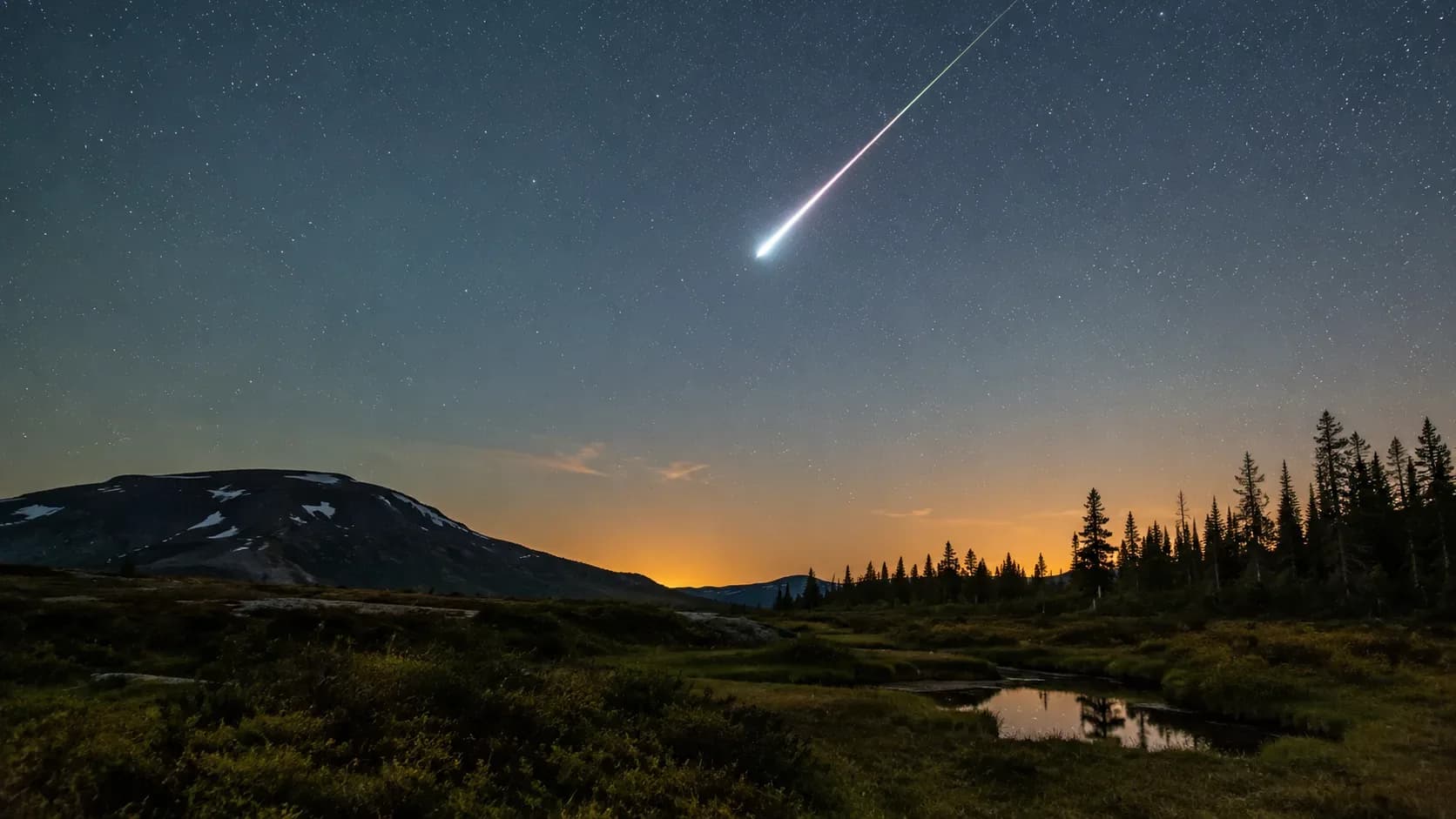
A meteor cuts across the night sky and, for a few seconds, everybody looking up gets the same little show. Then the streak disappears and we move on. Make a wish. Finish the coffee. Go back inside.
Except the meteor is not necessarily finished with us. When meteors burn up high in Earth's atmosphere, they can leave behind traces of iron, magnesium and other metals. Under the right conditions, some of that material gathers into thin, dense layers in the ionosphere roughly 60 miles above the ground. Scientists call them sporadic E layers. We cannot see them from the backyard, but radio waves certainly can.
An Invisible Layer With a Very Real Effect

NASA describes sporadic E layers as something like giant mirrors for radio-frequency waves. A signal that was supposed to keep traveling can hit one of these layers and bounce back toward Earth instead. That can produce some strange results. Air traffic controllers and marine radio users may hear distant transmissions as though they came from much closer. Radars looking beyond the horizon can pick up false returns — what NASA calls "ghosts." And the ionosphere is already one of the biggest sources of error in the GPS signal reaching your phone. Sporadic E can add to that uncertainty.

That does not mean a meteor streaks overhead and suddenly your map sends you into a lake. The effect is subtler than that. The meteor leaves metallic material behind; atmospheric winds and charged particles help shape that material into an ionized layer; then that layer can change the path of radio waves passing through it.
There is an entire invisible region between ordinary weather and outer space where remnants of meteors, electric fields, winds and plasma are quietly deciding how cleanly some of our signals travel.
Why NASA Had to Fire a Rocket Through It
If scientists wanted a better look, they ran into an awkward problem: sporadic E lives in a part of the sky that is hard to reach. Around 60 miles up, it is too high for weather balloons and too low for satellites to orbit through. That makes sounding rockets unusually useful — they can shoot through the region, take measurements for a few minutes and fall back toward Earth.
NASA's SpEED Demon mission — short for Sporadic-E ElectroDynamics Demonstration — launched from Wallops Flight Facility in Virginia in August 2022. The flight was a technology demonstration, but it hit exactly what researchers hoped to find: a sporadic E layer.
The important part of the story arrived this summer. A peer-reviewed study published in August 2026, followed by a NASA report on September 2, laid out what the mission's unusual measurement system actually revealed.
Five Measurements Instead of One

Traditionally, a sounding rocket gives scientists a narrow slice through the atmosphere — like trying to understand an entire room by looking through one crack in the wall. SpEED Demon changed that. The rocket released four small probes, called dropsondes, away from the main payload. The four probes and the main rocket measured the same sporadic E layer at five places at nearly the same time.
NASA principal investigator Aroh Barjatya compared the improvement to turning that single crack in the wall into a picket fence. For the first time, researchers could see how the structure changed across multiple nearby points instead of assuming the one path they measured represented the whole layer. And it did not look as tidy as expected.
The 'Flat Layer' Turned Out to Be Messy
Scientists often picture sporadic E as a relatively sharp, flat sheet of metallic ions. The new measurements showed something much more uneven and structured. The layer appeared to be interacting with turbulent winds in the surrounding atmosphere. Study lead Henry Valentine said the structure looked less like a flat pancake and more like a cinnamon roll. On the rocket's descent, the layer even separated into two peaks.
The researchers found that the shape was consistent with a type of rolling atmospheric instability called Kelvin-Helmholtz billows — the same broad wave-like pattern that can appear in ordinary clouds when layers of air move past one another at different speeds. They are careful not to say that explanation is proven, because the flight did not directly measure every wind and electric-field condition needed to confirm it.
That caution matters. The discovery is not that NASA solved every mystery in the ionosphere. It is that scientists finally saw enough of one of these layers at the same time to realize the old picture was too simple.
What This Means for the Phone in Your Hand
Probably not much on any ordinary Tuesday — and that is actually the point. Most of the time we use GPS, radios, aircraft navigation and other signal-dependent technology without thinking about the space between us and the transmitter. But those signals do not travel through nothing. They cross a living atmosphere that changes with sunlight, seasons, solar activity and winds. Meteor material becomes part of that environment too.
Scientists have known about sporadic E for decades, but better measurements can help explain when these layers form, how they move and why signals sometimes behave differently than expected. The technology from SpEED Demon has already been reused. NASA says similar multi-probe techniques were flown during the 2023 annular eclipse and the 2024 total solar eclipse, and a direct successor called SEED flew from Kwajalein Atoll in 2025 to study sporadic E at lower latitudes.
So the next time a meteor flashes overhead and disappears, it is worth remembering that "gone" is a relative term. The bright part may last only seconds. Some of what it leaves behind can become part of an invisible layer tens of miles above us — a layer capable of bouncing a radio signal back toward Earth and reminding us that space is not nearly as far away from everyday life as it looks.
Reader Links
Want to see the science behind the story? These links go directly to the original reporting and research: