'Only Luke Is With Me': The Beloved Physician Who Wrote So We Could Know the Certainty
On the feast of St. Luke, a look at the physician who wrote a Gospel and Acts, stayed with Paul to the end and recorded the parable of the prodigal son.
Oct. 18 is the traditional feast day of St. Luke, the man Christians have long credited with writing the Gospel of Luke and the Acts of the Apostles. He was not one of the Twelve. He was not an eyewitness to the ministry of Jesus. By most accounts he was a doctor who became a missionary, a traveling companion and a careful historian.
His day falls on a Sunday this year, a good day to remember him.
The beloved physician
Almost everything we know about Luke comes from a handful of verses. The Apostle Paul calls him "Luke, the beloved physician" (Colossians 4:14) and lists him among his "fellowlabourers" (Philemon 24).
Tradition credits him with the Gospel of Luke and the Acts of the Apostles, which together tell the story from the birth of John the Baptist to Paul preaching in Rome. Sources from the late second century, including Irenaeus and the Muratorian Canon, identify Luke as the author of both, Encyclopaedia Britannica notes. Britannica calls him "the most literary of the New Testament writers."
Luke tells us plainly how he worked. He opens his Gospel by explaining that many had written accounts and that he had "perfect understanding of all things from the very first," so he wrote "in order" so that his reader "mightest know the certainty of those things" (Luke 1:3-4).
That is a historian's promise. Luke did not ask for blind faith. He gathered the testimony of "eyewitnesses, and ministers of the word" and set it down so people could know it was true.
The man who stayed
In Acts, the narrative suddenly shifts from "they" to "we" at Acts 16:10, as Paul sets out for Macedonia. Britannica explains that these "we" sections place the author with Paul on parts of his missionary journeys, including the voyage to Rome as a prisoner.
The most moving line about Luke comes near the end of Paul's life. Writing from prison, after others had departed, Paul told Timothy: "Only Luke is with me" (2 Timothy 4:11). Britannica places this at the time of Paul's martyrdom in Rome, around A.D. 66.
Whatever comfort a physician's life offered, Luke traded it to follow a hunted preacher across the Mediterranean, through shipwreck and on to a Roman prison, and he stayed when others left.
A Gospel for outsiders
Britannica says Luke's Gospel was written for Gentile converts, and it is full of people the respectable world looked past. Luke gives us the shepherds at the manger (Luke 2), the Good Samaritan (Luke 10), the lost sheep, the lost coin and the prodigal son (Luke 15), Zacchaeus up in his tree (Luke 19) and the thief on the cross who heard, "To day shalt thou be with me in paradise."
The heart of it is a single verse: "For the Son of man is come to seek and to save that which was lost" (Luke 19:10).
Luke also preserved the great songs of Christmas, including Mary's Magnificat, "My soul doth magnify the Lord." Without Luke, the church would have no account of the angels' announcement to the shepherds, "Glory to God in the highest, and on earth peace, good will toward men" (Luke 2:14).
What Luke still teaches
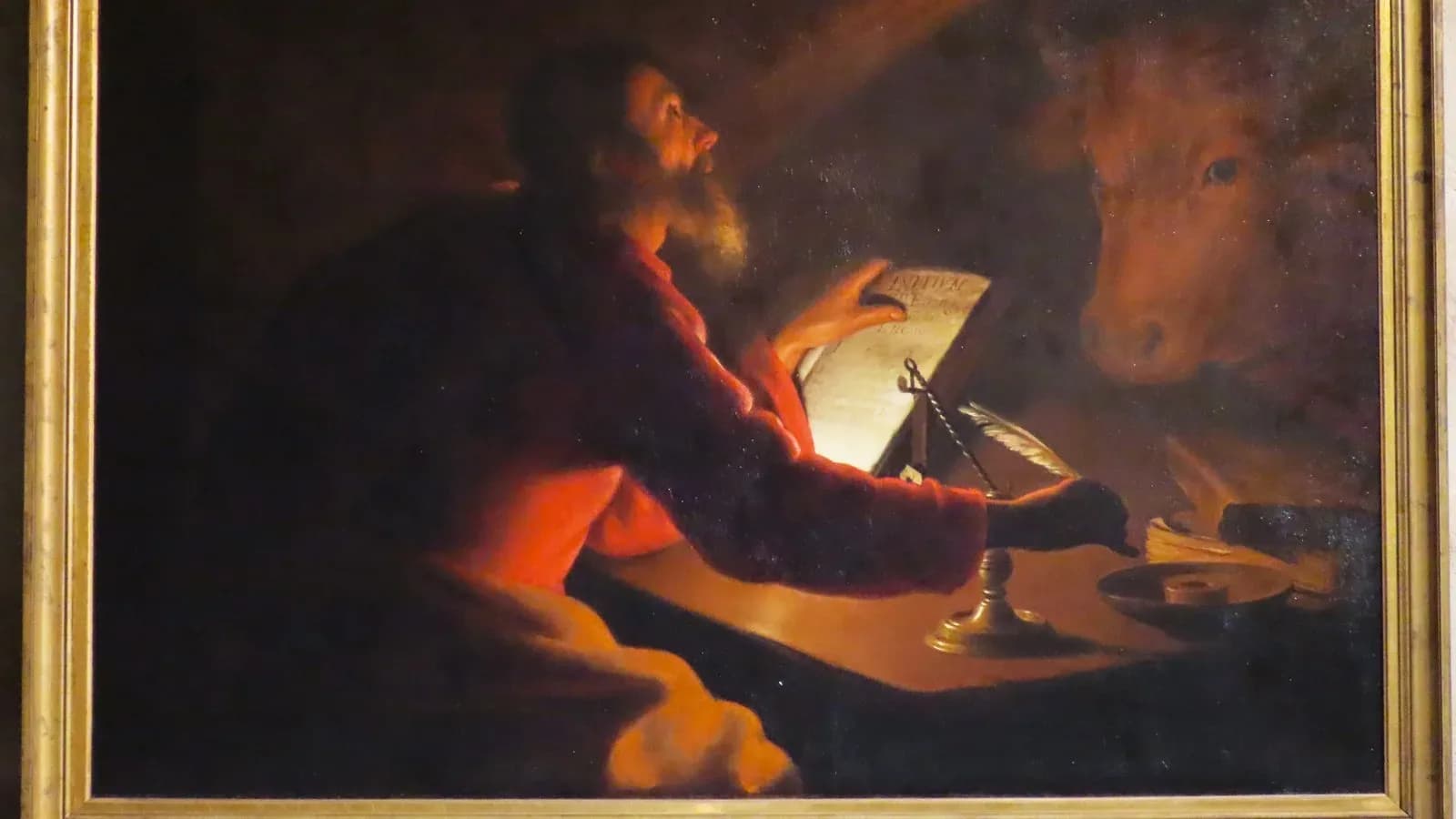
Britannica records the ancient tradition that Luke died at 84 in Thebes, Greece, and that his remains were later moved to Constantinople and then to Padua, Italy, where they are kept in the Basilica of Santa Giustina. He is a patron saint of physicians and artists, and his symbol is an ox.
His life speaks to Christians in three plain ways.
First, faith and facts are friends. Luke investigated, checked and wrote "in order." American believers have long understood that, as Noah Webster did when he called the Bible the source of all that is good. Christianity has never been afraid of the truth.
Second, ordinary work can serve God's kingdom. Luke was a physician and a writer. He used his skills for something larger than himself. Nurses, doctors, writers and teachers can do the same.
Third, faithfulness often looks like staying. Luke is remembered not for preaching to crowds but for being there when Paul was alone. Every church needs people like that.
On this Sunday, open the Gospel of Luke. Read the first four verses and remember that the man who wrote them wanted you to know the certainty of what you believe. Then read Luke 15 and remember why he wrote it.
Related on Dock Line: Noah Webster Gave America Its Dictionary. He Called the Bible the Source of All That Is Good.; Burgoyne Surrendered at Saratoga 249 Years Ago Today. Congress Answered With Prayer and Confession.