Praha's Painted Church Has Drawn the Faithful for Generations
St. Mary's Church of the Assumption in tiny Praha is perhaps the best-known of Texas's painted churches. Here is the story of the Bohemian parish and the Swiss painter behind it.
On a farm road three miles east of Flatonia, in a Fayette County community of a few dozen people, stands a church worth the drive. St. Mary's Church of the Assumption in Praha is, in the words of the Handbook of Texas, "perhaps the most well-known of Texas's so-called 'painted churches.'"
A Bohemian parish
The settlement was first known as Mulberry, and also as Hottentot, a name the Handbook says apparently referred to a band of outlaws. In the mid-1850s a Bohemian immigrant named Mathias Novak came to the area. He worked for American settlers until he had saved enough to buy 100 acres and build a house, and early Masses were celebrated there. Other Bohemian families followed, and in 1858 the settlers renamed the town Praha, after Prague, the capital of their homeland.
In 1865 a Bernardine priest, Father Joseph Bithowski, built a small frame church, and the first Mass in it was offered at midnight on Christmas Day. By the 1880s Praha had a newer frame church that served as the mother parish for the surrounding towns. A Czech Catholic school opened in 1896.
The railroad passed a mile north of town in 1873, and Flatonia grew up beside the tracks and drew business away. Praha's population never rose above 100 in the 20th century and stood at 25 in 2000. Both of its schools closed in 1973. The parish carried on.
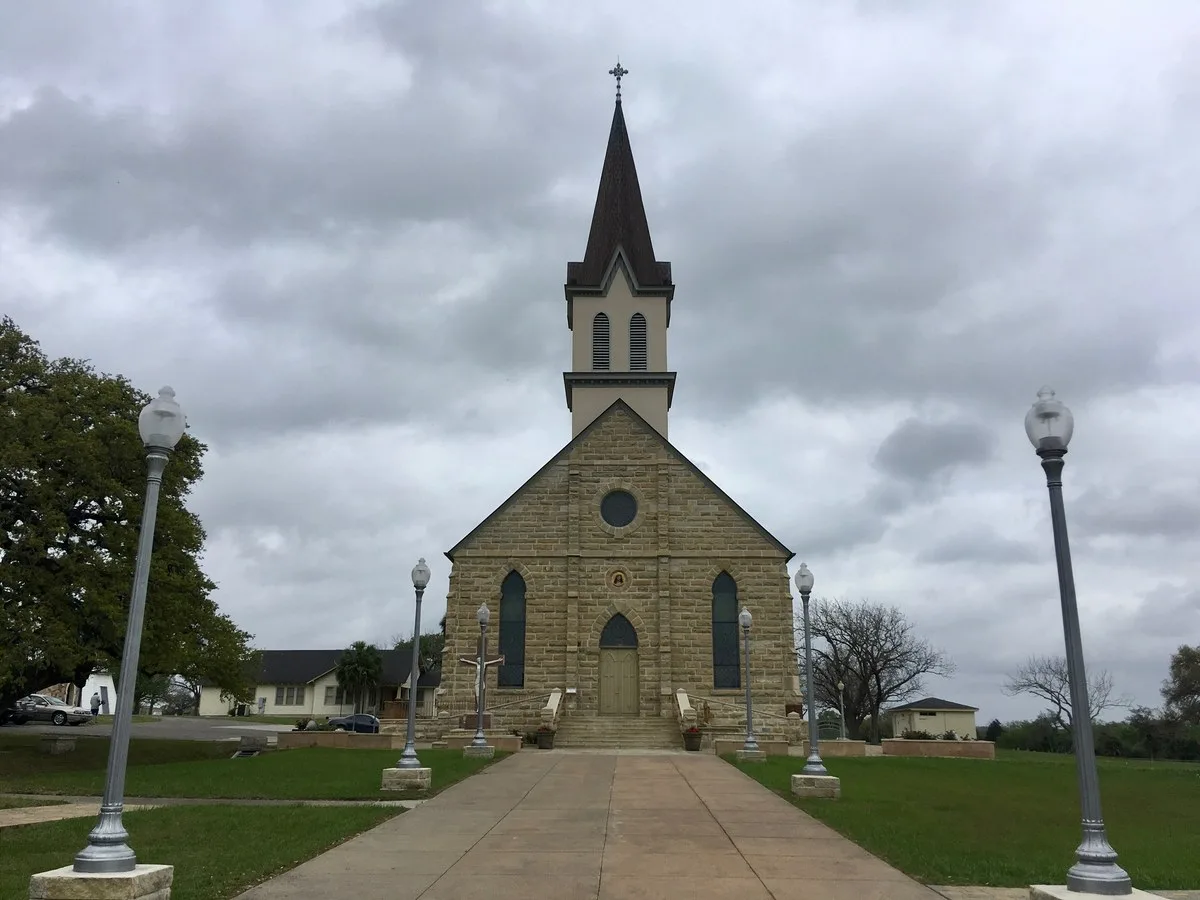
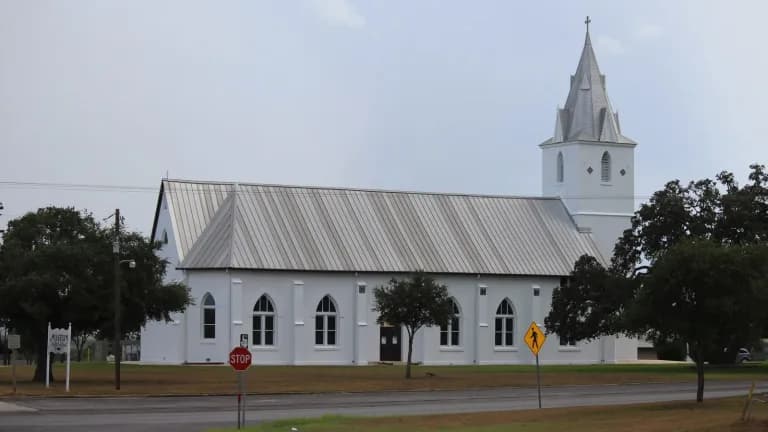
The south facade and spire of St. Mary's in Praha, 2018. Photo: Kyle G. Sweeney / Wikimedia Commons, CC BY 4.0.
The painter from Switzerland
The interior was painted by Godfrey Flury, a Swiss-born decorative painter. The Handbook's entry on Flury says he was educated by priests in Solothurn. He came to the United States at 16, then worked his way from New York to Kansas City and San Antonio before settling in Moulton in 1892, where he painted homes and churches.
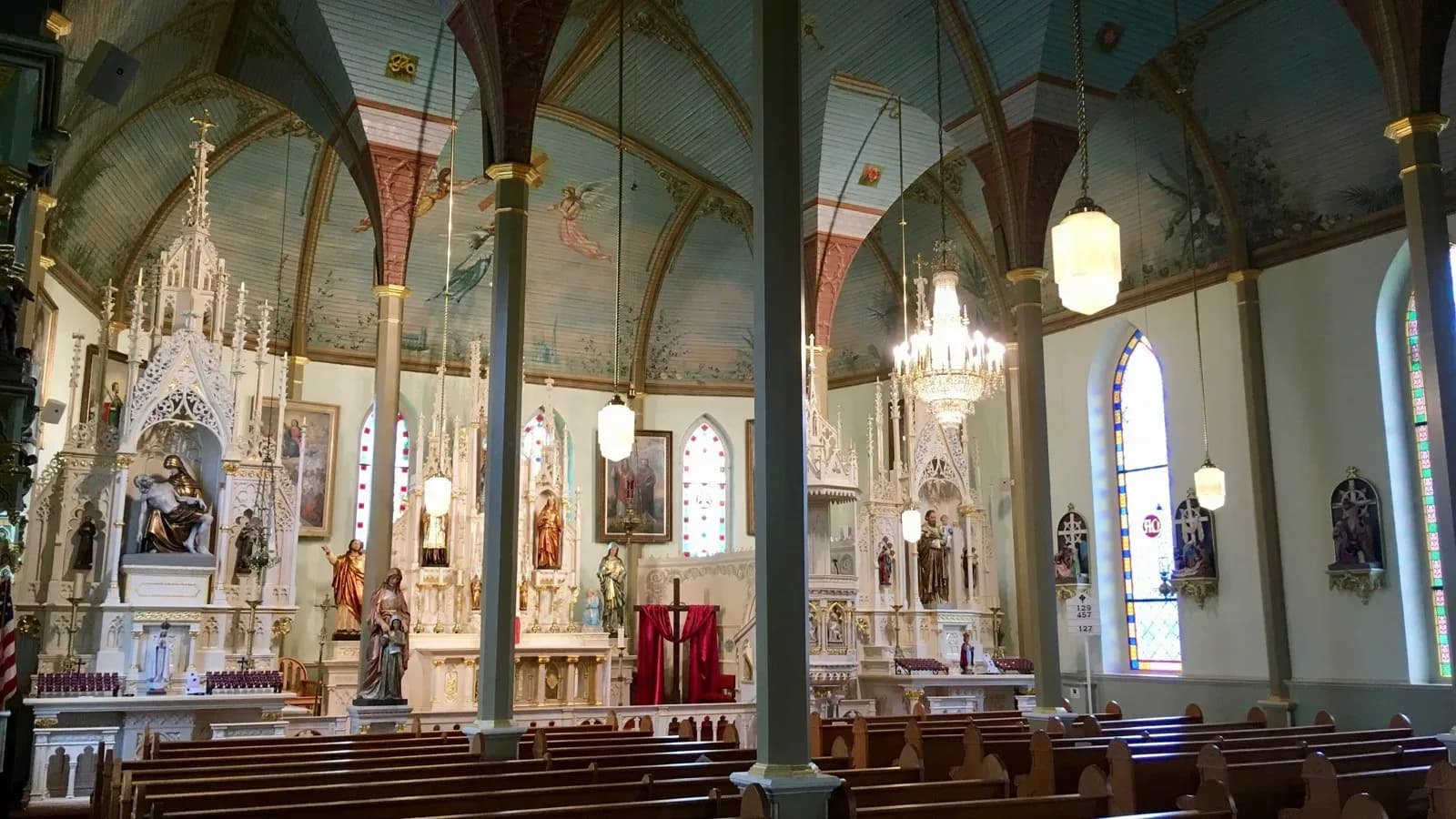
In 1895 he was hired to paint the inside of St. Mary's, a job the Handbook calls "the most important of his career." He painted the wooden ceiling sky-blue and added trompe l'oeil ribs that imitate medieval stone vaulting. He gave the wooden columns painted Gothic capitals. The ceiling panels carry vines, flowers, gold scrolls and symbols such as a chalice, a star and an eye within a radiant triangle. Above the altar he painted the main cathedral in Prague and a convent nearby, and at the highest point three angels around a jeweled cross.
Flury married his second wife, Agnes Valchar, in the Praha church on April 16, 1895. He later moved to San Antonio and then Austin, where he ran a sign-painting business, and he died in 1936. His authorship of the Praha interior was confirmed in 1972, when his preliminary sketches and notes were matched to the church.
Still a place of worship
St. Mary's was added to the National Register of Historic Places in 1983. But it is a parish church, not a museum. The Handbook says the community has celebrated the Feast of the Assumption every Aug. 15 since 1855. Mass is said in the historic church, Czech food is served and Texas Czech bands play, and the event now draws more than 5,000 visitors. Praha also holds a yearly Veterans Day commemoration. With Nov. 11 a little more than two weeks away, that is worth remembering.
Those who visit should go as guests in a house of prayer and keep their voices low. The painted angels and the blue ceiling were made to lift a congregation's eyes to heaven. For more than 170 years, the families of Praha have come to this ground to worship. Their faith built the church, and their faith keeps it.
Related on Dock Line: The Day After Yorktown, Washington Pardoned His Prisoners and Sent the Army to Church; Churches Will Pray for the Persecuted on Nov. 1 and 8. Thirty Years On, Remember Them as Bound With Them.