Before the Cider
The summer work behind Michigan’s apples, doughnuts, and favorite fall traditions.
Most people begin thinking about a Michigan apple orchard when the air turns cool.
That is when the roadside signs appear.
Fresh cider.
Hot doughnuts.
Pick-your-own apples.
Hayrides this weekend.
Families pull into the parking lot wearing sweatshirts, carrying coffee, and announcing that this year they are definitely going to pick only one bag of apples.
An hour later, they are walking back to the car with three bags, a gallon of cider, two dozen doughnuts, a decorative pumpkin, and a child asking whether an apple tree would grow in the backyard.

While families spend July at the lake, growers are already working toward October.
That is the part everyone remembers.
What most visitors never see is everything that happened before the cider.
While families were spending July at the lake, growers were already working toward October. They were checking trees, watching the weather, thinning fruit, scouting for insects and disease, mowing orchard lanes, repairing equipment, preparing farm markets, and making hundreds of small decisions that would shape the harvest months later.
The cider may taste like fall.
The work behind it begins long before anyone reaches for a sweatshirt.
Fall Begins in Winter
An apple orchard does not shut down when the last customer leaves in October.
Long before the trees bloom, growers prune them during the dormant season. Pruning helps shape the tree, opens the canopy to light and air, removes damaged wood, and influences how much fruit the tree may try to carry.
It is careful work. Cut too little, and the tree can become crowded. Cut too much, and the grower may reduce the crop. Every branch is part of a decision that will not be fully judged until months later.
To a visitor, a winter orchard may look quiet.
To a grower, it is already making plans.

Visitors see the finished experience. The farm family sees everything that came before it.
Then Everyone Watches the Weather
Spring bloom is beautiful, but beauty is not the only thing happening.
The flowers must survive cold temperatures. Pollinators must arrive. Wind and rain can affect their work. A warm spell can push development forward, and a later freeze can threaten blossoms that opened too soon.
During bloom, growers may spend nearly as much time studying weather forecasts as television meteorologists do.
The difference is that a meteorologist can be wrong and still return to work the next day.
An orchard may have to live with the answer until next year.
That is one reason the smiling orchard owner greeting visitors in October deserves more credit than most people realize. The season may have included frost warnings, heavy rain, dry stretches, wind, hail, heat, or all five before anyone bought the first doughnut.

An apple selected from a tree feels different from one lifted from a supermarket display.
Sometimes a Good Crop Has Too Many Apples
One of the strangest things about growing apples is that more fruit is not always better.
A tree can set more apples than it can properly size and mature. If too many remain, the fruit may stay small, branches may be stressed, and the tree can have less energy for the following season.
So growers thin the crop.
Some thinning is done with carefully timed treatments when fruit is very small. Some may be done by hand. Either way, the goal is to leave the tree carrying the right number of apples in the right places.
To anyone who has ever paid grocery-store prices for apples, deliberately removing perfectly good little apples may seem emotionally difficult.
The tree, however, is not running a clearance sale.
Thinning helps the remaining fruit receive the sunlight, nutrients, and growing room needed to become the apples customers want to pick later.
Michigan State University Extension calls crop-load management one of the most important decisions in the orchard because mistakes can affect both the current crop and the next one.
A visitor sees a red apple hanging from a branch.
A grower sees months of calculations.
July Is Not the Quiet Part
By July, the trees are green and the fruit is beginning to look more like apples, but the season is far from automatic.
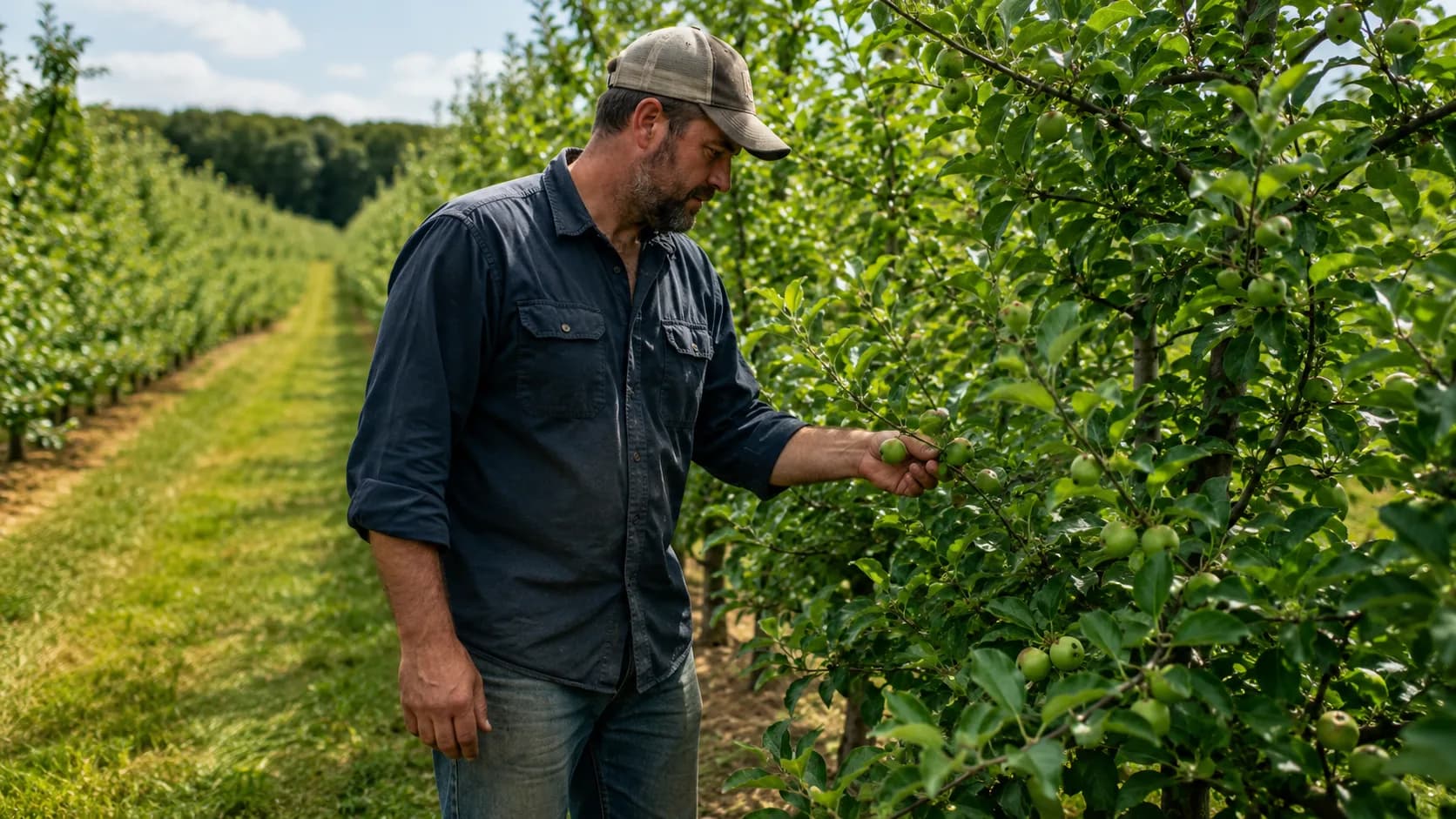
Growers scout leaves, branches, and fruit for insects, diseases, and damage. They monitor weather conditions that can encourage problems. They mow, manage weeds, inspect irrigation, maintain trellises, check equipment, and continue evaluating how the crop is developing.
Michigan State University Extension maintains season-long pest-management and scouting resources because healthy, marketable fruit requires attention throughout the growing season, not one heroic effort at harvest.
The orchard may look peaceful from the road.
That is because the work is being done quietly.
There are no marching bands when someone finds an insect problem early.
Nobody rings a bell because the irrigation system worked correctly during a dry week.
But those small victories are part of every apple that reaches a farm-market shelf.
The Apples Are Not All Keeping the Same Calendar
Apple season is not one single harvest day.
Different varieties mature at different times. Some early apples can be ready in midsummer, while many of the familiar pick-your-own varieties arrive from late summer through October.
That means growers are not simply waiting for everything to turn red at once.
They are tracking maturity, color, firmness, flavor, weather, labor, storage space, and market demand across multiple blocks and varieties.
One row may be nearly ready while another still has weeks to go.
An apple does not become ready because the calendar says Saturday would be convenient.
This is occasionally disappointing to visitors who have driven forty minutes for a specific variety and believe enthusiasm should count as a horticultural condition.
The orchard staff must then explain that the Honeycrisp is close, but not quite ready.
The customer may stare at the tree as though considering an appeal.
The apple remains unmoved.
Preparing the Orchard People Come to Visit
For orchards that welcome the public, growing the apples is only part of the job.
The farm market must be cleaned and stocked. Signs need to be repaired. Parking areas need attention. Picking bags, bins, ladders, wagons, picnic tables, restrooms, handwashing stations, point-of-sale systems, and employee schedules all have to be ready.
Cider equipment must be cleaned and maintained. Food areas need preparation. Doughnut recipes may be familiar, but the fryer does not prepare itself out of respect for tradition.
Some farms add hayrides, corn mazes, play areas, bakery counters, gift shops, or weekend events. Each attraction creates another list of jobs that must be finished before the first family arrives.
Visitors see the finished experience.
The farm family sees paint that dried yesterday, a tractor repaired Tuesday, a delivery that arrived late, an employee who called in sick, and a weather forecast threatening rain during the busiest Saturday of the month.
Hospitality at an orchard may look relaxed.
That is often because somebody worked very hard to make it look that way.
Pick Your Own Is Simple — Until You Run It
Pick-your-own apples sound beautifully uncomplicated.
Open the gate.
Hand people a bag.
Let them pick apples.
In reality, the orchard must decide which rows are open, which varieties are ready, how customers should move through the property, where vehicles should park, how fruit will be priced, and how staff will answer the same questions hundreds of times without losing the warmth that makes the visit enjoyable.
There are also visitors who pull on apples until small branches come with them, climb where they should not, sample enthusiastically, or discover that a full bag is heavier than it appeared twenty minutes earlier.
Most customers are careful and respectful.
A few seem to believe the admission price includes temporary ownership of the tree.
Even so, pick-your-own remains one of the best ways for families to understand where food comes from. An apple selected from a tree feels different from one lifted from a supermarket display.
It may be warm from the sun.
It may have a small mark on the skin.
It may not look exactly like the apple printed on a cereal box.
But it is fresh, and the person holding it has participated - even briefly - in the harvest.
Why Apples Picked at the Orchard Taste So Good
Part of the answer is freshness.
Part is the variety.
Part is the fact that the apple was picked when it was ready rather than chosen primarily for its ability to survive shipping and storage.
But some of the flavor probably comes from the experience.
You walked the row.
You found the apple.
You twisted it from the branch.
You wiped it on your shirt even though someone had packed napkins specifically to prevent that.
Then you took a bite while standing beneath the tree.
That apple has an unfair competitive advantage over anything waiting in the kitchen fruit bowl.
The memory is already mixed into the flavor.
The Doughnut Is the Reward for Everyone
Michigan orchard traditions would not be complete without cider and doughnuts.
The cider represents the crop. The doughnut represents the wisdom of not trying to make every part of the visit educational.
After walking the orchard, carrying apples, and explaining to children why they cannot take every pumpkin home, families gather around paper bags that become translucent with evidence.
The first doughnut is eaten because it is part of the tradition.
The second is eaten to confirm the first one was as good as remembered.
The rest are supposedly for later.
A cider doughnut may disappear in thirty seconds.
Preparing the orchard that sold it took most of the year.
Michigan Grows More Than a Fall Attraction
Apples are Michigan's largest fruit crop, and the state regularly produces hundreds of millions of pounds in a season. The industry includes family farms, commercial orchards, packing operations, storage facilities, processors, cider mills, farm markets, seasonal employees, truck drivers, retailers, and many other businesses.
The public orchard is the most visible part, but it is only one part.
Some apples are sold fresh. Others become cider, sauce, slices, baked goods, or processed products. Some are stored so customers can buy Michigan apples long after pick-your-own season ends.
Behind a simple bag of apples is an agricultural system that depends on weather, science, labor, equipment, transportation, and judgment.
It also depends on people being willing to do the work before anyone is paying attention.
The Season the Customer Never Sees
When visitors arrive in September or October, the orchard is ready to perform.
The apples have color.
The market smells like cinnamon.
The cider is cold.
The doughnuts are warm.
The tractor is pulling a wagon filled with people who are enjoying agriculture without realizing how recently that tractor may have been involved in something far less picturesque.
It is easy to believe the farm simply woke up looking like fall.
It did not.
The experience was built through winter pruning, spring bloom, summer scouting, crop thinning, equipment repairs, weather worries, staffing decisions, and ordinary days when nobody was visiting.
That hidden season may be the most important part of the story.
The Bottom Line
A Michigan orchard in fall feels effortless because the hard work is mostly invisible.
Families arrive, pick apples, drink cider, eat doughnuts, take photographs, and leave carrying more than they intended.
That is exactly how the day should feel.
But the next time you twist an apple from a branch, it is worth remembering what came before it.
Someone pruned the tree when it was cold.
Someone watched the blossoms during a frost warning.
Someone removed fruit so the remaining apples could grow.
Someone scouted the leaves, repaired the equipment, mowed the lane, prepared the market, cleaned the press, trained the staff, and opened the gate.
Fall at a Michigan orchard does not begin when the first customer smells cider.
It begins months earlier, when the trees are still green, the apples are still small, and nearly everyone else is thinking about summer.
The cider is simply when the rest of us finally notice.
Dock Line Tip — Visit a Michigan orchard earlier in the season if you can — talk with the growers, ask what varieties are coming on, and remember that the cider and doughnuts rest on months of quiet work.