Fort Bend's Extension Office Picks Collards for October. Here Is How to Grow and Cook Them.
Collards shrug off cold, taste sweeter after a frost and can produce all winter near the coast. Here is AgriLife's care and harvest advice and a simple skillet method.
If there is one green that belongs in a Fort Bend County garden this fall, the county extension office has picked it: collards.
The October newsletter from the Texas A&M AgriLife Extension office in Fort Bend County names collards its "Harvest of the Month." The office is at 1402 Band Road in Rosenberg. The newsletter calls collards "one of the most nutritious vegetables," low in calories and high in protein, vitamins and minerals.
A green that takes the weather
Collards belong to the cabbage family, but they don't form heads. They are grown for their leaves. According to AgriLife's Easy Gardening: Collard Greens guide, they handle more heat and cold than most vegetables grown in Texas. They can survive temperatures of 20 degrees or lower in some cases and taste sweeter after a light frost.
That matters on the coast. The guide says that in mild regions, including South Texas and coastal areas, collards will produce all winter.
Both the newsletter and the guide list the same varieties for Texas: Blue Max, Champion, Flash, Georgia LS, Georgia Southern, Top Bunch and Vates.
Timing and care
For a fall crop, the guide says to sow seed about 80 days before frost. In most of Texas, that means August or September. If your collards are already up, here is how the guide says to keep them going:
Thin them. When seedlings reach 4 to 6 inches or start crowding, thin them gradually to about 18 inches apart. Crowded plants grow smaller, paler leaves. The thinnings can be moved to another spot or eaten as greens.
Feed them. Side-dress with about 1 tablespoon of garden fertilizer per plant, or 1 cup per 30 feet of row. Mix it lightly into the soil and water. Repeat in 4 to 6 weeks if leaves turn pale and insects aren't to blame. Collards need plenty of nitrogen to stay dark green.
Water them. Give them a good soaking each week it doesn't rain.
Weed carefully. Pull or hoe weeds gently to spare the roots.
Watch for pests. The guide names aphids, cabbage loopers and harlequin bugs. It lists Bt-based products and sulfur among the organic options. Read and follow the label.
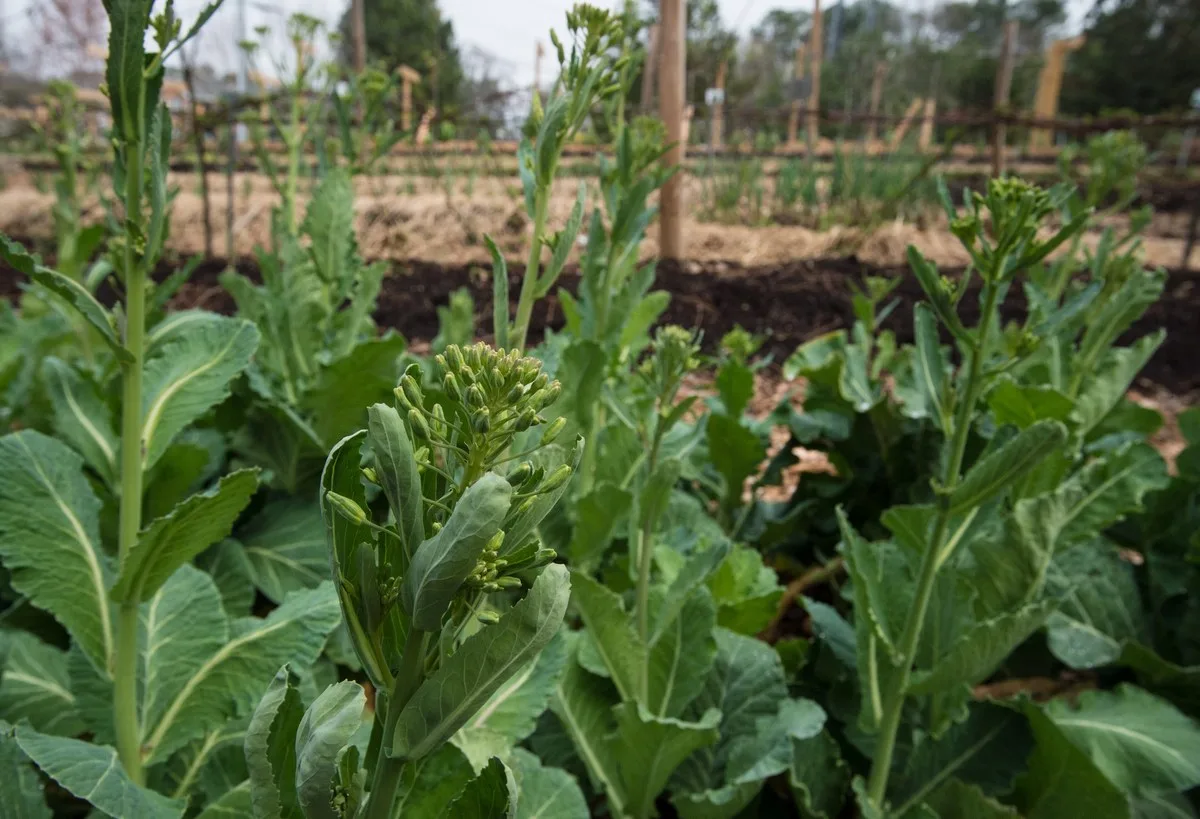
Collards growing in a terraced garden row. Illustrative; photographed in Georgia by the USDA. Photo: USDA / Wikimedia Commons, Public domain.
Harvest from the bottom up
There are two ways to harvest. Small plants pulled while thinning can be cut about 4 inches above the ground, and some will sprout back from the side of the stem. On grown plants, take only the lower leaves. That lets the plant keep growing and producing more.
In the kitchen
The newsletter's advice is simple: sauté your greens and add garlic, salt, red pepper flakes and paprika. The AgriLife guide adds a caution that is worth heeding. To keep the nutrients, don't cook collards in too much water.
So skip the big pot. Strip the leaves from the tough center stems, roll them up and slice them into ribbons. Sauté the garlic briefly in a little oil, add the greens with a splash of water or broth, and stir until they wilt and turn tender. Season with salt, red pepper flakes and paprika, and taste as you go. It is a plain dish that has fed Southern families for generations, and a well-kept row of collards will keep it on the table all winter.
More from the extension office
The newsletter lists a Nov. 12 entry deadline for the county Pecan Show and a Pecan Harvest Festival on Nov. 21. Gardeners with questions can reach the Fort Bend County Master Gardeners help desk weekdays from 9 a.m. to noon at 281-341-7068 or [email protected]. The extension office's main line is (281) 342-3034.
Related on Dock Line: Greenville Gardeners Still Have Time to Plant Garlic, Greens and Roots; What to Plant in Your Brazos Valley Fall Garden Right Now