Angleton Has 5,700 Water Lines of Unknown Material. Staff Want $230,880 to Find the Lead
Replacing every unknown line could cost $11.5 million. The city wants computer modeling and meter checks to narrow the list first.
Angleton does not know what about 5,700 of its water service lines are made of. If the city had to assume every one of them might be lead and replace them all, staff put the bill at $11,491,173.
The City Council was scheduled to take up a cheaper way to find out at its regular meeting at 6 p.m. Tuesday, Oct. 27, at City Hall, 120 S. Chenango St. Staff are asking for $230,880 to have an engineering firm use computer modeling, backed by spot inspections of meters, to predict which lines are lead and which are not. This story was written from the agenda and meeting packet before the vote, so the council's decision was not known when it was written.
Why so many lines are unknown
A service line is the pipe that runs from the water main to a home. According to a staff summary by Public Works Director Hector Renteria, Angleton finished the first phase of its lead service line inventory in October 2024, at a cost of $12,500. The city submitted that inventory to the Texas Commission on Environmental Quality and notified the public as required.
But the method left about 5,700 lines listed as unknown. Staff wrote that this would mean replacing anything unidentified, which is how they arrived at the $11.49 million figure. Staff say they looked for outside money to pay for that and found no source they could recommend.
Instead, the city wants to use predictive modeling, which staff say TCEQ has now approved as a way to identify line material. The goal is to shrink the unknown list so that far fewer lines have to be dug up and replaced.
What the $230,880 would buy
The request has two parts. Pape-Dawson Engineers, which helped with the first phase under the name KSA, would charge $140,880 for the next one. Staff also collected quotes from several contractors to do the inspections, and those quotes averaged $90,000. The agenda form lists the request as unbudgeted and drawn from the city's Fund 03.
The modeling needs inspection data from only 700 to 1,000 meters, on both the public and private sides, according to staff. The city is aiming for a little more than 10% of its meters and could go as low as 700, depending on cost.
The firm's proposal, dated July 10, describes a 30-month project. It breaks the fee down this way:
Project management and coordination: $13,100
Audit of existing data and a workshop with city staff: $20,940
Mining old construction plans for install year, location and ownership: $41,150
Predictive modeling and validation: $38,990
Updated inventory and a ranked list of lines to verify in the field: $11,700
Services directed by the city: $15,000
The firm would use machine learning, trained on lines the city has already checked, to give each unknown line a 0 to 100% likelihood of being made of a particular material. The proposal assumes about 600 properties with verified material and about 5,100 predicted ones. After the data audit, the firm and the city would decide whether there is enough good data to finish the model before going further. The proposal said its prices were good for 90 days and could be revised after that.
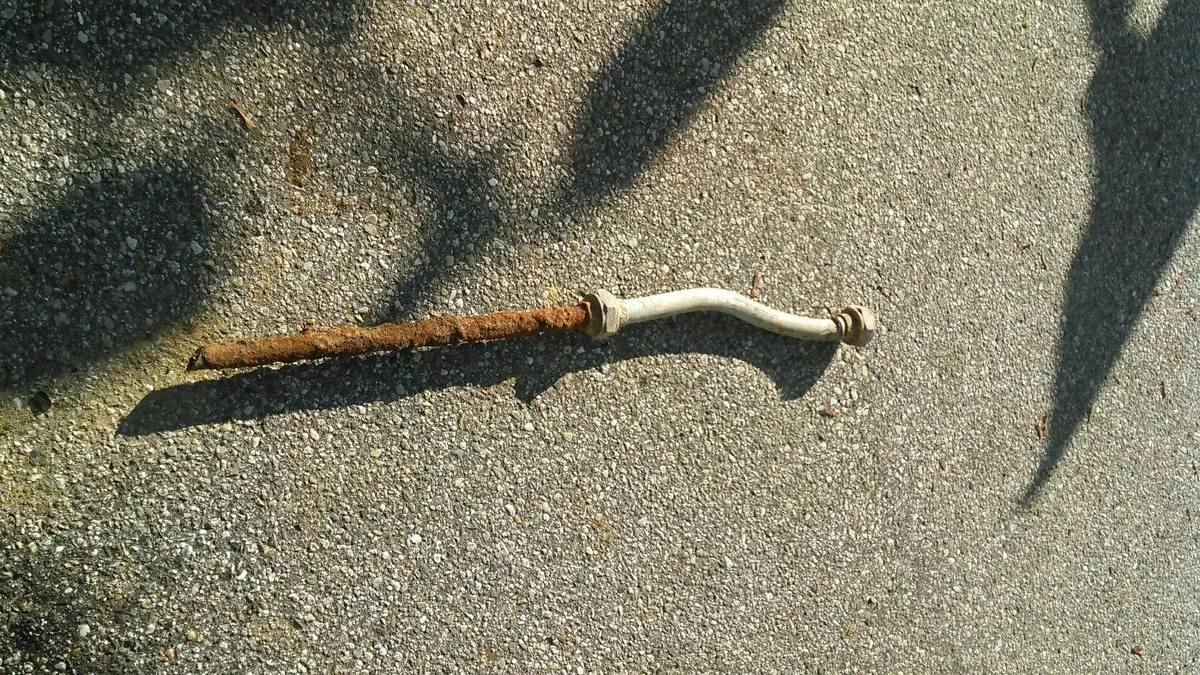
Illustrative: a lead gooseneck pipe in a 2019 EPA photo. This pipe is not from Angleton. Photo: U.S. Environmental Protection Agency, Office of Ground Water and Drinking Water, Public domain.
The deadlines
Staff list three dates under federal rules: July 1, 2027, for verifying that customers have been notified; Nov. 1, 2027, for a plan to change out lines; and the end of 2037 to have all affected service lines replaced. Staff recommend approving the proposal and moving ahead with the inspections.
Why lead matters
The Environmental Protection Agency says in its guide to lead in drinking water that where homes are connected to the main by lead service lines, those pipes are usually the largest source of lead in the water. Lead pipes are more likely in homes built before 1986. The EPA's health goal for lead in drinking water is zero, and it says young children, infants and unborn babies are especially vulnerable.
The agency also says you cannot see, taste or smell lead in water, so testing is the only sure way to know. A test costs $20 to $100. Its advice for worried households includes using a filter certified to remove lead, using only cold water for drinking, cooking and baby formula, and running the tap before drinking when water has been sitting in the pipes. Boiling water does not remove lead.
Elsewhere on the agenda
The council also had on its agenda the 2027 employee health plan, a $590,835.61 financing proposal for a vacuum system, and permission to hire engineering and grant administration firms for a Texas General Land Office mitigation program. Meeting files are on the city's CivicClerk portal.
For more on how Texas cities protect what comes out of the tap, see how Lake Conroe water is made into drinking water and why water systems now worry about cyber threats.
A city owes its families clean water, and it owes its taxpayers a fair price for it. Finding out where the lead is before digging up every street serves both.