Clocks Fall Back Sunday, Right in the Middle of Texas Deer Crash Season. What the Research Says
Texas logs close to 8,000 reported animal-vehicle crashes a year, most at night on rural roads from October through December. The end of daylight saving time puts more drivers on the road in the dark just as deer are on the move.
Daylight saving time ends early Sunday, Nov. 1, and the clocks fall back an hour. For many Texans, the drive home from work will move into the dark overnight.
The deer will not change their schedule. That matters, because the time change lands in the middle of the worst season of the year for animal crashes on Texas roads.
What the Texas numbers show
Close to 8,000 crashes involving wild or domestic animals are reported in Texas each year, according to a study done for the Texas Department of Transportation by researchers at the University of Texas at Austin's Center for Transportation Research. Roughly 20 people die in those crashes each year, many more are hurt, and thousands of animals are killed. Wildlife accounts for roughly 70% of the crashes.
The real number is higher. The study counted only crashes with a police report. Many drivers never report hitting an animal, and the researchers estimated the number of animals killed could be five to 10 times higher.
When the researchers analyzed Texas crash data from 2010 to 2016, they found most animal crashes happen at night, typically around 8 p.m., in unlit places on rural roads with very little traffic, and in October, November and December. A second peak comes around sunrise in the same months. The crashes cluster between 5 and 8 a.m. and from 6 p.m. to midnight, with the heaviest periods around 6 or 6:30 a.m. and 8 or 9 p.m.
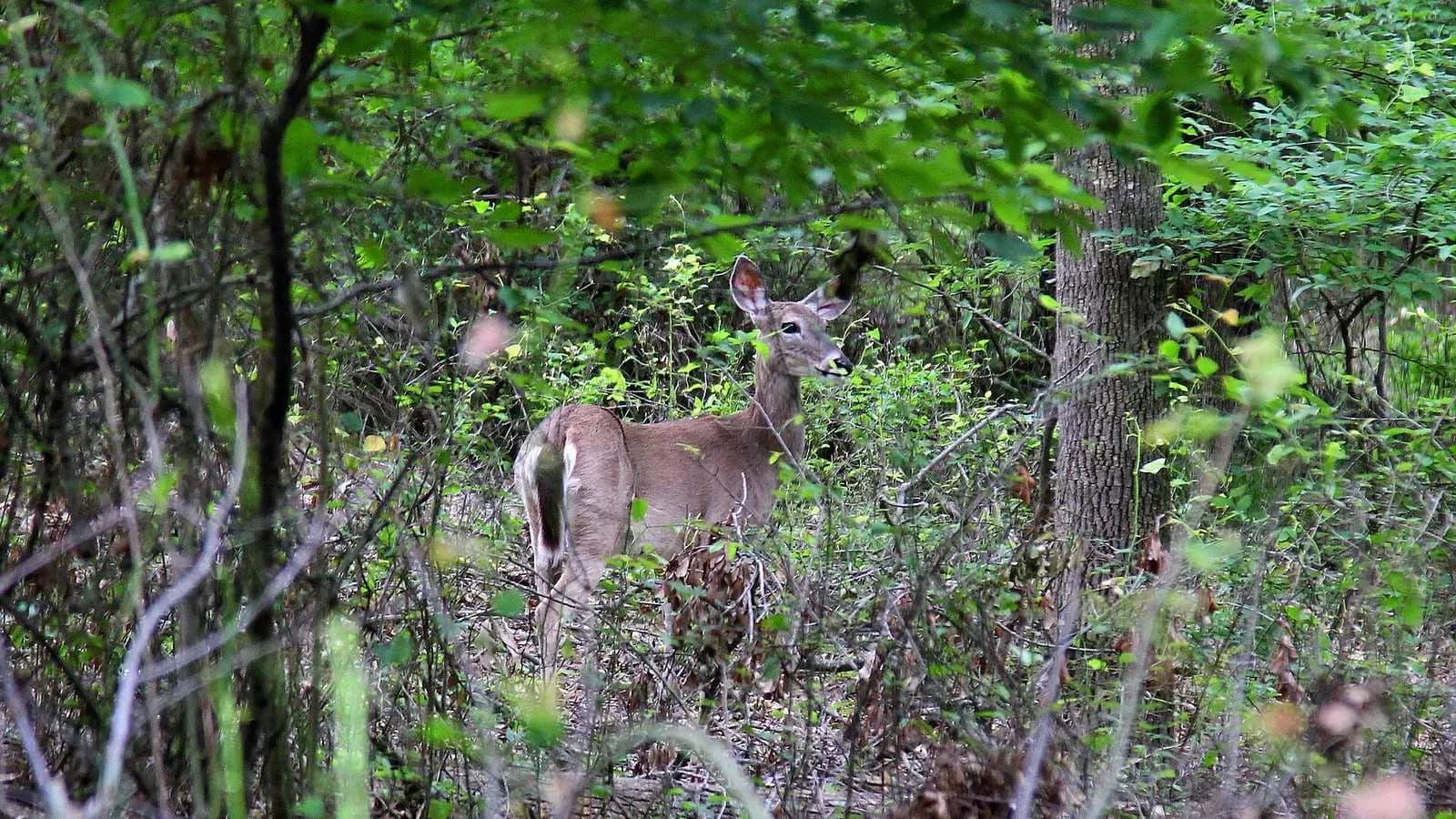
The reason is simple. Deer, rabbits, possums and ocelots are most active at dawn and dusk. Animals follow the sun. People follow the clock.
The San Antonio area had the most wildlife crashes in the study, with Tyler next. The McAllen-Brownsville region had the most hot spots for crashes involving domestic animals. Rural counties had the most crashes for the miles driven.
And there are a lot of deer. Texas Parks and Wildlife estimates the statewide white-tailed herd at 5.64 million this year after three strong fawn crops.
Why the time change makes it worse
In the four weeks after the fall time change, car crashes of all kinds rise about 6%, and nighttime crashes are up 28%, according to Environment America, a conservation group, citing outside research. The group says collisions with deer rise 16% in the week after the clocks change, and that nearly 10% of all deer-vehicle collisions happen in the two weeks after the autumn change.
The timing is not an accident of the calendar alone. Fall is breeding season, the rut, for deer, and other animals are fattening up for winter, Environment America notes.
Building a way across
The UT researchers concluded that overpasses and culverts, paired with fencing that funnels animals toward them, show promise for cutting crashes and reconnecting habitat. They recommended changes to more than a dozen TxDOT manuals so wildlife crossings are considered as a routine part of road projects, and wrote that well-planned crossing structures can improve safety significantly and are cost-effective.
Environment America says crossings built with guiding fences can reduce wildlife-vehicle collisions by up to 97%. The group is asking Congress to reauthorize the federal Wildlife Crossing Pilot Program and fund it at $100 million a year for five years.
The group's volunteer roadside count this month gathered some 1,400 sightings of animals along roads in 33 states, and 60% were dead animals, it said. It describes that as a snapshot, not a scientific survey.
Drive like it is deer season
Because it is. The research points to the same practical lessons. Slow down on rural roads after dark and near sunrise. Watch the shoulders and fence lines, not just the lane in front of you. Use your high beams on empty country roads when it is safe.
Scripture says, "A righteous man regardeth the life of his beast" (Proverbs 12:10). Caring for creation and caring for our neighbors on the highway turn out to be the same work this time of year. Set your clocks back Saturday night, and give yourself a few extra minutes on the road home.