Hundreds of Thousands of Sandhill Cranes Are Coming to Texas for Winter. Here Is Where to Hear Them
About 700,000 sandhill cranes winter in Texas, from the Panhandle to the coast. Here is how to know one, when they peak and where to go, from Muleshoe to Aransas County.
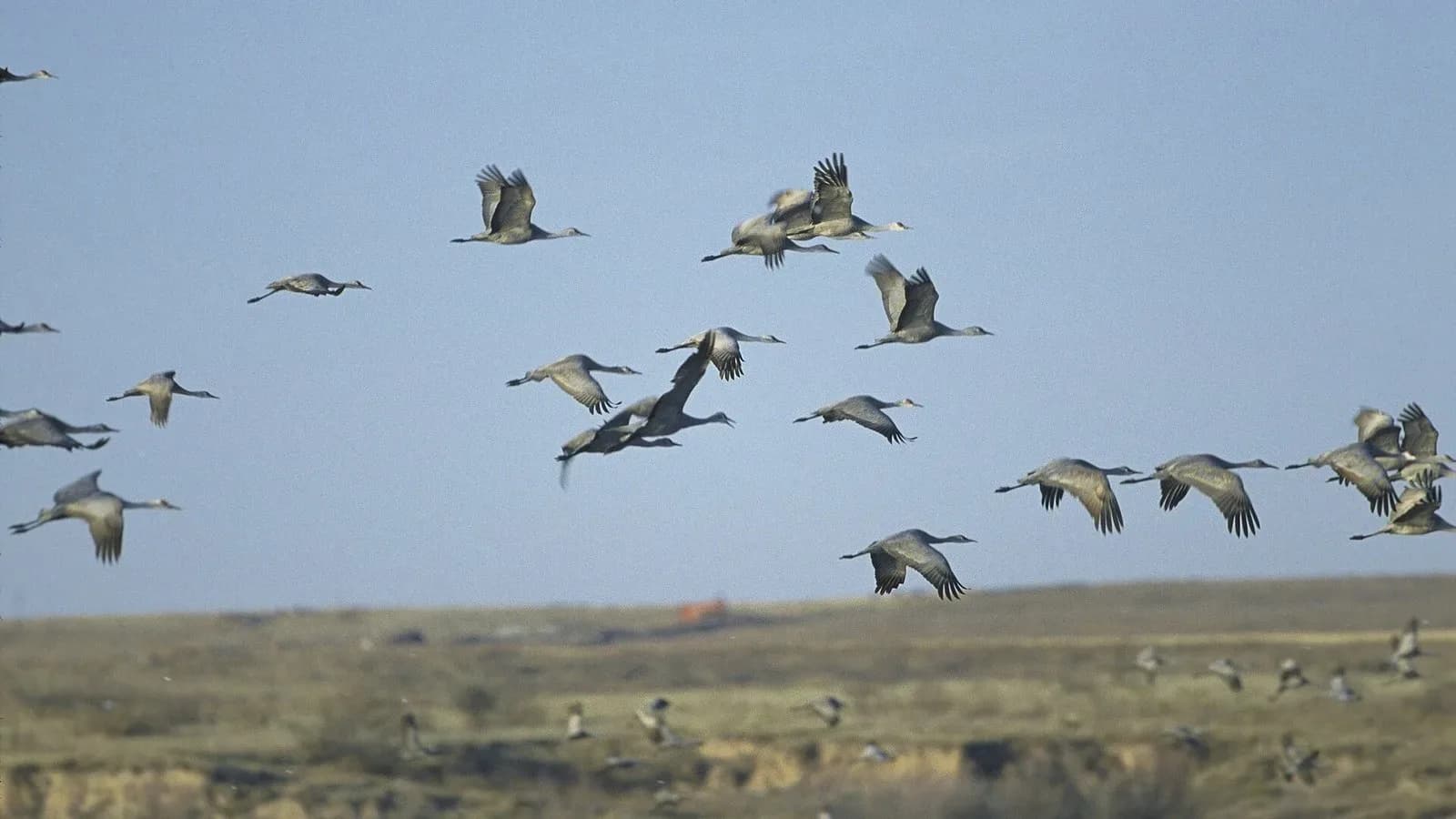
You may hear them before you see them. A rolling, rattling call drifts down from high overhead, and then a long, loose line of big gray birds comes into view.
Sandhill cranes are heading for Texas. They start migrating south in October from Canada and the northern states, and roughly 700,000 spend the winter along the Texas coast and in the Panhandle, according to Texas Parks & Wildlife magazine.
How to know one
Sandhill cranes stand 3 to 4 feet tall. They are gray, heavy-bodied birds with slender necks, long legs and a red, beret-like patch of skin on top of the head. Sometimes their feathers look rust-colored, because they preen by rubbing iron-rich mud on them.
Their wings span about 5 feet and beat slowly and steadily, so the birds seem to glide. Their bugling call, "Kar-r-r-r-o-o-o," can carry for miles. It comes from a long windpipe that coils into the breastbone. Two migratory subspecies, the greater and the lesser, come to Texas.
Don't confuse them with whooping cranes, the larger white birds that also winter in Texas. Whooping cranes are federally endangered and illegal to hunt. Sandhill cranes are legal to hunt in Texas, the magazine notes. The only endangered sandhill subspecies, in Mississippi and Cuba, do not occur in Texas.
When to go
Sandhill cranes winter in huge flocks, sometimes numbering in the tens of thousands. They like open country: wetlands, prairies and grasslands. They feed on roots, grains and insects, and now and then on small mammals, reptiles and amphibians. December through February is the peak time to see them in Texas.
Where to go
Muleshoe National Wildlife Refuge. Established in 1935 as a wintering and resting area for migrating waterfowl, it is the oldest refuge in Texas, according to the City of Muleshoe. The refuge sits 20 miles south of Muleshoe on State Highway 214 and covers more than 5,809 acres. Cranes begin arriving in late September, and the refuge hosts one of the largest concentrations of sandhill cranes in North America. Numbers peak between December and mid-February. The refuge offers a visitor center, picnic area, camping, and a nature trail, and more than 280 bird species are on its list.
Houston area. The magazine names wet fields around Houston, Brazos Bend State Park and Anahuac National Wildlife Refuge as hot spots.
Aransas County. On the Texas Parks and Wildlife Department's Aransas Loop of the Great Texas Coastal Birding Trail, Cape Velero Drive off FM 1069 is a 3-mile paved road through grassland, scrub and marsh. Sandhill cranes and snow geese are often found there in winter in the scrubby middle section. Nearby Port Bay Road, 2.2 miles farther south on FM 1069, also lists sandhill cranes among its birds. Both sites are day use only, and birders are welcome in the subdivision along Cape Velero.
While you are on the coast, Rockport is the base for several boats that visit the winter feeding areas of whooping cranes at Aransas National Wildlife Refuge. TPWD says a boat gives the best views of the whoopers, since views from the refuge observation tower are usually distant. The Rockport-Fulton Area Chamber of Commerce has information on trips.
Tips for watching
Bring binoculars and keep your distance. Stay on public roads and respect private land.
In spring the cranes head north to breed, so Texans rarely see their famous courtship dance, the magazine notes. Courting birds stretch their wings, pump their heads, bow and leap into the air. Pairs stay together for years, and young cranes migrate south with their parents in the fall.
A winter gift
The return of the cranes each fall shows the faithful order of creation. Job was told to ask the birds of the air, and they would teach him (Job 12:7). This winter, find a field at sunrise, listen for that call and watch the sky fill.