The Ocean Carried Him Away. People Brought Him Home.
A critically endangered Kemp's ridley sea turtle was swept across the Atlantic, found in Wales, and carefully brought back to Texas. Rhossi's story shows what patient conservation work looks like when people refuse to rush the ending.
A critically endangered Kemp's ridley sea turtle was swept across the Atlantic, found in Wales, and carefully brought back to Texas. Rhossi's story shows what patient conservation work looks like when people refuse to rush the ending.
Some stories are easy to reduce to a headline. Sea turtle rescued. Sea turtle comes home. Happy ending. But Rhossi's story is better than that, and stranger too.
It begins with a Kemp's ridley sea turtle—one of the most endangered sea turtles in the world—found far from where he belonged, cold-stunned on a beach in Wales after being carried thousands of miles from the Gulf. He was tiny then, weighing only about two pounds. A local dog found him. People stepped in. And what followed was not one dramatic rescue moment, but nearly two years of patient work.
Nearly Two Years in Wales

The people in Wales did not just save Rhossi for a day. The team at Anglesey Sea Zoo kept him alive, stabilized him, and spent the better part of two years helping him recover. By the time he was ready to travel, the little turtle that had nearly died in cold water had grown to about 46 pounds. That kind of recovery does not happen because somebody snapped a photo and wished him luck. It happens because trained people kept showing up and doing the work, day after day, long after the first wave of attention was gone.
The Journey Home

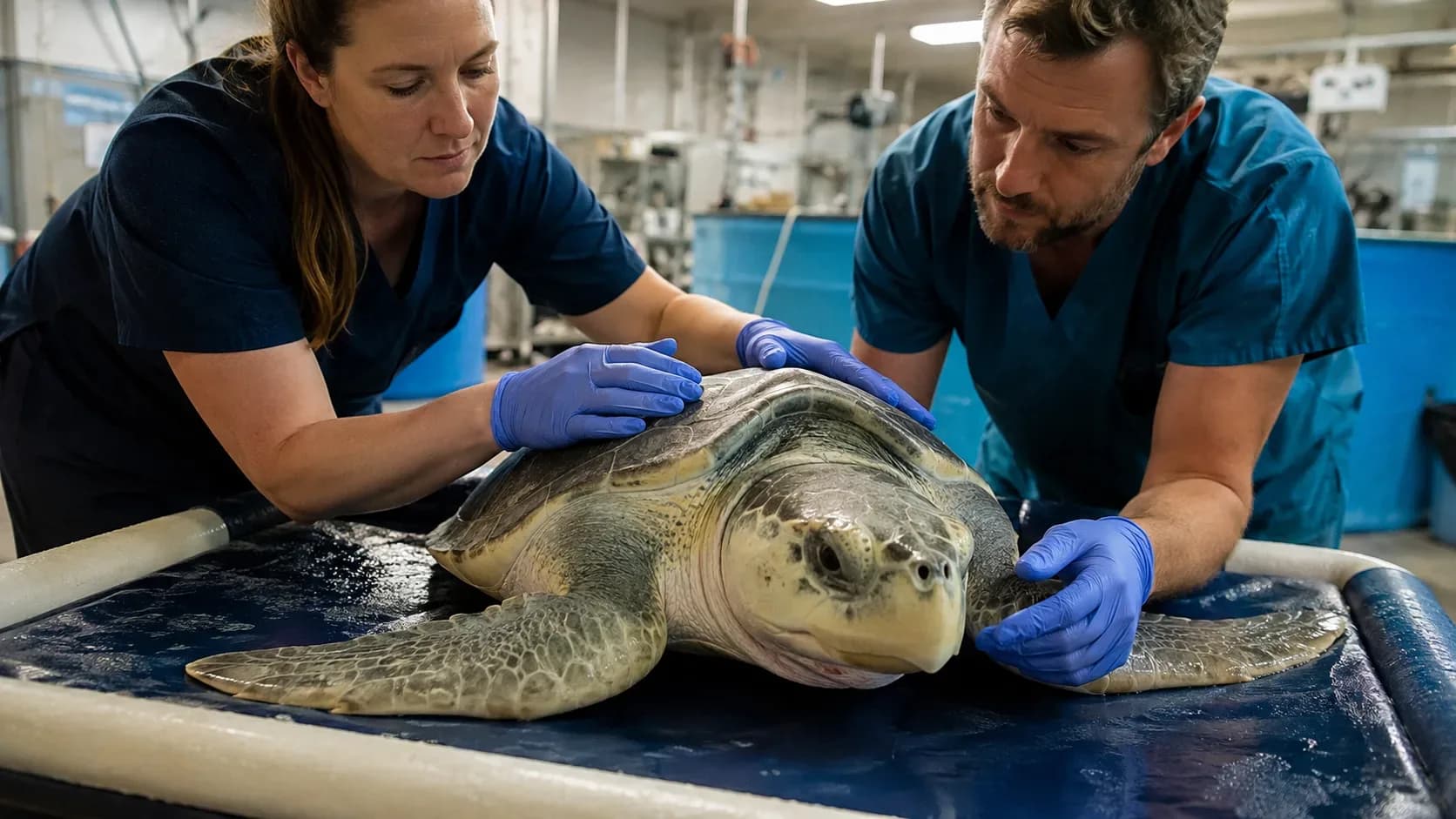
Then came the part that sounds almost made up if you did not know better. Rhossi's road home involved a helicopter ride from Wales to Heathrow, then a transatlantic flight to Houston, and then more veterinary care once he arrived in Texas on August 10. The operation involved Anglesey Sea Zoo, Houston Zoo, U.S. Fish & Wildlife, NOAA, Texas State Aquarium, and others. A senior Houston Zoo veterinarian, Dr. Joe Flanagan, even briefly came out of retirement to help examine him. That alone tells you this was not a symbolic handoff. People wanted to get this one right.
The Release That Did Not Happen Yet

Everybody likes the ending where the animal gets released, the cameras click, and the turtle disappears into the surf while everybody feels good about the world for a few minutes. But Rhossi's caretakers did not force that ending just because it would look nice. After arriving in Texas, he underwent a comprehensive medical exam. While he appeared active and vigorous, scans raised concern about lingering pneumonia. So the release was delayed.
Instead of pretending the finish line had already been crossed, the people caring for him chose the less glamorous route: more monitoring, more treatment if needed, and more patience. That decision may be the most encouraging part of the whole story. It is one thing to rescue an animal. It is another to resist rushing the final chapter.
In a world that increasingly performs everything for quick reaction, Rhossi's story reminds us that care is often slower than applause. The real measure of concern is not whether people cheer for a release date. It is whether they are willing to wait until the animal actually has the best chance to survive once it is back in the wild.
About the Species
Kemp's ridleys are the smallest sea turtles in the world, and they are endangered throughout their range. They are primarily associated with Gulf waters, though juveniles can be swept around Florida and far up the Atlantic by ocean currents. NOAA notes that bycatch in fishing gear remains one of their biggest threats. In other words, Rhossi is not just an interesting traveler. He belongs to a species that still needs all the help it can get.
A Chain of People Doing Their Part
That is why this story reaches beyond one turtle. A dog on a beach. A sea zoo in Wales. A helicopter pilot. International transport. Wildlife officials. Veterinarians. Aquarium and zoo teams. None of them could do every part alone. Rhossi's survival depended on a chain of people and organizations doing their part well enough that the next one could do theirs.
We talk all the time about systems failing, people cutting corners, and institutions missing the point. This time, a lot of moving parts worked the way you would hope they would.
Rhossi was swept away by forces he could not control. Then, across two continents, human beings chose not to shrug and move on. They treated a lost turtle as worth the trouble. They did not just save him once. They kept saving him, one decision at a time.
Not every hopeful story has to be sentimental. Sometimes it is enough to say that the world is still full of people willing to do careful work for something that cannot repay them. A creature native to Gulf waters wound up in Wales, survived because strangers cared, and is now one step closer to getting home because those strangers did not stop caring halfway through.
The ocean carried him away. People brought him home. Not all the way yet. But far enough to remind us that sometimes the right ending is the one people refuse to rush.
Sources: Houston Zoo — Rhossi's Road Home | Houston Zoo Blog | NOAA Fisheries — Kemp's Ridley Turtle | Anglesey Sea Zoo