A Third U.S. Aircraft Carrier Arrives in the Middle East
U.S. Central Command said Monday the USS Theodore Roosevelt is operating in its area, joining two other carrier strike groups. Officials said the ship entered on Sunday.
The facts come first below. My opinion follows in the section marked as opinion.
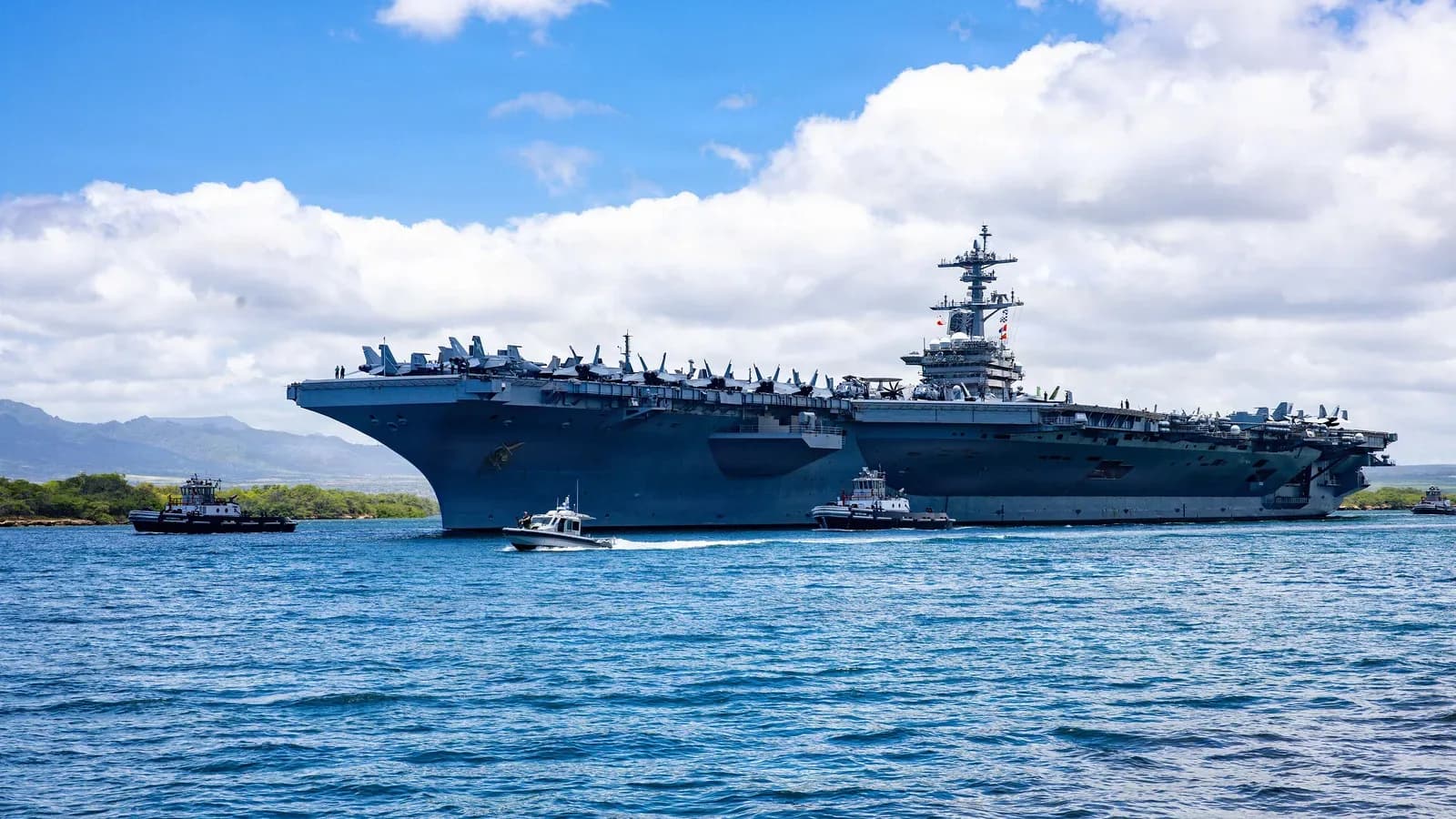
The USS Theodore Roosevelt is operating in the U.S. Central Command area of responsibility, the command said Monday, joining two other American carrier strike groups already in the region, Fox News, Al Jazeera and The Jerusalem Post reported. U.S. officials told those outlets the carrier entered the area on Sunday.
On Monday, Central Command posted a photograph and wrote, "USS Theodore Roosevelt (CVN 71) transits the Indian Ocean, Nov. 15. The aircraft carrier is currently operating in the CENTCOM area of responsibility as part of a scheduled deployment," Fox News reported. A review Monday evening found no separate public statement from the Pentagon. Al Jazeera, in an earlier version of its report, had noted that the Pentagon and Central Command had not formally confirmed the arrival; the Monday Central Command post is the command's public confirmation that the ship is operating in its area as a scheduled deployment.
The other carriers already there are the USS George Washington and the USS George H.W. Bush, Al Jazeera and The Jerusalem Post reported. Al Jazeera said a U.S. official told it in October that the Roosevelt had left its San Diego base in September, bound for the Middle East.
The Roosevelt is a nuclear-powered aircraft carrier, commissioned in 1986, that carries more than 5,000 personnel and a full air wing of more than 60 aircraft, Al Jazeera reported. It is named for the 26th U.S. president.
It is not clear how long all three carrier strike groups will remain in the region. The Roosevelt had been expected to replace one of the two carriers already deployed, though American officials said all three could remain if necessary, The Jerusalem Post reported. The newspaper said a similar three-carrier presence occurred in April, the first time since the 2003 Iraq War that three U.S. carriers had operated in the region at the same time. Fox News also noted that three carriers had been positioned in the region earlier this year, as Central Command said in April.
No new large-scale American strike campaign against Iran has been announced, The Jerusalem Post reported. The newspaper said President Donald Trump has told senior advisers that he may refrain from ordering additional strikes unless Iran or the Iran-backed Houthis launch new attacks against American interests, and that Saudi and Turkish leaders have urged him to avoid another round of escalation.
Al Jazeera, in a Monday explainer, said Trump stated last week that further military strikes against Iran are "quite unlikely" and that the military component of the war was "effectively over" after discussions with Qatar's prime minister, while also saying the U.S. military remains "locked and loaded" if conditions change. The same report said the United States and Iran entered a two-week ceasefire in April and later announced a broader memorandum of understanding in June, which collapsed in early July, and that mediators from Pakistan and Qatar have since tried to prevent a return to a full-scale exchange of attacks.
The deployment comes as the war with Iran has continued for more than eight months, Fox News reported. Dock Line previously reported on the conflict, including U.S. strikes on Iran's Qeshm Island as talks to end the war went on.
Opinion:
A scheduled deployment can still be a serious fact. Three carriers in one theater are not a press release. They are ships, crews and a signal, whether the signal is rotation, deterrence or a table being set for something more. The public is owed a straight account of which of those it is.
Congress, not a photograph from the Indian Ocean, holds the war power and the power of the purse. If the military part of the war is truly winding down, the country should hear that in plain language, and the posture should match the words. If it is not, Americans should not have to parse official silence. A third carrier does not decide the rightness of the war. It does decide that the facts on the water should be told without varnish.