Corpus Christi Nearly Ran Dry. Now Voters Will Decide Who Pays for Water.
After a failed desalination plan and a near-empty reservoir, Corpus Christi voters will decide in November whether big industrial users keep their exemption from drought fines.
Corpus Christi came within a few feet of running dry this year. Now the voters of Texas' eighth-largest city will decide in November on Proposition B whether the refineries and chemical plants that drive the local economy should keep a special exemption from drought fines that ordinary households never got.
The measure, known as the Fair Water Amendment, would amend the City Charter to end programs that exempt large industrial water users from drought surcharges and curtailment rules. Under the city ordinance calling the Nov. 3 election, those users would pay surcharges on use above roughly 12.8 million gallons a month at no less than the rates council set in March 2025: $3 per 1,000 gallons in Stage 2, $6 in Stage 3 and $12 in a water emergency. KRIS 6 News reports the change would follow a required five-year notice period, and that residential, commercial, institutional and agricultural customers would face no new mandatory surcharges.
The story, laid out in a detailed investigation published Oct. 12 by The Texas Tribune with Inside Climate News and The Texas Newsroom, is a hard lesson in what happens when a city makes promises it cannot keep and leaders keep changing the plan.
A deal made in 2018
In August 2018, at the height of the shale boom, a committee of large industrial water users and public officials brought Corpus Christi a plan to make the city "drought proof." The region's biggest water users, including OxyChem, Valero and Citgo, would help pay for the state's first seawater desalination plant. In return, they would not face pressure to cut back during future dry spells.
The mechanism was a change to the city's drought plan. Large industrial users would pay an immediate rate increase of about 8 percent, called the drought surcharge exemption fee. In exchange, they would be exempt from drought surcharges that could more than double water rates for some users. City Council approved it unanimously. Then-Mayor Joe McComb called it "a giant step for the city."
The price kept climbing
In 2019, city staff told council a plant producing 10 million gallons a day would cost $140 million, and the industry fees could cover the loan payments. In early 2020, the city decided it wanted 20 million gallons a day at $220 million, and staff wrote that the fee would cover only two-thirds of the payments, leaving residential ratepayers to cover the rest.
By January 2024, officials wanted to triple the plant's size, and the estimated cost had reached $757 million. The city estimated debt payments of about $68 million a year. The industry fee brought in about $6 million a year. In July 2025, the contractor told council the price tag was an estimated $1.2 billion. That September, after a 13-hour meeting, council fired the contractor.
The city has spent at least $50 million on a plant that does not exist. According to the Tribune, walking away entirely would mean returning $235 million already borrowed from the state, plus about $70 million in interest.
Down to the bottom of the lake
Meanwhile, drought set in. Lake Corpus Christi dropped below 10 percent full in March 2026, the lowest since it first filled in the late 1950s. Lawn watering and car washing were largely banned for residents. Officials debated cutting hours at public swimming pools, which use about 20,000 gallons a day in summer. ExxonMobil's plastics plant, the region's largest water user, consumed 13.5 million gallons a day. According to the Tribune, industrial users consume more water than all 500,000 residents of the seven-county Coastal Bend combined.
Credit-rating agencies downgraded their outlooks for the city. Industrial users drilled emergency wells. Council approved more than $1 billion for seven water supply projects, most of them groundwater. Relief finally came in July, when heavy rains in the upper Nueces River Basin pushed reservoirs past 40 percent.
Gov. Greg Abbott said in March that city leaders "squandered" state loans awarded for the project.
Who is to blame
Both sides have a case, and both deserve a fair hearing.
Bob Paulison, executive director of the Coastal Bend Industries Association, says the companies did their part and the city failed to build what it promised.
"You kept dragging your feet and thinking that everything was OK until it was too late."
Isabel Araiza, a college professor and founder of the group For the Greater Good, has fought the desalination project for a decade and led the petition drive.
"The reason we were in the water crisis was because of their water usage."
Her campaign gathered nearly 13,000 signatures, and in August City Council voted 6-2 to place it on the ballot, according to KRIS 6. The petition is what it calls the Fair Water Amendment. It would repeal the exemption fee and sharply raise what large users pay during the next drought. Araiza is also running for City Council. According to the Tribune, another petition organizer, Jenny Espino, works with Texas Campaign for the Environment and organizes with the Democratic Socialists of America.
McComb warns the measure could drive away the jobs that built the region.
"If industry shuts down, Corpus Christi will be just a fishing village again."
What it means
The Nov. 3 ballot also carries the mayor's race, every City Council seat and Proposition A, the renewal of the Crime Control and Prevention District. Council member Roland Barrera called the measure "a referendum against the system." Early voting runs Oct. 19 through Oct. 30.
There is plain truth on both sides of this one. Refineries and plants put food on tables across South Texas, and a city that chases them off will not be better for it. But a deal that asks families to give up their lawns while the biggest users are shielded from the same rules is not one most Texans would call fair. Scripture calls for equal weights and measures, and that is a fair test for any government rate schedule.
The deeper failure is stewardship. Over eight years, rotating councils and staff kept changing the plan, the price ballooned, and tens of millions of dollars went out the door with nothing to show for it. City Manager Peter Zanoni said it well: "No city manager, no city council, no resident should ever have to be put through this again."
The rain bought Corpus Christi time. It did not buy a solution. Whatever voters decide, the next council will inherit the same dry country and the same unpaid bills.
Related from Dock Line
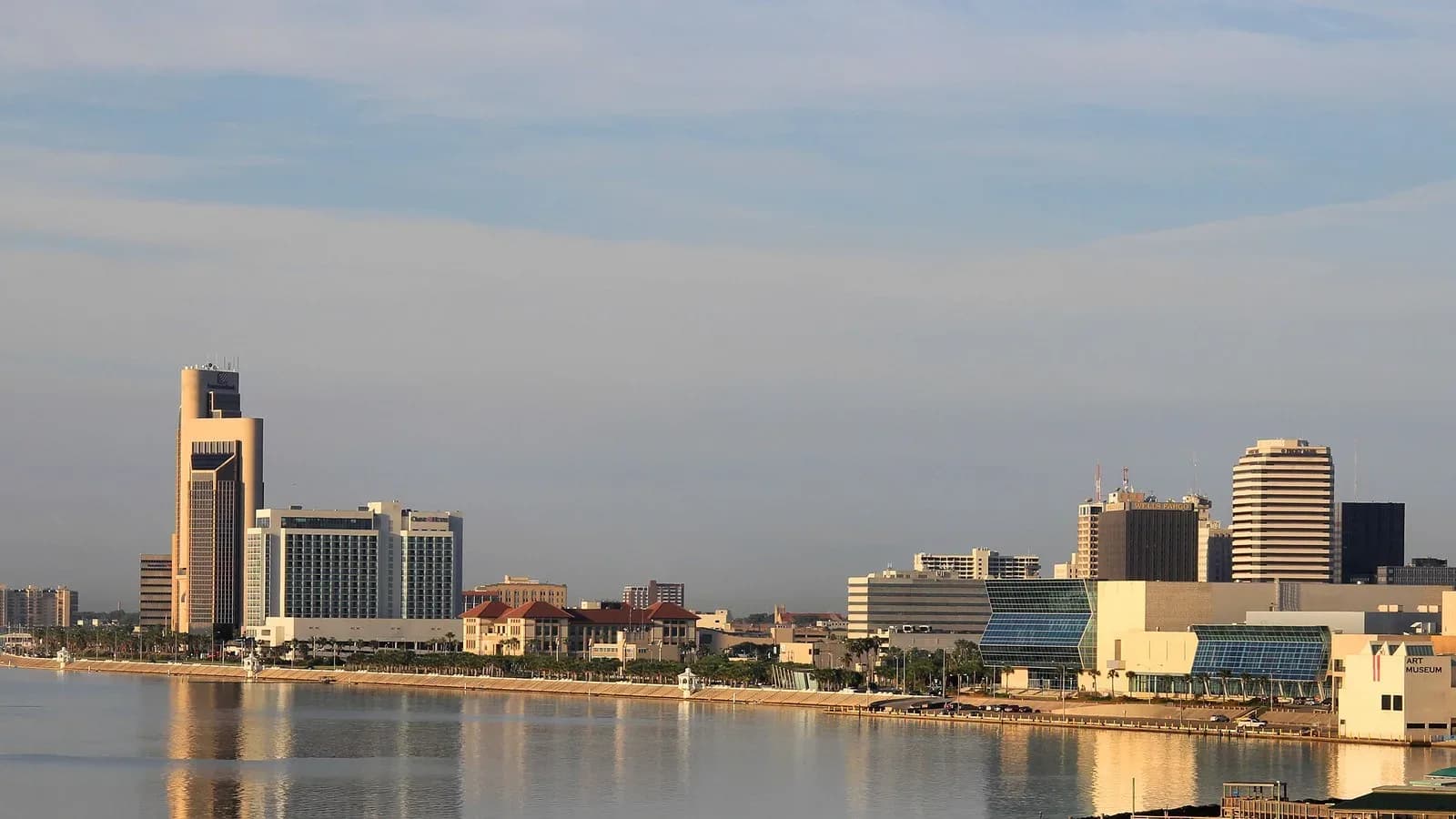
Hero photo: Downtown Corpus Christi skyline, 2014, by Nv8200pa via Wikimedia Commons, licensed CC BY 4.0; cropped and resized.