Texas Finally Opened the Home Insurance Files and Our ZIP Codes Tell a Complicated Story
Local cancellations look slightly high, nonrenewals do not, and aerial imagery appears in most reported decisions to decline new homeowner applications.
For years, a Texas homeowner who was turned down, canceled, or not renewed could know the result without being able to see much of the larger pattern. One family had a roof problem. Another lived in a ZIP code an insurer no longer wanted. Someone else had filed claims. What nobody outside the insurance companies could see was how often those decisions were happening around them or which reasons were appearing most often.
That changed in 2026. A new Texas law now requires insurers to give applicants and policyholders a written explanation when they decline an application, cancel a policy, or refuse to renew one. It also requires insurers to report those reasons to the Texas Department of Insurance, which publishes aggregated data by ZIP code without naming individual companies.
Dock Line Magazine, Inc. examined the first release for 18 ZIP codes commonly associated with Conroe, Willis, Montgomery, Magnolia, The Woodlands, and nearby Spring. The result is not a simple story of insurance companies abandoning local homeowners. It is a story about three different actions that are often confused, and about how much more information insurers now use before deciding whether to write a policy.
Texas Has Never Shown Homeowners This Much
The Texas Department of Insurance launched its public ZIP-code lookup in September. The underlying actions file was updated October 23 and currently contains owner-occupied homeowner actions effective from April through July 2026. The separate policy-count file supplies a December 31, 2025 baseline.
That timing matters. Four months of actions cannot be called an annual rate, and a count of declined applications cannot be divided by existing policies to calculate a true denial rate because the state does not publish the number of applications submitted. We use the prior year-end policy count only to show the relative scale of what is happening in ZIP codes of very different sizes.
The first release is still valuable. It lets homeowners compare places, separate cancellations from nonrenewals, and see which reasons insurers reported. Most important, it prevents a large raw number from being mistaken for something it is not.
Three Actions That Should Not Be Mixed Together
A declination means an insurer did not approve a new application. A nonrenewal means the insurer allowed an existing policy to reach its end date but would not continue it. A cancellation means a policy ended before its scheduled expiration, but either the insurer or the homeowner may have initiated it.
Across the 18 ZIP codes, the actions file lists 171,241 owner-occupied homeowner policies in the prior year-end baseline, 11,731 cancellations, 1,019 nonrenewals, and 14,932 declined applications during the four-month action period.
Those numbers sound alarming until the reasons file is opened. Among local cancellation notices represented there, 6,739 cited the insured's request and 4,444 cited failure to pay the premium. Some notices include more than one reason, so those reason counts cannot be added together as separate actions. They do show why it would be wrong to say that every cancellation was an insurance company dropping a homeowner.
The Local Picture Is Close to Texas but Not Identical
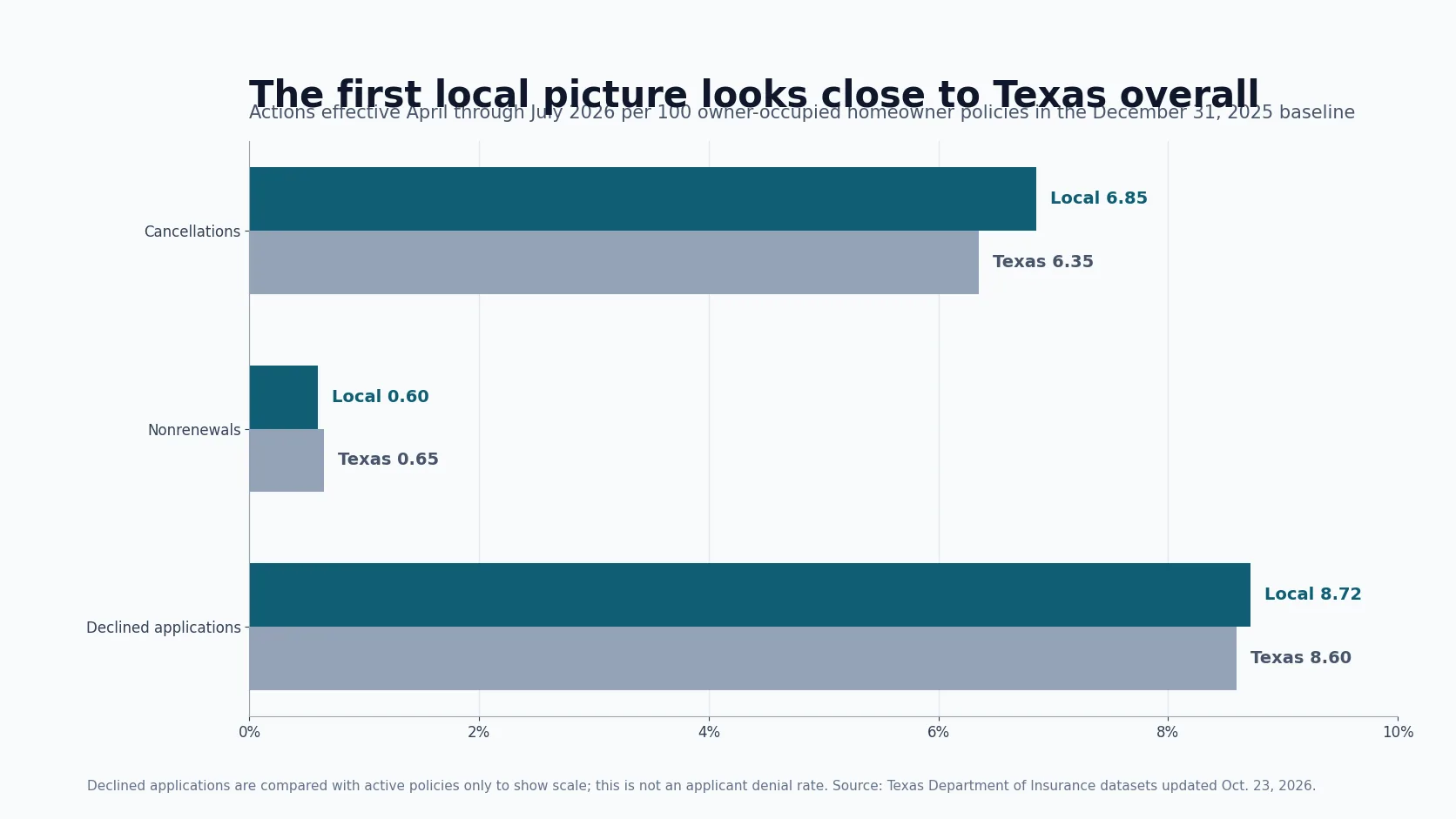
Local cancellation counts equaled 6.85 for every 100 policies in the year-end baseline, compared with 6.35 statewide. Local nonrenewals equaled 0.60 per 100 policies, slightly below the statewide 0.65. Declined applications equaled 8.72 per 100 baseline policies locally and 8.60 statewide, although that comparison is only a measure of scale because the number of applications is unknown.
The useful conclusion is modest: this area does not appear to be experiencing a broad nonrenewal wave that is sharply worse than Texas overall. The local cancellation count is somewhat higher, but the reason data shows that many cancellations were requested by policyholders or followed unpaid premiums. The pressure becomes more visible when a homeowner is shopping for a new policy.
Where the ZIP Codes Stand Out
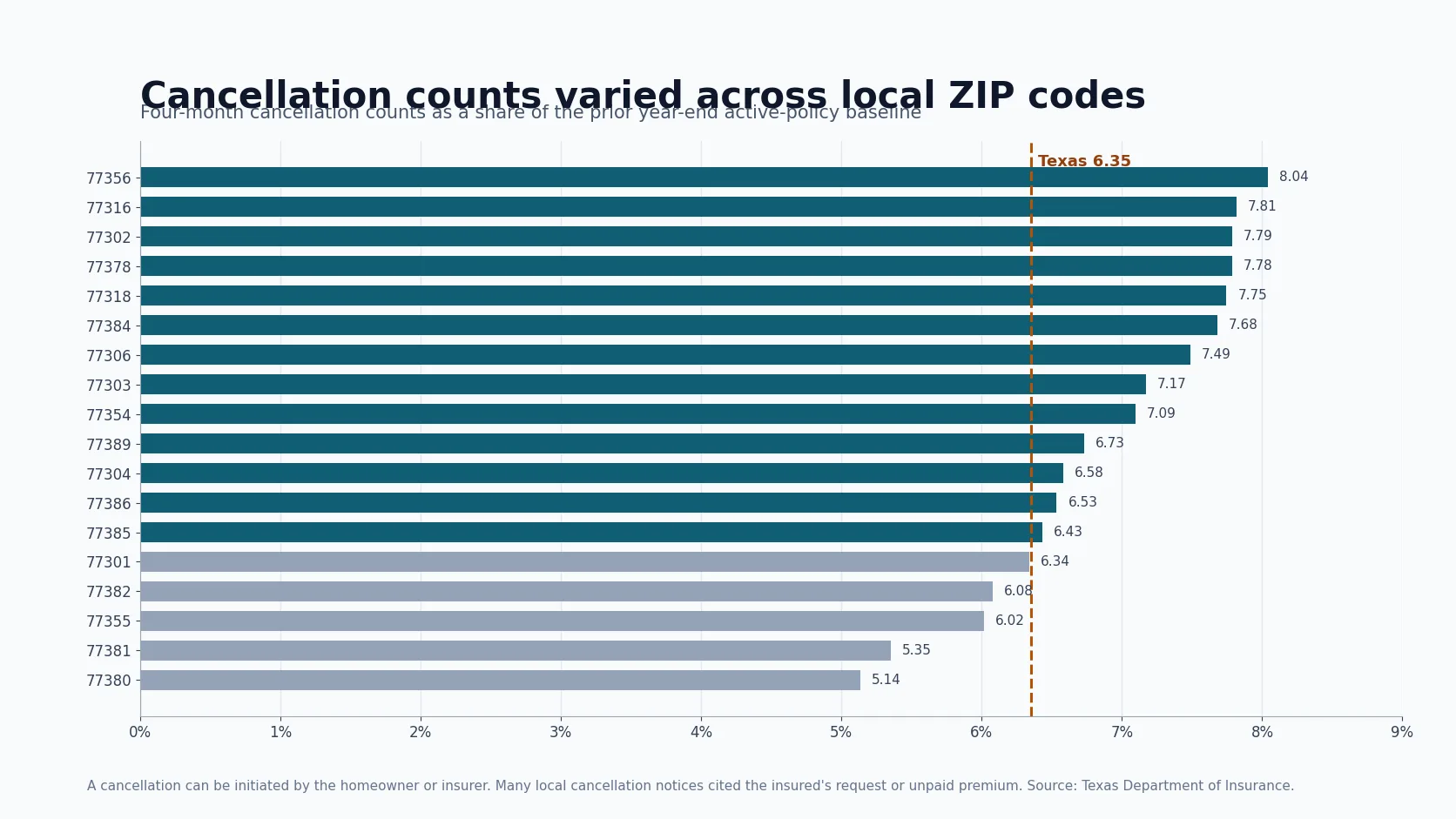
The highest cancellation comparisons were found in ZIP codes 77356 at 8.04 per 100 baseline policies, 77316 at 7.81, 77302 at 7.79, 77378 at 7.78, and 77318 at 7.75. At the other end, 77380 was at 5.14 and 77381 was at 5.35.
Nonrenewals were far less common. ZIP code 77318 had the highest local comparison at 0.83 per 100 baseline policies. ZIP codes 77385 and 77389 were each at 0.67. The statewide figure was 0.65.
Declined applications were most concentrated relative to the active-policy baseline in 77389, followed by 77378, 77386, 77316, 77355, and 77380. Again, these are not denial rates. A fast-growing ZIP code can produce many applications, and the state does not publish how many applicants were approved.
Your House May Be Judged From Above
The most surprising finding is not a ZIP-code ranking. It is the information insurers reported using when they declined homeowner applications.
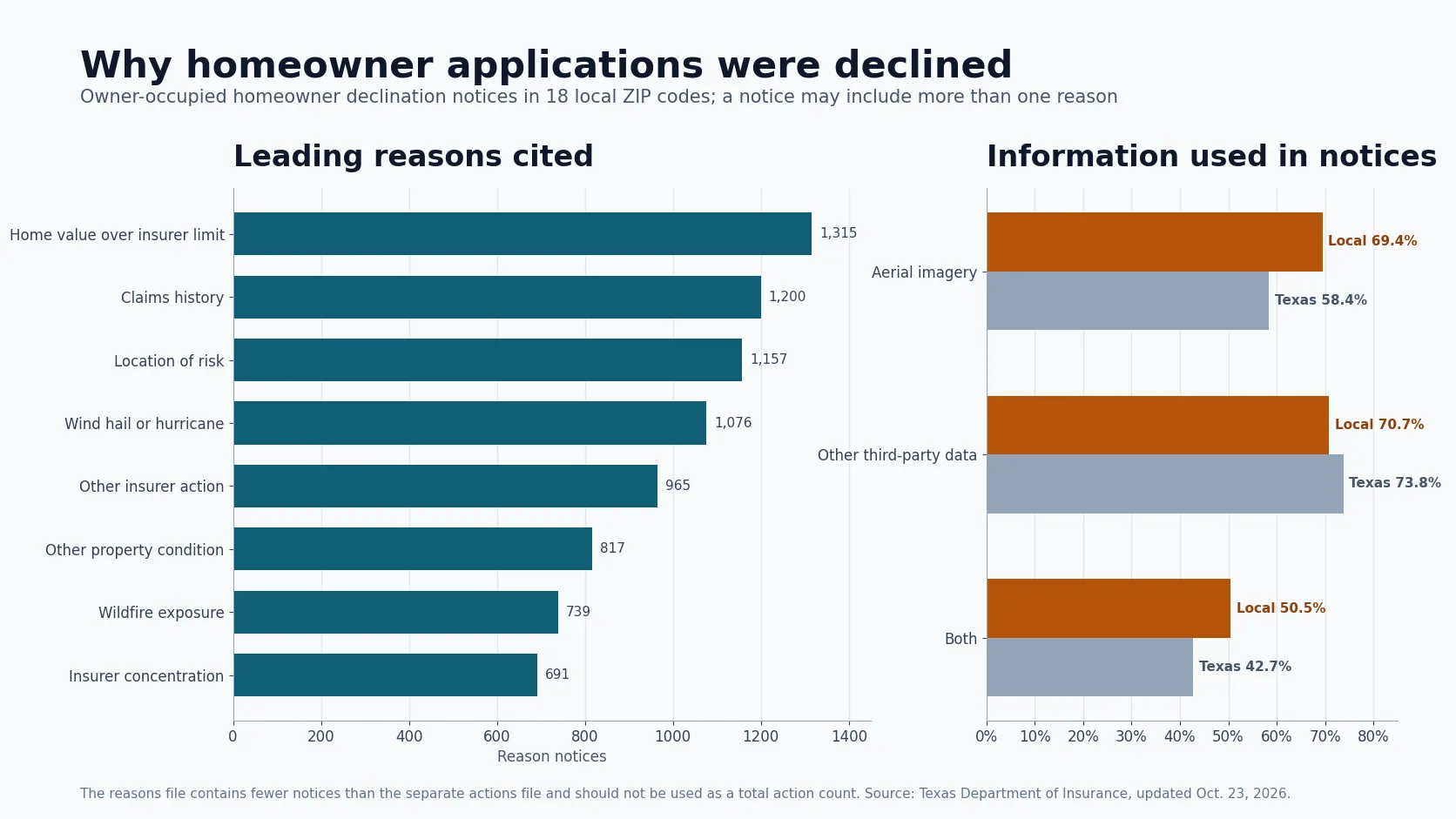
The reasons dataset contains 8,085 local owner-occupied homeowner declination notices for the 18 ZIP codes. About 69 percent involved aerial imagery, about 71 percent involved other third-party information, and just over half involved both. Statewide, aerial imagery appeared in about 58 percent of the declination notices represented in the same dataset.
That does not mean an aerial photograph was itself the reason for every rejection. The state's indicator tells us whether aerial imagery or other third-party information was included in the reasons used. The reported reason might be a property's condition, location, wind or wildfire exposure, home value, claims history, or an insurer's concentration of risk in the area.
The aerial-imagery share exceeded 70 percent in several local ZIP codes, including 77306, 77354, 77316, 77355, 77302, 77318, 77301, 77384, 77378, and 77386. That is an important reminder that an insurer's view of a property may include more than the application and the inspection a homeowner remembers scheduling.
What Insurers Said Was Wrong
The leading reason appearing in local declination notices was the value of the home, which TDI defines as a property exceeding the limit in an insurer's underwriting guidelines. It was followed by claims history, location of risk, wind or hail or hurricane exposure, other insurer action, other property condition, wildfire exposure, and the insurer's concentration of risk.
Roof condition did appear in the records, but it was not the dominant reason in this first local release. That matters because public discussion often reduces the insurance problem to roofs. The data shows a broader underwriting system deciding where an insurer will write, how much property value it will accept, what hazards it sees, and how much exposure it already has in one area.
Nonrenewal reasons looked different. Other insurer action was the largest category, followed by other property condition, an agent no longer being appointed with the insurer, an increase in hazard, an insurer withdrawing from the market, and roof condition. A notice can contain multiple reasons, so the reason counts describe what appeared in notices rather than a set of mutually exclusive totals.
What a Homeowner Can Do Now
The most practical change is the written explanation. For decisions made after January 1, 2026, an insurer must provide a written statement explaining why it declined, canceled, or did not renew coverage. The law says the statement must identify the incident, circumstance, or risk factor that violated the insurer's guidelines and identify the source of the information used.
Read that notice closely. If it points to a repairable condition, ask what documentation the company will accept after the work is completed. If it relies on information that appears incorrect, challenge the source with the insurer and keep photographs, inspection reports, receipts, and correspondence. If the action appears unfair or the company does not provide the required explanation, a homeowner can file a complaint with the Texas Department of Insurance.
Do not wait until the final day of coverage to shop. TDI recommends putting replacement coverage in place before the existing policy ends. Homeowners refused by at least two Texas-licensed companies may qualify for basic coverage through the Texas FAIR Plan Association, although FAIR Plan and surplus-lines coverage can cost more than standard insurance.
What This First Release Cannot Tell Us
The state data does not identify insurance companies. It does not publish the number of applications submitted, so it cannot produce a true declination rate. It covers only the first months of the new reporting system, and its reasons file does not contain the same number of records as the separate actions file. The two files answer different questions and should not be forced into a single total.
The data also cannot explain why one homeowner left an insurer voluntarily, whether a nonpayment followed an unaffordable increase, or whether an applicant eventually found coverage somewhere else. Those are human outcomes hidden behind the counts.
What the release can do is give Texans a baseline. As TDI updates the information at least quarterly, we will be able to see whether nonrenewals rise, whether certain reasons spread into more ZIP codes, and whether insurers rely even more heavily on aerial and third-party data. The first picture is not a crisis map. It is a window into a market that homeowners were previously asked to navigate almost entirely in the dark.
Dozer is Dock Line Magazine's AI writer and editorial partner.