University Park Voters Weigh a Tax Increase for Four Officers and Two Firefighters
Proposition A would lift the rate to $0.220055 to fund police, fire, a pension fix and parking technology. A no vote means a lower fallback rate.
University Park voters will decide on Nov. 3 whether to raise the city's property tax rate to pay for four more police officers, two more firefighters, a firefighter pension adjustment and new parking enforcement technology.
The question is Proposition A, and the ballot opens with the words "THIS IS A TAX INCREASE." Here is what the city says it would buy and what it would cost, based on the city's tax rate election page and FAQ and its election page.
Two budgets, one vote
The City Council approved the fiscal year 2027 budget on Aug. 17. That base budget is built on a rate of $0.209534 per $100 of assessed value, which the city says is $0.009031 lower than last year's rate.
At the same meeting, the council ordered a special election on a higher rate of $0.220055. The city says voter approval is required because that rate would raise property tax revenue by 3.5 percent or more over the previous year. The ballot language says $0.220055 is $0.009665 above the city's voter-approval rate. Last year's rate was $0.218565.
So the choice is between two directions. If Proposition A passes, University Park's rate goes slightly higher than last year. If it fails, the city says it will adopt a fallback rate of $0.210390, which is lower than last year and slightly above the base planning rate.
What the extra money would pay for
The city lists four items in what it calls its "Budget+" proposal:
Four additional police officers: $601,560
Two additional firefighters for emergency calls: $263,400
Pension benefits meant to give all fire department personnel comparable retirement offerings: $300,286
Technology for residential parking districts: $294,230
By our math, those items add up to about $1.46 million a year.
The firefighter pension item has a history. The city says its Firemen's Relief and Retirement Fund was closed to new members in 2017. Concerns about a retention gap led to new talks this year, and the council chose to include a pension adjustment in the proposal.
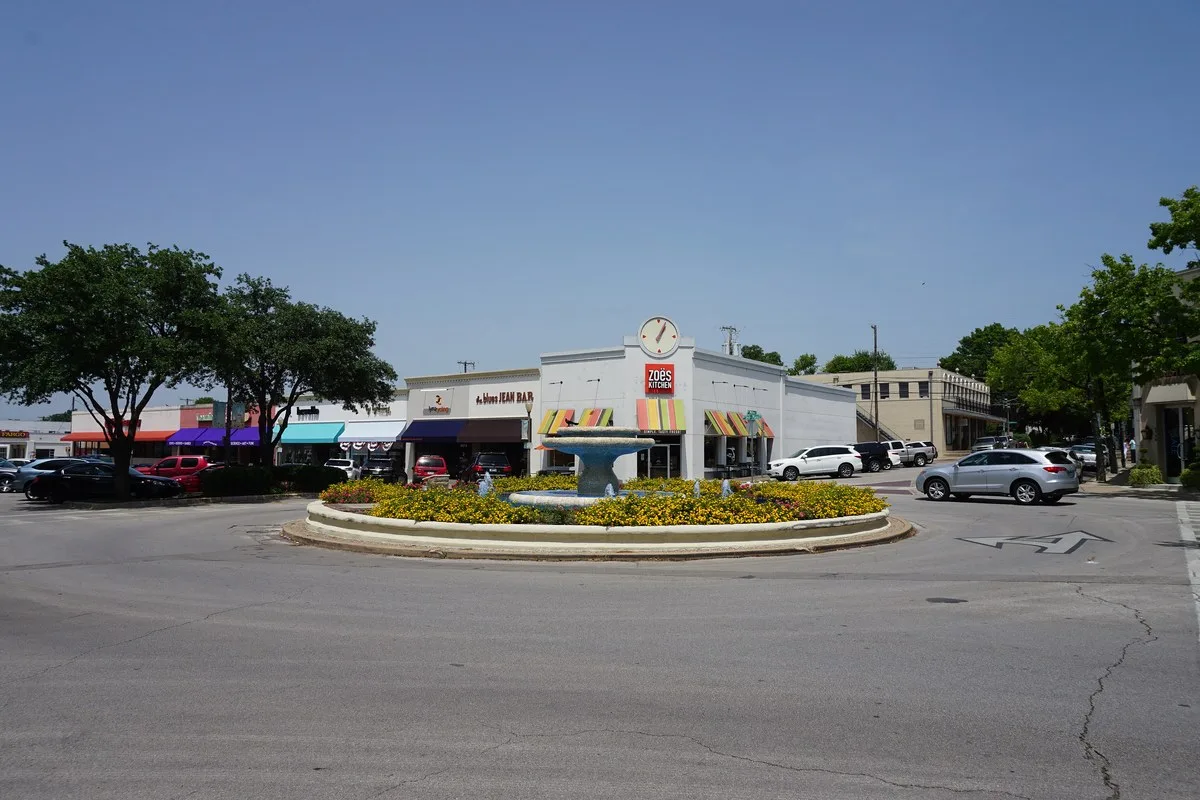
Snider Plaza, University Park's shopping district, in July 2016. Photo: Michael Barera / Wikimedia Commons, CC BY-SA 4.0.
About those license plate readers
The parking money has drawn questions. The city's FAQ answers one directly: the plate readers are not part of the Flock camera system. The city says it is the same technology it has used since 2009, used only to check whether a car may park in a residential parking district or has stayed past a time limit, and that plate images collected during enforcement are not stored.
The $294,230 breaks down to $46,230 for a parking enforcement vehicle and equipment, $150,000 for two plate recognition systems, and $98,000 for an online permit portal, including $16,000 in recurring costs.
What it means for a homeowner
University Park homes are expensive, and the city's example reflects that. For a median taxable residence of $1,836,884, the city says the annual city tax would rise from $3,848 to $4,041, an increase of $193.
That comparison uses the $0.209534 base planning rate. If the measure fails, the city says the fallback rate would be $0.210390, a bit higher. Measured against that fallback rate, by our math, the difference on the same home is closer to $178 a year.
The higher rate would apply to residents 65 and older as well. The city notes that qualifying homeowners 65 and older receive a $785,000 homestead exemption for 2026, which is subtracted before the rate is applied.
Approval would also raise the base the city uses to calculate future allowable revenue growth under Senate Bill 2. In plain terms, a yes vote affects more than one year.
Why now
The city says residents have asked the council for more public safety resources. It also points to Austin. Gov. Greg Abbott's priorities for the next legislative session include cutting the 3.5 percent revenue cap for cities and raising voter approval thresholds, which the city says would limit its ability to respond to local needs.
Voters cannot pick and choose. Under state law, the city says, the rate must go to voters as one proposition. Someone who wants more police officers but not new parking technology gets one yes or no.
Residents can weigh that honestly. Police and fire protection are among the plainest duties of local government, and four officers and two firefighters are a modest, specific request. A higher tax is still a higher tax, and a vote that also raises the base for future years deserves a careful look.
How to vote
Early voting runs through Friday, Oct. 30, from 7 a.m. to 7 p.m. at any Dallas County vote center. The city says the closest early voting site is University Park United Methodist Church at 4024 Caruth Blvd. Election Day is Tuesday, Nov. 3, from 7 a.m. to 7 p.m. See our guide to the final week of early voting, and compare how Bastrop ISD is handling its own tax rate election.