America's AI Boom: Can Our Power Grid Keep Up?
Artificial intelligence may live in “the cloud,” but the computers running it need real land, real electricity and, in many cases, real water. As data centers spread across the country, communities are asking who will supply those resources — and who will pay for them.
Artificial intelligence may live in “the cloud,” but the computers running it need real land, real electricity and, in many cases, real water. As data centers spread across the country, communities are asking who will supply those resources — and who will pay for them.
Artificial intelligence may live in "the cloud," but the computers running it need real land, real electricity and, in many cases, real water. As data centers spread across the country, communities are asking who will supply those resources - and who will pay for them.
Artificial intelligence can feel almost invisible.
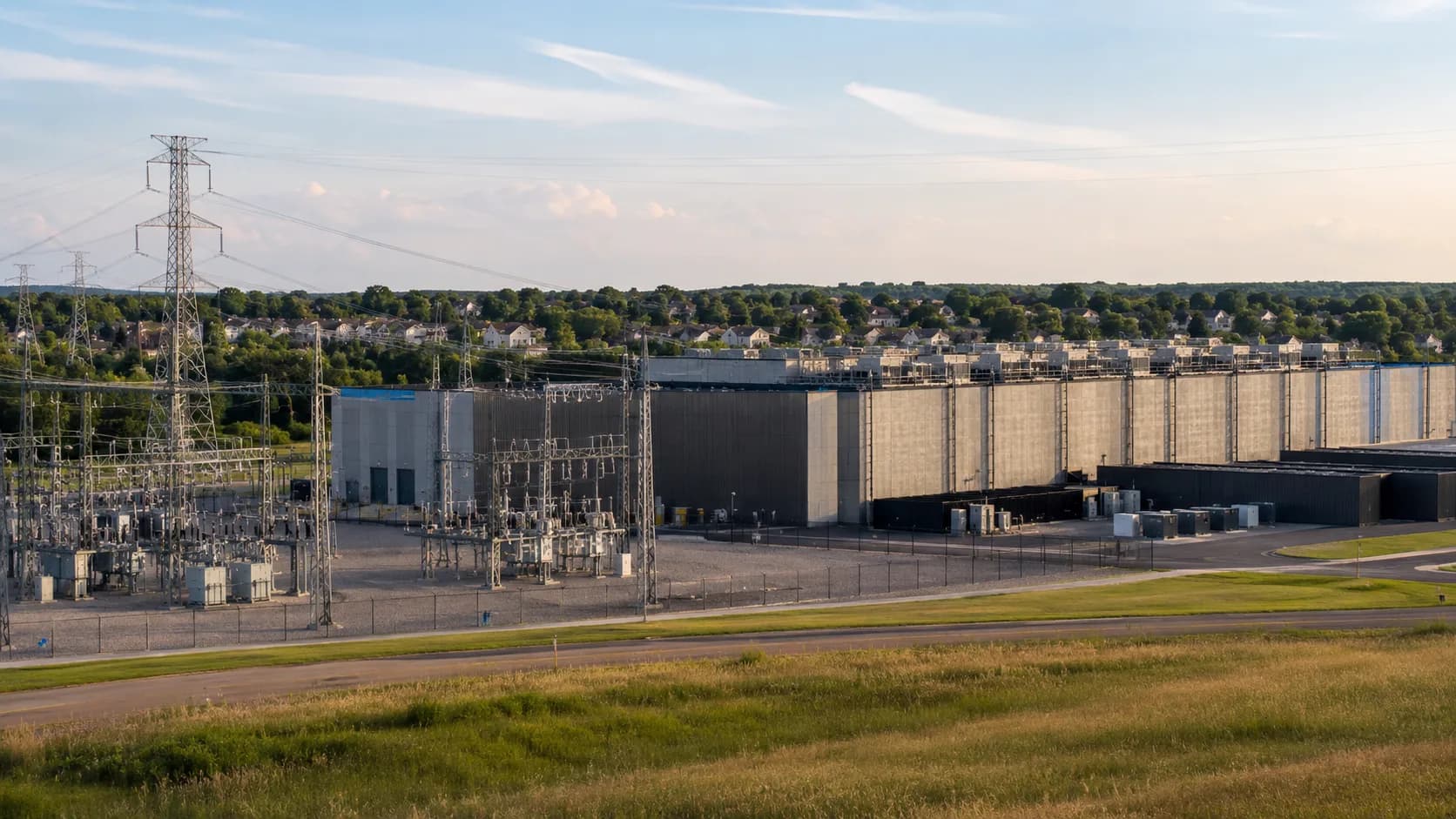
We ask a computer a question, request directions, stream a movie, order groceries or pull up a medical record, and the answer appears within seconds. Behind that seemingly effortless transaction, however, is an enormous physical system of servers, cooling equipment, electrical substations, fiber-optic cables and increasingly large data centers.
Those facilities have become the factories of the digital economy.
Unlike traditional factories, they do not turn steel into automobiles or cotton into clothing. They process, store and transmit information. Artificial intelligence has greatly increased the amount of computing needed to perform those tasks, setting off a nationwide race to build larger and more powerful data centers.
That race is creating investment and opportunity. It is also raising an important question: Can America produce enough electricity for the AI revolution without overburdening the families and communities already connected to the grid?
The question is not whether AI needs more infrastructure. It is whether that infrastructure can be built without shifting unfair costs onto the communities around it.
A New Era of Electricity Demand
For years, electricity consumption in the United States remained relatively flat as appliances, buildings and industrial equipment became more efficient. That period appears to be ending.

The U.S. Energy Information Administration expects electricity use to continue rising through 2027, driven largely by large computing facilities, including data centers. EIA has described the current period as the strongest four-year growth in American electricity demand since 2000.
The longer-term projections are even more striking. A June 2026 report from Lawrence Berkeley National Laboratory estimated that data centers could account for approximately 11.8 percent of all U.S. electricity use by 2030. Because AI development remains difficult to predict, the researchers offered a range from 9.5 percent to 15.3 percent. Their reference estimate would put data-center consumption at approximately 649 terawatt-hours annually by the end of the decade.
That does not mean the lights are about to go out across America. It does mean grid planners are confronting levels of new demand they did not anticipate only a few years ago.
Where the Building Boom Is Happening
Northern Virginia remains the nation's largest established data-center market, supported by extensive fiber connections, proximity to major government and corporate users, and decades of industry development.
But the boom is spreading. Atlanta, Dallas-Fort Worth, Chicago and Phoenix have become major markets, while developers are exploring new locations in West Texas, Tennessee, Wisconsin, Ohio and other areas where land and power may be easier to secure. CBRE reported that inventory in North America's four largest markets grew 33 percent during the year ending in the first quarter of 2026.
Texas is emerging as one of the most important pieces of the national picture. JLL has projected that Texas, viewed as a single market, could surpass Northern Virginia as the world's largest data-center market by 2030. That projection depends on how many proposed projects actually secure power, financing, permits and customers.
Those qualifications matter. A project appearing in an application or development pipeline is not the same as a completed facility.
In June 2026, the Electric Reliability Council of Texas said it was tracking more than 438,000 megawatts of large-load connection requests, with nearly 89 percent associated with data centers. That number is not a forecast that all those facilities will be built. It is an indication of the extraordinary volume of proposals competing for access to the Texas grid.
Aren't Data Centers Supposed to Supply Their Own Electricity?
This is where much of the public confusion begins.
Some data-center developers are promising to "bring their own power." That may involve constructing an on-site natural-gas plant, contracting with a solar or wind farm, purchasing nuclear power, installing batteries or supporting construction of an entirely new generating facility.
But bringing power does not necessarily mean operating completely outside the public electrical system.
A data center may still rely on the grid for backup, balancing, transmission or power during maintenance and emergencies. Even a company purchasing enough electricity from a distant power plant may need new substations and transmission lines to deliver that energy to its facility.
The real question is not simply whether a company has purchased electricity. It is whether the company is paying the full cost of the generation, transmission, substations and other improvements required to serve it.
Will Household Electric Bills Go Up?
There is no universal answer.

A new data center can become a valuable customer for a utility, purchasing enormous amounts of electricity around the clock. That additional revenue can potentially help spread some existing costs across a larger customer base.
The risk appears when a utility spends billions of dollars building new power plants, transmission lines and substations for a proposed data center - and then attempts to recover those investments from all customers.
There is an additional concern: What happens if the utility builds the infrastructure but the data center is delayed, downsized or never completed?
Federal and state regulators are increasingly attempting to prevent households from being left with that bill. In June 2026, the Federal Energy Regulatory Commission ordered the nation's six regional grid organizations under its jurisdiction to justify or reform the rules for connecting data centers and other large users. One of the ideas emphasized by commissioners is the use of cost-recovery agreements requiring large customers to pay their share even if a project does not ultimately use all the infrastructure built for it.
Several states are developing their own protections. Georgia regulators say their large-load rules are designed to keep data-center-related costs from raising bills for existing residential and small-business customers. Texas leaders are pushing requirements for data centers to pay their electrical infrastructure costs, add generation capacity and use water-efficient cooling technology.
These policies demonstrate that higher household bills are not inevitable. They also show that protecting ratepayers requires deliberate rules. Promises alone are not enough.
The Water Question
Electricity is only part of the story.
Computers generate heat, and that heat must be removed continuously. Some data centers use cooling towers in which water absorbs heat and a portion of that water evaporates. Other facilities rely more heavily on outside air, enclosed liquid systems, reclaimed wastewater or combinations of several technologies.
Consequently, there is no single number that accurately describes how much water every data center uses.
Lawrence Berkeley National Laboratory researchers found that water consumption can vary dramatically depending on server efficiency, utilization, cooling technology, climate, location and the source of the electricity. Their analysis concluded that there is no single cooling solution that produces the best result in every location.
This is particularly important in drought-prone areas. A system that saves electricity by using evaporative cooling may consume more water. A dry-cooling system that conserves water may require more electricity during extremely hot weather. Reclaimed water can reduce pressure on drinking-water supplies, but the necessary pipelines and treatment systems must be available.
The debate should therefore be based on local conditions rather than broad assumptions. A facility in a water-rich northern climate presents a different set of challenges than a similar facility in West Texas, Arizona or Nevada.
Questions every community should ask
Where will the electricity come from, and who will pay for new infrastructure?
Where will the water come from, and what happens during drought restrictions?
Will the developer report actual electricity and water use after opening?
What protections apply if the project is delayed, downsized or canceled?

Could Nuclear Energy Be the Answer?
Nuclear power is gaining attention because data centers need dependable electricity every hour of the day - not only when the sun is shining or the wind is blowing.
Some technology companies are supporting the restart or continued operation of existing nuclear plants. Others are investing in advanced reactors that could eventually supply new power to the grid.
Small modular reactors, commonly called SMRs, are attracting particular interest. They are intended to be smaller and more repeatable than traditional nuclear plants, with components that could eventually be manufactured in factories and assembled in modules. In theory, a utility or industrial customer could add reactors as electricity demand grows.
The technology is moving beyond the drawing board, but it is not yet a quick solution for most data centers. The Nuclear Regulatory Commission issued a standard design approval for NuScale's 462-megawatt US460 design in May 2025. That approval allows the design to be referenced in future license applications; it does not mean a completed commercial plant is currently supplying electricity.
Google and Kairos Power are working toward advanced-reactor projects totaling as much as 500 megawatts by 2035, beginning with a planned 50-megawatt project in Tennessee targeted for 2030. These commitments are meaningful, but they also suggest that advanced nuclear energy will probably become a larger part of the answer during the 2030s - not a complete solution to the projects seeking electricity today.
The Answer Will Be a Combination
No single energy source is likely to carry the entire AI expansion.
Natural gas can be constructed more quickly than nuclear generation and can operate when needed, but it produces emissions and may require new pipelines. Wind and solar can add power relatively quickly and without fuel costs, but their output varies with weather and time of day. Batteries can shift electricity into high-demand periods, although they do not create electricity themselves. Existing nuclear plants provide dependable carbon-free generation but are limited in number.
New transmission will also be necessary. America may have available electricity in one region while lacking the infrastructure needed to move it to another.
Data centers themselves can become part of the solution. Some computing tasks can be delayed or shifted to another location when the grid is under stress. Batteries and backup systems can help reduce a facility's draw during peak periods. Better forecasting can help utilities avoid building infrastructure for speculative projects that never materialize.
The data center of the future may not simply consume electricity. It could communicate with grid operators, reduce nonessential computing during emergencies and help balance the electric system.
Growth With Guardrails
Data centers are not temporary visitors. They are becoming part of the nation's essential infrastructure, supporting communications, banking, healthcare, government, entertainment, transportation and artificial intelligence.
Communities can benefit from construction investment, property taxes, technology development and improved electrical and fiber infrastructure. But those benefits must be weighed against demands on land, water and the electric system.
The choice does not have to be between welcoming every proposal and banning the industry altogether.
A responsible approach would require developers to demonstrate that their electricity and water plans are achievable before construction begins. It would require large users to pay for the infrastructure built to serve them. It would encourage reclaimed water, efficient cooling, flexible electricity use and new generation that adds capacity rather than simply competing with existing customers.
It would also give residents clear information before decisions are made - not after contracts have been signed and construction has begun.
America has powered major industrial changes before. Each one required investment, planning and rules that evolved as the technology grew.
Artificial intelligence will be no different.
The most important question is not whether more data centers are coming. They are.
The question is whether we will build them in a way that strengthens the communities around them - or leaves those communities carrying costs they never agreed to bear.
Editorial note: Research was checked August 5, 2026. A companion source file is included with this article package.
Sources
U.S. Energy Information Administration — Electricity demand growth and data centers (Jan. 13, 2026)
EIA — Fossil generation and data-center power demand (March 12, 2026)
Lawrence Berkeley National Laboratory — U.S. Data Center Energy Usage Report: 2025 Update
ERCOT — PUCT approves Batch Zero large-load process (June 18, 2026)
Lawrence Berkeley National Laboratory — Water use of data center workloads
U.S. Nuclear Regulatory Commission — NuScale US460 standard design approval
Projected capacity, interconnection requests, and company timelines are not the same as completed facilities. Water use varies widely by cooling design and location.