Buc-ee's: The Gas Station That Deserves Respect
How clean restrooms, brisket, Beaver Nuggets, and Texas-sized ambition turned a fuel stop into a road-trip destination.
There was a time when stopping for gasoline was a brief and largely forgettable event.
You pulled beside the pump.
You filled the tank.
You bought a soft drink.
You used the restroom only when the situation had reached the point where personal dignity was no longer the primary concern.
Then you left.
Nobody took photographs.
Nobody bought a souvenir shirt.
Nobody returned to the car carrying barbecue, fudge, beef jerky, outdoor decorations, three bags of snacks, and an item for the living room that had not existed on the shopping list five minutes earlier.
Then Texas gave us Buc-ee's.
Now a gasoline stop can take 45 minutes — and that is assuming everyone in the family remembers where the vehicle is parked.
It Started With a Simple Promise
Buc-ee's began in Texas in 1982 with a straightforward mission: give customers a place that is clean, friendly, and fully stocked. More than four decades later, the company still describes those three ideas as the foundation of the business.
That may not sound revolutionary.
But consider the traditional roadside stop.
Travelers often expected the restroom to be questionable, the food to be wrapped in plastic, the coffee to have survived several presidential administrations, and the cashier to look mildly surprised that someone had entered the building.
Buc-ee's approached the same business differently.
Instead of asking how little a gas station could provide, the company asked how much could be added before the words gas station no longer seemed adequate.
The answer, apparently, was quite a lot.
The Bathrooms Matter More Than Anyone Wants to Admit

The real Buc-ee's conversation often begins with the restrooms.
We can talk about brisket, Beaver Nuggets, merchandise, gas pumps, and the beaver mascot.
But the real Buc-ee's conversation often begins with the restrooms.
The company made cleanliness one of its central promises rather than a chore assigned to whichever employee appeared least busy.
That matters because road travelers are not always searching for an experience.
Sometimes they are searching for a clean restroom and becoming increasingly willing to negotiate with the universe.
Parents understand this.
So do grandparents.
So does anyone who has heard a small voice from the back seat announce an emergency approximately seven miles after passing the previous exit.
Buc-ee's recognized that clean, spacious facilities do more than satisfy a practical need. They build trust.
A traveler who has stopped at one location and found it clean is more likely to recognize the sign ahead on the next trip and say:
“Let's stop there. We know what we're getting.”
That consistency may be more valuable than any billboard or television advertisement.
It also proves that one of the most successful ideas in modern roadside retail was something every traveler had been requesting for decades:
Please clean the bathroom.
The Fuel Pumps Are Only the Beginning
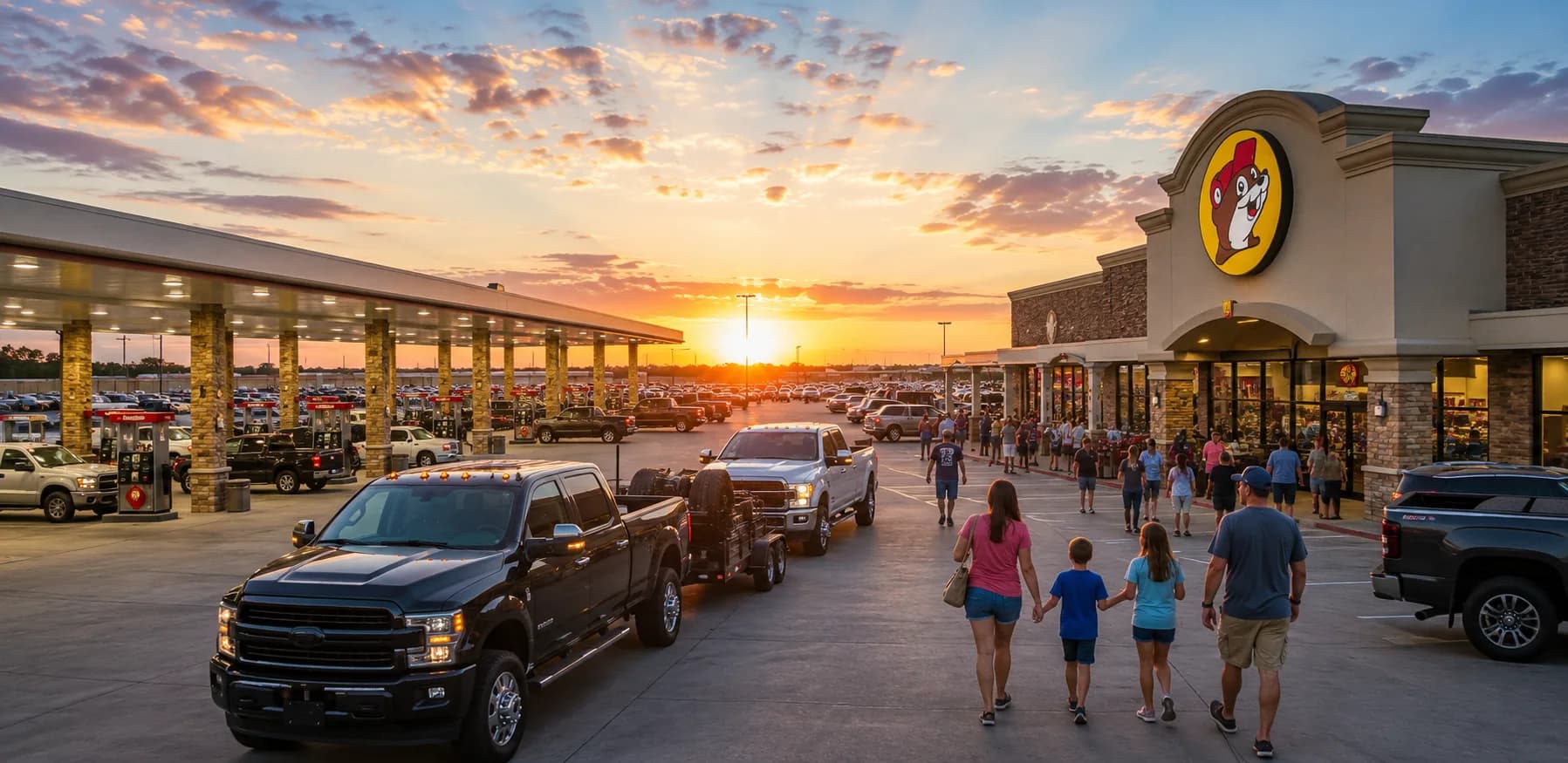
A Buc-ee's travel center does not gently appear beside the highway.
It announces itself.
The billboards begin miles before the exit.
The beaver smiles from above the road.
Then the building appears, surrounded by what can look like enough fuel pumps to support a small military operation.
When the new Luling travel center opened in 2024, it covered more than 75,000 square feet and offered 120 fueling positions.
That is not a corner convenience store.
That is a roadside ecosystem.
The large number of pumps solves one of the most annoying problems at ordinary fuel stops: waiting behind someone who has apparently decided to complete several unrelated errands while leaving the vehicle beside the only available pump.
At Buc-ee's, there is usually another pump.
And another.
And another.
Somewhere beyond the horizon, possibly another.
But the unusual part is that many customers finish fueling and then walk inside voluntarily.
They are not merely paying for gasoline.
They are entering the main event.
A Convenience Store Ate a Barbecue Restaurant

Many customers finish fueling — then walk inside for the main event.
Food changed the roadside stop.
People once entered a gas station looking for something that could be eaten safely while driving.
Buc-ee's created a place where customers may plan the stop around the food.
The options vary, but the familiar attractions include brisket sandwiches, breakfast tacos, jerky, pastries, fudge, roasted nuts, kolaches, and the sweet corn-puff snack known as Beaver Nuggets. Food writers and travelers have repeatedly described those products as part of what transformed the chain into a destination rather than a necessary interruption.
The brisket counter is particularly theatrical.
Employees prepare and wrap sandwiches while calling out the arrival of freshly chopped brisket with enough energy to make you wonder whether Texas has just won another battle.
It is food service combined with performance.
You may enter intending to buy a bottle of water.
Then you hear someone announce fresh brisket.
Five minutes later, you are holding a sandwich, a container of fudge, a bag of jerky, and enough Beaver Nuggets to keep a youth baseball team awake through an entire tournament.
This is not poor planning.
It is the Buc-ee's effect.
Beaver Nuggets Should Come With a Warning
Every successful roadside institution needs one food item that visitors feel obligated to explain to people who have never tried it.
Buc-ee's has Beaver Nuggets.
They are sweet, crunchy corn puffs coated with a caramel-like flavor, and they occupy a fascinating place between snack, dessert, and personal weakness.
Nobody seems to purchase the smallest possible amount.
The bags are opened in the car with the stated intention of sharing.
Within twenty miles, someone is holding an empty package and blaming the other passengers.
Beaver Nuggets are also proof that successful branding does not always require a complicated name.
Call a product caramel corn puffs, and it sounds ordinary.
Call it Beaver Nuggets, place a smiling beaver on the bag, and people carry it across state lines as a gift.
Marketing professors could study that for years.
Texas travelers simply open another bag.
Part Store, Part Gift Shop, Part Treasure Hunt

The store does not merely meet road-trip needs. It creates new ones.
The modern Buc-ee's contains far more than food and travel necessities.
There are shirts, hats, cups, home decorations, seasonal merchandise, outdoor products, toys, blankets, kitchen items, and enough beaver-branded goods to make it possible for an entire family to dress as though it has joined a very cheerful woodland organization.
This is where the quick stop begins to lose control.
One family member heads toward the restroom.
Another studies the barbecue menu.
Someone disappears into the clothing section.
A child finds the toys.
A spouse begins evaluating a decorative sign that would look perfect in a room that had not required decoration until that exact moment.
Eventually, everyone reconnects near the front of the store carrying completely different items and asking the same question:
“Where did we park?”
Buc-ee's understood that travelers are a captive audience only if they are given a reason to stay.
The store does not merely meet road-trip needs.
It creates new ones.
The Beaver Is Doing More Work Than Most Executives
The Buc-ee's mascot is friendly, instantly recognizable, and almost impossible to separate from the experience.
The smiling beaver appears on signs, clothing, cups, food packages, photographs, and merchandise.
People pose beside it.
Children recognize it.
Adults buy shirts featuring it and then wear them hundreds of miles from the nearest store.
That kind of loyalty is unusual for a business whose original purpose was selling fuel.
Most gas-station logos are designed to help drivers identify the correct credit-card charge later.
The Buc-ee's beaver became something closer to a regional character.
It represents road trips, Texas humor, clean bathrooms, snacks, and the knowledge that everyone in the car is about to take longer than promised.
The Real Product Is Certainty
Buc-ee's offers plenty of products, but its most important product may be certainty.
Travelers generally know what they will find:
A well-lit location.
Numerous fuel pumps.
Clean facilities.
Food prepared throughout the day.
Shelves that are stocked.
A familiar atmosphere.
Enough activity to make the stop feel safe and intentional.
The company's original clean, friendly, and in-stock promise sounds simple because it is simple. The difficult part is delivering it consistently across large stores serving enormous numbers of travelers.
People rarely develop affection for a business merely because it is large.
They return because it reliably solves a problem.
Buc-ee's solves several at once.
It gives the driver fuel.
It gives the family food.
It gives the children something to explore.
It gives the traveler a dependable restroom.
And it gives everyone a story about purchasing far more than they expected.
Not Everyone Wants the Full Experience
Respecting Buc-ee's does not require pretending that everyone enjoys it.
Some travelers see the crowded parking lot and decide they would rather continue driving with the fuel warning light glowing.
The store can be busy.
The choices can be overwhelming.
A customer wanting nothing more than gasoline and black coffee may not need 75,000 square feet of opportunity.
There is also something special about the smaller independent stations found throughout Southeast Texas.
Those places may serve breakfast tacos wrapped in foil, barbecue made from a family recipe, burgers cooked after the order is placed, or kolaches sold by someone who already knows the regular customers.
The building may not contain a wall of jerky.
There may be only four fuel pumps.
But the food can still be worth the exit.
Buc-ee's did not invent the idea that good food could be found beside a gas pump. Texas roadside stores had been proving that for generations.
What Buc-ee's did was take that local roadside tradition, enlarge it dramatically, standardize the experience, and package it beneath one very successful beaver.
Is It Still a Gas Station?
Technically, yes.
You can purchase gasoline.
But calling Buc-ee's a gas station is a little like calling a county fair a place to buy lemonade.
It is accurate.
It is simply incomplete.
Buc-ee's is part convenience store, part restaurant, part gift shop, part roadside attraction, and part test of whether a family can leave with only the items it intended to purchase.
It is also an example of a business recognizing that the most ordinary part of a trip could become memorable.
People do not normally become excited about stopping for fuel.
Buc-ee's changed the emotional meaning of the stop.
The question became not:
“Do we need gasoline?”
But:
“Is there a Buc-ee's on the way?”
That is an extraordinary achievement for any retailer.
Texas Built It Big — But Not Carelessly
The size receives most of the attention, but size alone would not explain the loyalty.
A huge, dirty, poorly stocked travel center would simply give customers more room to be disappointed.
Buc-ee's works because the spectacle is supported by practical execution.
The pumps matter.
The bathrooms matter.
The food matters.
The staffing matters.
The shelves matter.
The lights, parking, signs, and consistency all matter.
Texas may enjoy making things bigger, but customers continue returning only when bigger also works better.
That is why Buc-ee's deserves respect.
Not because every sandwich is life-changing.
Not because everyone needs a beaver shirt.
Not because no other roadside store can compete.
It deserves respect because it took one of the least celebrated experiences in American travel and asked how it could be improved.
Then it added brisket.
The Bottom Line
A road trip is made of destinations, but it is also made of stops.
Some stops are forgotten before the vehicle reaches the entrance ramp.
Others become part of the story.
Buc-ee's became part of Texas road-trip culture by understanding that travelers appreciate the same things everywhere: cleanliness, reliability, decent food, friendly service, and a little entertainment along the way.
It also understood something deeply Texan:
When improving a gas station, there is no particular reason to stop at slightly better.
Make it enormous.
Add barbecue.
Build more pumps.
Sell the shirt.
Put a smiling beaver on everything.
And make sure the restroom is clean.
You may enter because the truck needs fuel.
You may leave with brisket, fudge, Beaver Nuggets, a new cap, and a decorative metal rooster that nobody remembers selecting.
But you will probably remember the stop.
And that is how a gas station earns respect.