A Garage Full of Toilet Paper Is Not a Hurricane Plan
Edouard reminded Southeast Texas that the hardest part of a tropical system is not always the wind. It is the uncertainty. A real household plan begins long before the forecast cone arrives.
Edouard reminded Southeast Texas that the hardest part of a tropical system is not always the wind. It is the uncertainty. A real household plan begins long before the forecast cone arrives.
Edouard gave Southeast Texas another look at the strange hours before a storm, when the forecast keeps moving and everybody tries to decide how worried to be. The useful question is not whether we guessed this storm correctly. It is whether the next one could interrupt ordinary life without sending us into a panic.
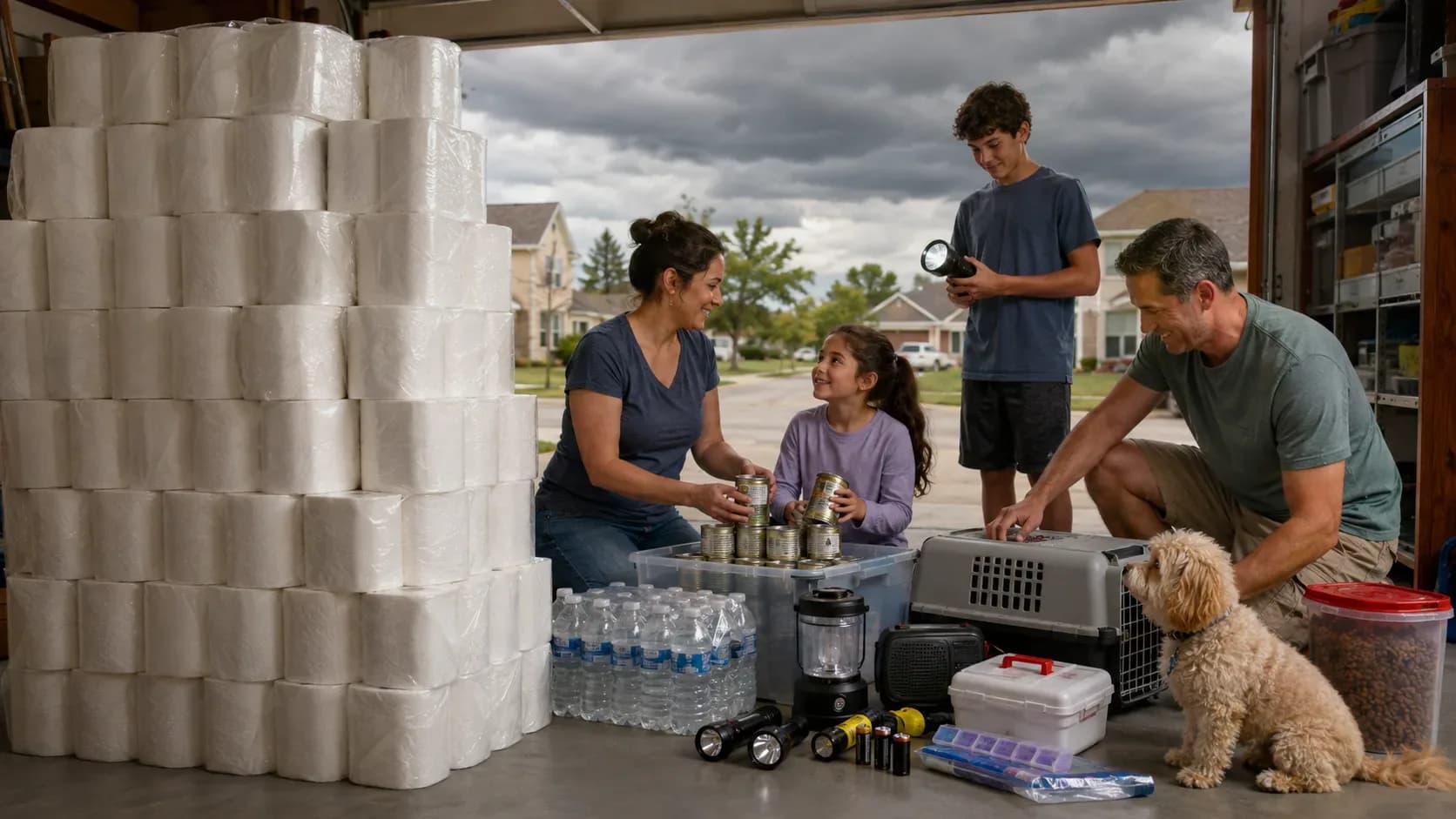
There is a peculiar moment before a tropical storm reaches Southeast Texas. The radar is open on every phone. One person says the worst will arrive around five in the morning. Another looks at the same spinning colors and says, "Hmmm. Maybe not." Schools make decisions. Utility crews move into position. Families charge phones, watch the sky and wait to see which neighborhood ends up under the rain band. Then somebody buys enough toilet paper to survive the collapse of the Roman Empire.
We laugh because we recognize it. But as Tropical Storm Edouard came ashore near the Texas-Louisiana line and weakened into a depression, the National Weather Service kept emphasizing what mattered most: heavy rain, possible flash flooding and uncertainty about exactly where the strongest bands would settle. That uncertainty is not a failure in the forecast. It is part of tropical weather. It is also the reason preparedness cannot begin with a perfect prediction.
A Storm Does Not Have to Hit Your Driveway
When the center of a storm shifts away, it is tempting to decide we worried for nothing. When it shifts toward us, it is tempting to race to the store and buy whatever everybody else is buying. Neither response is much of a plan.
A tropical system can miss one part of a county and flood another. It can spare the roof but stop the electricity. It can leave the electricity on but close the road. It can pass without dramatic damage at one house while the family a few miles away is dealing with water, fallen trees or days without power. For the person whose home was damaged, no storm was "just a warning." That deserves to be said plainly.
But a storm can also warn the rest of us without destroying everything we own. It can show us the battery bank that was dead, the prescription that was almost empty, the generator that had not been started since last year and the family member nobody had decided who would check on. That kind of warning is worth using.
Preparedness Begins on an Ordinary Tuesday

The best time to prepare for a hurricane is when there is not one on the map. That is when bottled water is simply bottled water. Batteries are still on the shelf. Gas stations are not lined with vehicles. Nobody is standing in a grocery aisle wondering whether 14 cans of creamed corn count as a meal plan.
Federal preparedness guidance recommends building a household supply kit with water, nonperishable food, lights, batteries, a radio, first-aid supplies, medicines, cash, chargers and copies of important documents. The familiar starting point for water is one gallon per person per day for several days, with additional needs for pets, illness or hot weather.
The exact kit should not be identical for every house, because every house is not identical. A young couple with two dogs needs a different plan from an older couple managing refrigerated medicine. A family with an infant needs different supplies from a family with teenagers. Someone who uses a CPAP machine, powered mobility equipment or another medical device needs more than a flashlight and a case of water.
Preparedness starts by asking what has to keep working in this particular house. Who needs medicine? Who needs help moving? What needs electricity? What will the pets eat, and where can they go if a shelter or hotel does not accept them? Who is checking on the older neighbor down the road? Those questions are more valuable than a cart full of whatever happened to be left at the store.
Owning a Generator Is Not the Same as Having Power

A generator feels like a plan right up until it will not start. If a household depends on one, it should be tested before hurricane season and exercised according to the manufacturer's instructions. Fuel must be stored safely and legally. Extension cords must be rated for the load and condition in which they will be used. If a generator is connected to household wiring, the installation needs the proper transfer equipment and a qualified electrician.
Most important, portable generators belong outside. The Centers for Disease Control and Prevention says they should never be operated in a home, basement, garage or other enclosed space. Opening the garage door does not make the garage safe. The CDC recommends keeping a portable generator at least 20 feet from doors, windows and vents, directing exhaust away from the house and using a battery-powered or battery-backup carbon monoxide detector inside. Carbon monoxide cannot be seen or smelled. A machine intended to keep the family comfortable should not become the most dangerous thing at the house.
Power planning is not only about the generator. Charge battery banks before the weather arrives. Keep flashlights where people can actually find them in the dark. Know how long critical medical equipment can operate without wall power. Put refrigerator and freezer thermometers where they can be read. FoodSafety.gov says an unopened refrigerator generally keeps food safe for about four hours during an outage. A full unopened freezer can hold a safe temperature for about 48 hours, or about 24 hours if it is half full. When in doubt, throw it out. Tasting food is not a safety test.
The Boring Things Become Important Fast
Storm preparation is full of items nobody photographs for social media. A manual can opener. Paper copies of phone numbers. A waterproof folder containing identification, insurance information, medical records and a list of prescriptions. Photographs or video of the house and its contents before anything is damaged. Some cash in small bills for the hours when electricity works at neither the house nor the card reader. Pet carriers that can be reached without emptying half the garage. A weather radio that does not depend on a cell tower. Enough fuel in the vehicle to leave before everybody else has the same idea.
None of that is dramatic. That is the point. Preparation should feel almost boring. Buy a little at a time. Date it. Rotate it into ordinary use. Replace what expires. Run the generator. Recharge the power banks. Update the documents. Review the plan at the beginning of hurricane season and again when something in the household changes. A good emergency supply is not a museum exhibit sealed in a plastic tub for 12 years. It is a small system that stays ready because somebody pays attention to it.
Decide Before the Water Rises
The hardest decisions should not be invented in the middle of the storm. Know where the family will go if local officials order an evacuation. Know more than one route. Decide how pets will travel. If someone cannot drive or leave without help, arrange that help before the road is crowded.
Sign up for local emergency alerts. In Montgomery County, AlertMCTX is the county notification system. Follow the National Weather Service and local emergency management, not the loudest person forwarding a screenshot with no date on it.
Most of all, decide in advance that floodwater wins the argument. The National Weather Service warns that six inches of fast-moving water can knock over an adult, 12 inches can carry away most cars and two feet can carry away SUVs and trucks. Water across a road may hide a washed-out surface, a missing shoulder or a downed power line. If the road is flooded, turn around. Being late is inconvenient. Being swept off the road is something else.
The Plan Includes People

Supplies matter, but preparedness is not a private contest to see who can build the largest pile in a garage. The strongest neighborhood may be the one where people know who needs help. One family has a chainsaw. Another has a generator. Somebody is a nurse. Somebody knows which road floods first. Somebody can pick up a prescription. Somebody can bring an older neighbor inside before the heat becomes dangerous.
That does not mean taking foolish risks or turning a household into an unofficial rescue service. It means exchanging phone numbers before the storm, checking on people when it is safe and remembering that resilience is easier when nobody has to improvise alone. The person with six cases of toilet paper may discover that the neighbor with a working radio is better prepared.
Let the Warning Count
Edouard did not become the catastrophic hurricane people fear when they see a Gulf storm forming. But it did not have to. Parts of Southeast Texas dealt with flash flooding, downed trees, flooded roads and widespread power outages while other communities saw far less. That may be the most useful warning the storm could have given us.
The lesson is not that everybody should have panicked. It is that nobody gets to choose which rain band stalls over their neighborhood, which road floods or how long the electricity stays off. Another storm will come. It may be stronger. It may be weaker. It may turn at the last minute, stall over one watershed or pass far enough away that the plywood never leaves the garage.
Preparedness is not correctly guessing which house the storm will choose. It is being able to keep drinking, eating, communicating, taking medicine and making calm decisions when the ordinary systems around us stop being ordinary. A garage full of toilet paper is not a hurricane plan. A household that knows what it needs, where it will go and who it will check on is getting much closer.
Sources and further reading: National Weather Service Houston/Galveston — Area Forecast Discussion • National Hurricane Center — Edouard Landfall Update • Associated Press — Edouard brings flash flooding, downed trees and power outages to Texas • CDC — Preparing for Hurricanes or Other Tropical Storms • Ready.gov — Build a Kit • CDC — Avoiding Carbon Monoxide Poisoning • FoodSafety.gov — Food Safety During a Power Outage • National Weather Service — Turn Around Don't Drown • Montgomery County — AlertMCTX