The Clinic Had No Electricity. The Ambulance Brought Its Own.
Twenty-three students built a mobile clinic that carries medical equipment and the electricity needed to run it. A field test in Kenya showed what worked — and what still has to be proved.
Twenty-three students built a mobile clinic that carries medical equipment and the electricity needed to run it. A field test in Kenya showed what worked — and what still has to be proved.
At the end of a six-hour drive over rough roads in southwestern Kenya, the problem was not simply reaching the clinic. The clinic in Mosiro had no electricity. That changes what the word access means.
A building may have trained people, an examination room and patients waiting outside. But without dependable power, an ultrasound machine is just a heavy box. Vaccines cannot be kept safely cold. An X-ray unit cannot take a picture. Even lights, communications equipment and devices that measure vital signs become uncertain.
A group of 23 students from the Netherlands arrived with an unusual answer. Their vehicle did not merely carry medical equipment to the end of the road. It carried the electricity needed to use it.
An Ambulance That Reverses the Usual Trip

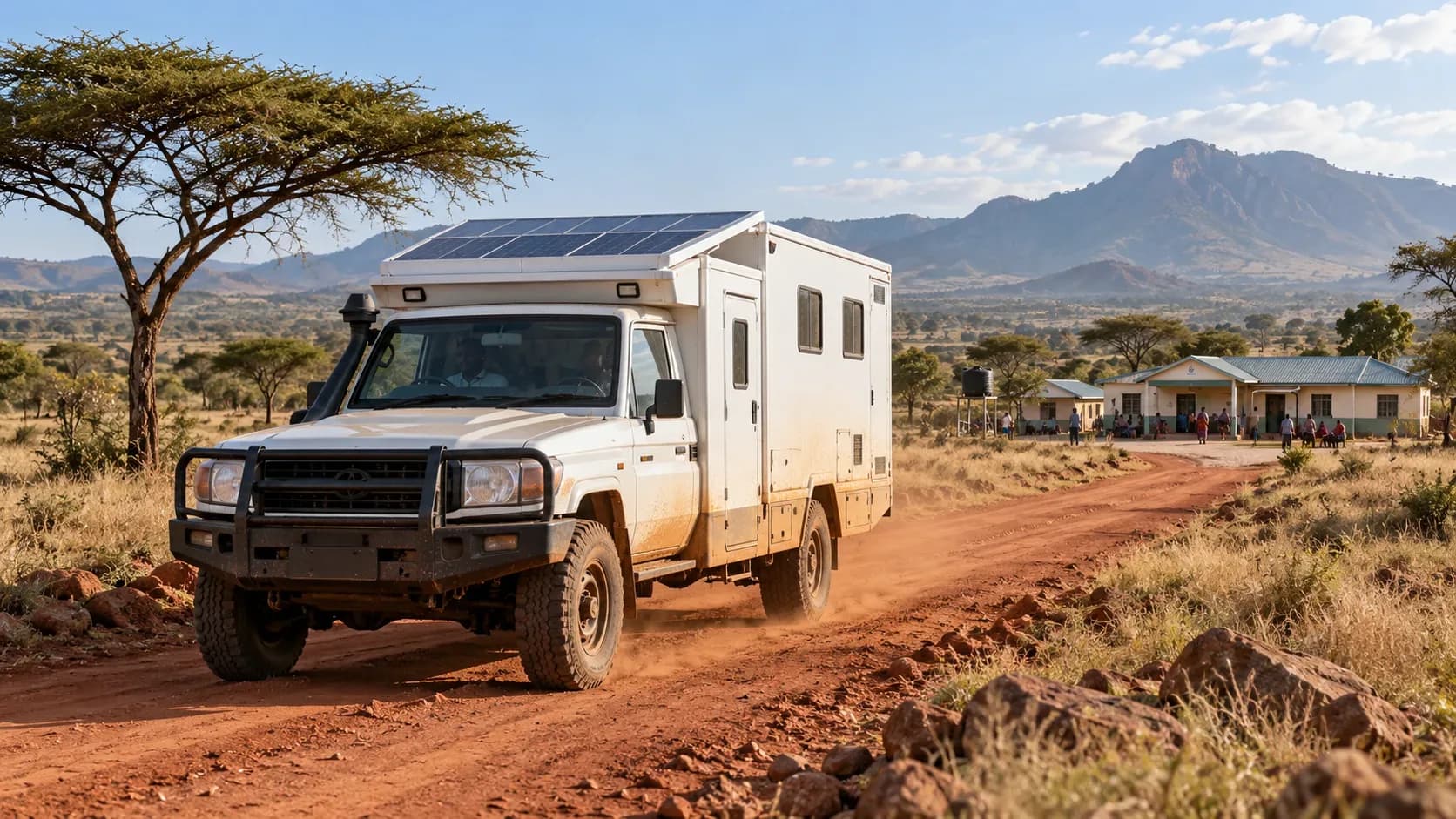
The vehicle is called Stella Juva, and its builders describe it as the world's first solar-powered ambulance. That name creates the wrong picture if we imagine sirens, a stretcher and a race back to an emergency room. Stella Juva operates more like a mobile health clinic. A conventional ambulance takes a patient to the hospital. This one is designed to take pieces of the hospital to the patient.
Solar cells cover the roof and collect energy while the vehicle travels. Once it stops, additional panels unfold from the sides, increasing the area exposed to sunlight. A 50-kilowatt-hour battery stores that power. Inside are tools that remote health workers often cannot use reliably: a portable X-ray machine, an ultrasound system, an automated external defibrillator and refrigeration for vaccines.
The design lists 542 solar cells and a projected paved-road range of as much as 715 kilometers under favorable conditions. Those are design specifications, not a promise that every trip will reach that distance. Terrain, weather, equipment use, battery condition and the amount of sunlight all matter. The important question was whether the entire idea would continue working after it left a university workshop.
The Test Left the Parking Lot
In August, Solar Team Eindhoven and the health organization Amref Health Africa tested Stella Juva at several field locations around Kenya's Narok region. The team drove more than 800 kilometers — about 500 miles — across paved and unpaved roads. Reaching Mosiro required hours on a dusty clay road broken by potholes.
There was one mechanical failure: a steering rod broke. The team replaced it in about half an hour and continued. That detail is not a blemish to hide. Remote equipment must be repairable, and a field test that reveals a weakness is more useful than a polished demonstration that never encounters one.
Then came the test that mattered most. While the vehicle was stationary, the team operated all of its onboard medical equipment simultaneously. According to the university and Amref, the solar system generated more electricity than the equipment consumed. The organizations estimated that the setup could have supported care for roughly 200 people during the two-day exercise.
No real patients were treated. Healthcare workers simulated use of the equipment, so the trial did not prove clinical outcomes. It did establish something more modest and still important: the vehicle could make the trip, arrive at a location without grid power and run the tools it was designed to carry.
The Larger Problem Is Not the Vehicle

The World Health Organization has estimated that close to one billion people in low- and lower-middle-income countries are served by healthcare facilities with either no electricity or unreliable electricity. In sub-Saharan Africa, WHO data show that about 15 percent of healthcare facilities lack electricity altogether, and only about 40 percent have reliable power. Rural and primary-care facilities are generally in the weakest position.
Those percentages describe daily consequences. A vaccine refrigerator cannot be allowed to drift in and out of a safe temperature range. A woman should not have to travel for hours simply because the nearest ultrasound machine has no dependable power. A clinic should not have to choose which device can be switched on when a generator is low on fuel.
That is why the solar ambulance is more interesting than another experimental vehicle covered in panels. It combines three things that are usually planned separately: transportation, medical equipment and electricity. Instead of waiting for a road to improve, a power line to arrive and a clinic to be fully equipped, the same platform attempts to bring all three capabilities at once.
What the Students Have Not Proved
A successful prototype is not a fleet. Stella Juva is returning to the Netherlands, and no manufacturer has announced large-scale production. No government or health organization has committed to buying dozens of vehicles. The cost of building, operating and replacing the prototype has not been turned into a proven business model.
There are practical questions ahead. Who will train local technicians? Will parts be available hundreds of miles from a major city? How will the panels, batteries and medical devices hold up after years of dust, vibration and heat? What happens through extended cloudy weather? Can a future version be built at a price that health systems can afford?
The quick steering repair was encouraging because the team was present with tools and expertise. A permanent service will need that same ability after the students have gone home. Maintenance is not a footnote to innovation. In a remote community, it may determine whether an impressive machine becomes essential infrastructure or an abandoned vehicle.
Those unanswered questions do not cancel the test. They define the next one. The students proved that the technical idea can work under real travel conditions. Industry, governments and health organizations must prove that it can be financed, manufactured, maintained and trusted.
An Idea That Can Travel Farther Than Kenya

The need is especially visible in regions where clinics may be separated by long distances and unreliable infrastructure. But the underlying idea does not stop at a national border. Hurricanes, floods, wildfires and other disasters can leave modern communities with intact medical skills but no dependable grid. Rural towns can be hours from specialized diagnostic equipment even when the roads are passable.
A mobile clinic that arrives with its own stored and renewable power could support temporary care, vaccine refrigeration, communications or basic diagnostics while larger systems recover. That does not mean this exact prototype is ready for Texas, Florida or anywhere else. It means the design asks a useful question: Why should a mobile medical unit assume that reliable electricity will be waiting at its destination?
One Excuse Is Gone
The most impressive part of Stella Juva is not the phrase "world's first." First can be temporary, expensive and impractical. The more meaningful achievement happened when the vehicle reached a clinic without electricity and its equipment did not go dark.
Twenty-three students have not solved rural healthcare. They have not solved manufacturing, funding or long-term maintenance. They have done something smaller and more useful: they removed one excuse from the conversation. Bringing both medicine and power to the end of the road is no longer merely an illustration of what might be possible someday. A prototype traveled the road, unfolded its panels and did it. Now the question is whether someone will build the second one.