The Whole World Feels Like It Is Happening at Once
The planet did not suddenly become one disaster. A warming climate, warm oceans, El Niño, tectonic movement and instant communication now place different events beside one another before breakfast. The challenge is learning what is connected, what is not and what the information means.
The planet did not suddenly become one disaster. A warming climate, warm oceans, El Niño, tectonic movement and instant communication now place different events beside one another before breakfast. The challenge is learning what is connected, what is not and what the information means.
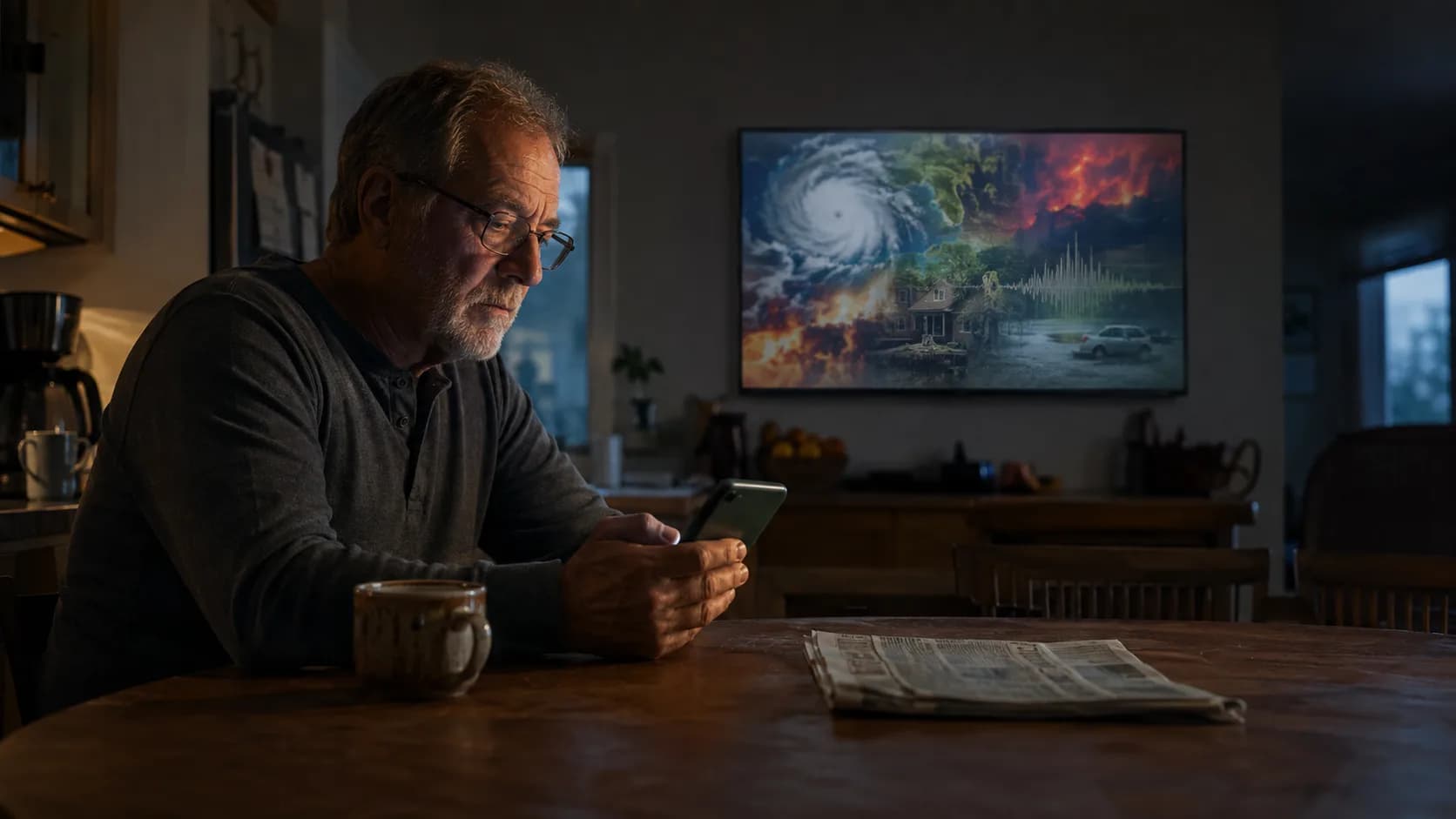
Before the first cup of coffee is finished, a telephone can deliver a heat warning from Europe, video of a flooded street in Asia, wildfire smoke rolling across Canada and an earthquake alert from an island most of us could not locate without opening a map. The stories arrive side by side, equally bright and equally urgent, even when the forces behind them have nothing to do with one another.
Then we step outside and discover that our own air feels wrong, the nighttime temperature never really fell, the garden is confused, or a storm has dropped more rain in an hour than we remember seeing in a day. The whole world feels like it is happening at once because, to us, it is.
The planet now fits in one hand
For most of human history, distance filtered information. A storm could destroy a town on another continent and weeks might pass before word reached anyone beyond the region. Photographs arrived later. The people reading about it were separated from the people living through it by time, geography and the limits of communication.
That separation has nearly disappeared. A person standing in a grocery-store line in Conroe can watch a live video from a street in Spain. Somebody in Michigan can see Canadian wildfire smoke moving toward the Great Lakes before the haze reaches the window. A homeowner in Delaware can receive a hurricane forecast, an earthquake notification and a heat advisory from three different parts of the world in the time it takes to pay one electric bill.
The telephone did not create those events. It removed the space between them. That is both useful and unsettling. We are warned faster. Emergency agencies can reach people sooner. Families can confirm that relatives are safe. Scientists can compare observations from thousands of instruments in almost real time. But our minds receive the planet as one continuous alarm.
Some of the weather really is connected

The feeling is not produced by technology alone. The physical background is changing too. Copernicus Climate Change Service reported that June 2026 was the second-warmest June measured globally and the hottest June on record for western Europe. The same report noted record-high June sea-surface temperatures worldwide, while dryness contributed to wildfire conditions across parts of Europe, North America and Russia.
The ocean matters because it stores and moves enormous amounts of heat. Warmer water can add moisture and energy to the atmosphere, influence rainfall patterns and raise the conditions from which individual weather systems develop. It does not manufacture every storm or explain every dry spell, but it can load the background in which those events occur.
This year another large influence has entered the picture. The World Meteorological Organization says El Niño has developed in the tropical Pacific and is expected to strengthen, affecting temperatures and rainfall patterns across much of the world. Some regions may become wetter. Others may face drought. Heat, wildfire risk and heavy rainfall can all increase in different places at different times.
That does not mean El Niño caused every headline. No two El Niño events behave exactly alike, and local geography, ocean conditions, seasonal patterns and plain atmospheric chance still matter. It means the dice are being rolled on a warmer table.
Earlier this month, Dock Line looked ahead at the developing pattern in It's August and Everybody Is Already Talking About Winter…. What seemed like a forecast discussion is beginning to feel less distant as heat, rainfall and ocean conditions become part of daily life around the world.
The human body keeps its own records
Temperature records can sound small when expressed as fractions of a degree. Human beings do not experience a global average. We experience the afternoon inside a parked car, the bedroom that will not cool at night, the medicine that must remain refrigerated and the electric bill produced by an air conditioner that never gets a rest.
A 2026 global study using Copernicus data found that hazardous heat stress is becoming more frequent, more intense and more widespread. It also found longer heat-stress seasons and hotter nights. The nighttime part is easy to overlook. A hot day is difficult. A hot night denies the body, the house, the crops and the electrical system their chance to recover. Several of those nights in a row turn inconvenience into accumulated strain.
That is one reason the world feels different even when a person cannot quote a temperature record. People are measuring change with sleep, breathing, utility bills, work schedules, gardens, livestock and the amount of time children can safely spend outside. The instruments are recording it. So are we.
Earthquakes belong to another story

This is where the conversation needs a firm line. Earthquakes appear beside storms, fires and heat waves in the news, but they are generally not another expression of the same climate system. Most natural earthquakes come from stress and movement in Earth's crust, especially where tectonic plates meet. A hot ocean does not explain a major fault rupture on the other side of the planet.
The U.S. Geological Survey says temporary increases and decreases in earthquake activity are normal. Its National Earthquake Information Center locates about 20,000 earthquakes worldwide each year — roughly 55 every day. Long-term records suggest an average year brings about 16 major earthquakes: approximately fifteen in the magnitude 7 range and one magnitude 8 or greater. Some years fall below that number. Some rise above it. A cluster can be frightening and destructive without proving that the entire planet has entered a new seismic age.
We also detect more than earlier generations could. There are more instruments, faster communications and millions of people carrying devices that can report shaking, receive alerts and share video within seconds. The earthquake is real. The suffering is real. The idea that every earthquake is part of the same weather crisis is not. Keeping those truths separate does not make the world less serious. It makes our understanding more useful.
Distance stopped protecting us from the consequences
Even when two disasters have different causes, their effects can meet later. A drought damages crops. A flood closes a factory. A wildfire interrupts rail service. An earthquake damages a port. A heat wave raises electricity demand. Somewhere else, a family notices the result as a higher grocery price, a delayed part, an insurance increase or an empty shelf.
Modern trade connected the world's conveniences. It also connected the world's interruptions. That is why an event thousands of miles away no longer remains merely somebody else's local story. The supply chain carries consequences. Insurance markets distribute losses. Smoke crosses borders. Food and energy prices respond to conditions far from the places where they are paid.
The world has grown smaller in two ways at once. We can see more of it, and more of it can reach us.
More information can feel like more disaster
There is another honest part of this story: the screen changes our sense of proportion. News systems are built to show what is new, dramatic and immediate. A quiet day in ten thousand towns does not become a notification. One collapsing building does. A normal rainfall total does not travel around the world. A street turning into a river does.
That does not mean the coverage is false. It means our mental sample is not neutral. When rare events from every time zone are collected into one feed, rarity can begin to look ordinary. When every red map appears at the same size, a warning affecting another continent can feel as close as the storm forming over our own county.
The answer is not to stop paying attention. It is to add context. Where did the event happen? Is it part of a measured trend, a seasonal pattern or a normal fluctuation? Which agency produced the warning? Does it affect our area, our family, our travel or the systems we depend upon? What action, if any, should we take? Information becomes useful when it leads to understanding instead of permanent alarm.
Prepared is different from afraid

The useful response to a smaller, louder world is not permanent alarm. It is context, local knowledge and calm preparation. We cannot keep the world from changing by refusing to look at it. We also do not have to carry every notification as though it were happening in the next room.
Preparedness is smaller and calmer than panic. Know where local warnings come from. Keep water, medicine, flashlights and backup power appropriate to the place you live. Review insurance before the storm is already named. Check on people who may struggle with heat or power loss. Learn which hazards actually belong to your region. Then make room to put the telephone down.
Human beings were not designed to emotionally process an entire planet before breakfast. Staying informed does not require remaining frightened all day.
There is also something good hidden inside the loss of distance. A stranger's suffering is harder to dismiss when we can see the face, hear the voice and watch neighbors helping one another. The same technology that delivers fear can deliver warning, knowledge, generosity and proof that people still run toward trouble to help. The world getting smaller can enlarge our anxiety. It can enlarge our empathy too.
Everything is happening, but it is not all the same thing
The planet did not suddenly become one disaster. It is experiencing a warming climate, unusually warm oceans, a strengthening El Niño, ordinary weather variability, tectonic movement and billions of human beings now able to witness the consequences almost immediately. Those stories overlap on the screen without sharing one cause.
The distinction matters. If we call everything climate change, we misunderstand earthquakes. If we call every weather extreme random, we ignore the changing background. If we assume the volume of alerts means danger is always at our own door, we exhaust ourselves before a real local warning arrives.
The better response is curiosity with context. Ask what is connected. Ask what is not. Ask what the measurements show, what the headline leaves out and what practical step belongs to us.
The world will keep getting smaller. We will know when something happens far away, how it looked, who felt it and, yes, sometimes almost what it smelled like. The challenge is no longer finding out. The challenge is learning what all that knowledge means.