Why Do Horses Still Patrol The Woodlands in 2026?
The Woodlands is not dropping mounted patrol. It is deciding how to structure it — and the debate reveals why horses still make sense in 2026.
The Woodlands is not dropping mounted patrol. It is deciding how to structure it — and the debate reveals why horses still make sense in 2026.
In a community built around modern conveniences, a mounted patrol can look like a leftover from another century. There are cameras on buildings, radios in every vehicle, smartphones in every pocket, and enough public-safety technology to make a horse seem almost out of place. Then the horse walks by, and the reaction explains why it is still there.
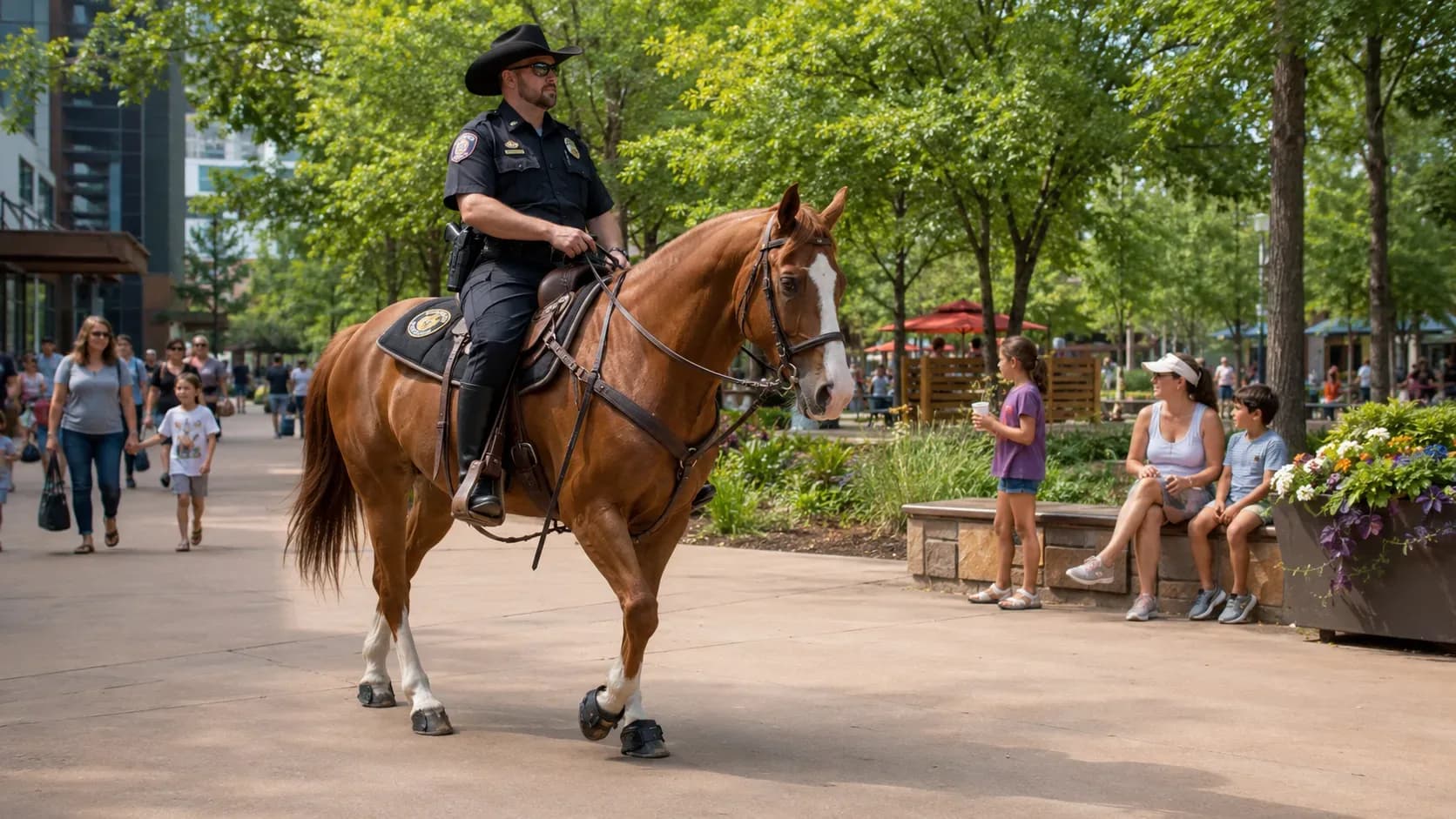
People notice a mounted patrol in a way they do not notice another SUV in traffic. Children wave. Adults stop. Visitors ask for directions. A rider can see over a crowd, move at a human pace through busy pedestrian areas, and still cover a lot of ground. In a place like The Woodlands Town Center, that combination has turned out to be more useful than old-fashioned.
That is why the current public conversation in The Woodlands is not really about whether mounted patrol should disappear. It is about how the program should be structured going forward.
The Woodlands Township has made that point plainly. Township officials say mounted patrol is not going away. The proposed 2027 budget includes funding to continue it. What the Board is evaluating is whether the current private courtesy-patrol model should eventually transition to a Montgomery County Sheriff's Office mounted unit. The horse is not the question. The service model is.
That distinction matters because many residents casually refer to the riders they see now as police officers, but today's Alpha & Omega mounted patrol personnel are civilian courtesy patrol staff, not commissioned law-enforcement officers. They work in support of public safety alongside law enforcement and have become a familiar part of the Town Center experience. If the Township eventually changes providers or shifts to a Sheriff's Office unit, the basic public presence residents see could remain mounted even though the underlying authority and administrative structure change.
A Horse Still Does Some Things Better

The case for mounted patrol is not nostalgia. It is practicality. A rider sits higher than a person on foot and can see farther across a crowd, parking area, or event space. That elevation improves sightlines without creating the physical barrier a vehicle can create. A horse can enter pedestrian-heavy areas where a patrol truck would be awkward, while still giving its rider mobility that a foot patrol cannot match.
Mounted patrol also creates a visible deterrent. People tend to notice a thousand-pound animal immediately. That visibility can calm a space, discourage nuisance behavior, and reassure families and visitors that somebody is present and paying attention. In a shopping, dining, and event district, being seen is part of the job.
The Township's own explanation of the program highlights proactive crime prevention, crowd management, traffic management, support for large events, and community engagement. Those are not ceremonial functions. They are practical assignments in a district that regularly mixes retail traffic, restaurants, events, pedestrians, and visitors who may not know the area well.
The Human Advantage Technology Has Trouble Replacing

The biggest reason mounted patrol survives in 2026 may be harder to measure than sightlines or mobility. People approach the horse. That matters more than it sounds.
A patrol car is useful, but most people do not casually walk up to one unless there is a problem. A camera can record what happens, but it cannot answer a nervous visitor's question, make a child feel comfortable around a public-safety presence, or create the kind of low-pressure interaction that builds familiarity over time.
A horse changes the social distance. It slows the encounter down. It makes the rider approachable. A child tugging a parent's sleeve to ask if they can pet the horse is not merely a cute moment. It is a reminder that public safety is not only enforcement. In the right setting, it is also visibility, connection, and trust.
That is a large part of what gives mounted patrol its staying power in The Woodlands. The program fits the character of a community that wants a safe Town Center but also wants that area to feel welcoming rather than heavily militarized. A mounted patrol is authoritative without being harsh. It is memorable without being intimidating. It helps watch over the district while still feeling like part of the place.
What May Change in 2027

The coming decision is therefore less dramatic than some of the online chatter suggests. The Township is evaluating whether a Sheriff's Office mounted unit could provide the same visible community presence while adding the broader authority and direct law-enforcement resources that commissioned deputies bring.
Township materials say no agreement with the Montgomery County Sheriff's Office has yet been approved. Alpha & Omega remains under contract through December 31, 2026.
In other words, The Woodlands is not debating whether the horse still belongs. It is debating whether the rider should remain part of a private courtesy-patrol model or eventually become part of a commissioned law-enforcement unit. That is an important difference, and it deserves to be understood before the conversation gets reduced to slogans.
Residents may disagree about contracts, accountability, or which structure offers the best value. That is normal. But stepping back from the contract argument reveals something more interesting: after all the changes in technology, communication, and policing tools, the mounted patrol itself still makes sense.
The Bottom Line
A camera can watch. A patrol vehicle can respond. A radio can coordinate. Those tools all matter. But none of them makes a family stop and smile. None of them naturally invites a visitor to ask for directions. None of them combines visibility, mobility, approachability, and simple presence quite like a horse moving through a public space.
That is why mounted patrol has lasted this long in The Woodlands, and it is probably why it is not disappearing now. In 2026, a horse still has a job because the right older tools do not become useless merely because newer ones arrive. Sometimes they survive because they still do something better than anything that tried to replace them.