Galveston’s ‘Ghost Wolves’ Carry Something Worth Saving
The coyotes along Galveston’s coast carry a genetic inheritance scientists hope could help endangered red wolves. A Saturday expo brings the story into view.
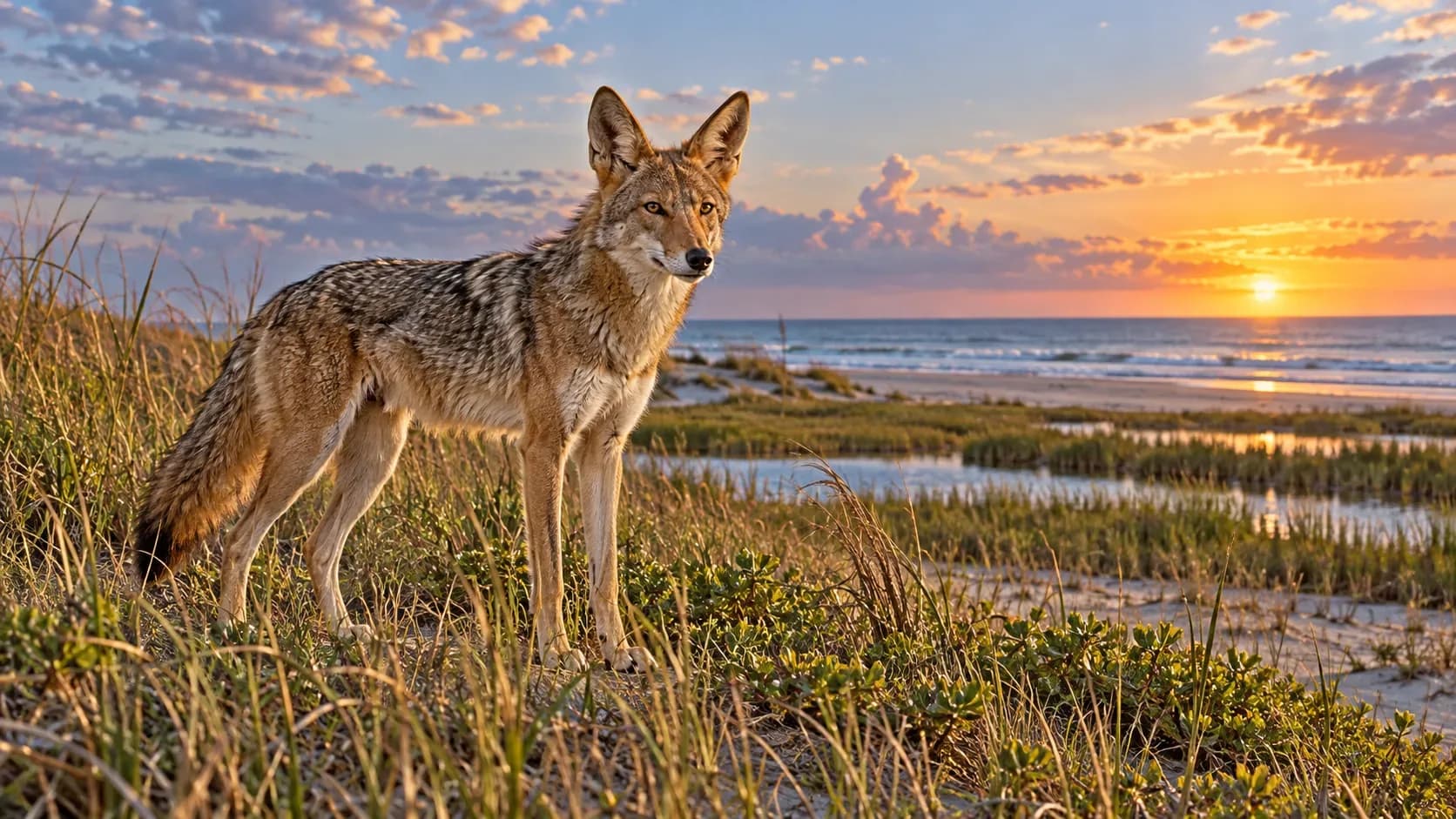
A coyote at the edge of a Galveston marsh may not look like a conservation discovery. Most of us would notice the pointed ears, watch it slip through the grass and keep going.
Scientists have found a reason to look more closely. Some coyotes along the Texas and Louisiana Gulf Coast carry red wolf ancestry, including genetic variation from older wolf lineages. Around Galveston, they have become known as ghost wolves. Their inheritance could matter to the future of one of America’s most endangered canines. [1, 4]
On Saturday, October 24, the Howl-O-Ween Ghost Wolf Expo at Moody Gardens will bring researchers, conservation organizations and the public together to explore that connection. The event is timely, but the discovery reaches well beyond a Halloween name. [7]
Someone noticed something unusual
The Gulf Coast Canine Project traces its Galveston investigation to Ron Wooten, a curious citizen whose photographs showed coyotes with unusual, wolf-like features. Researchers investigated genetic samples, and the first Galveston findings were published in 2018. [1, 2]
Drs. Kristin Brzeski and Bridgett vonHoldt established the Gulf Coast Canine Project in 2020 as the research expanded. Its work includes genetic sampling, GPS collars, cameras and diet studies, along with public conversations about living alongside these animals. [2]
That beginning is worth remembering. Someone noticed an animal that did not quite fit expectations and took the observation seriously. Scientists then asked questions that a photograph alone could not answer.
What the ghost carries
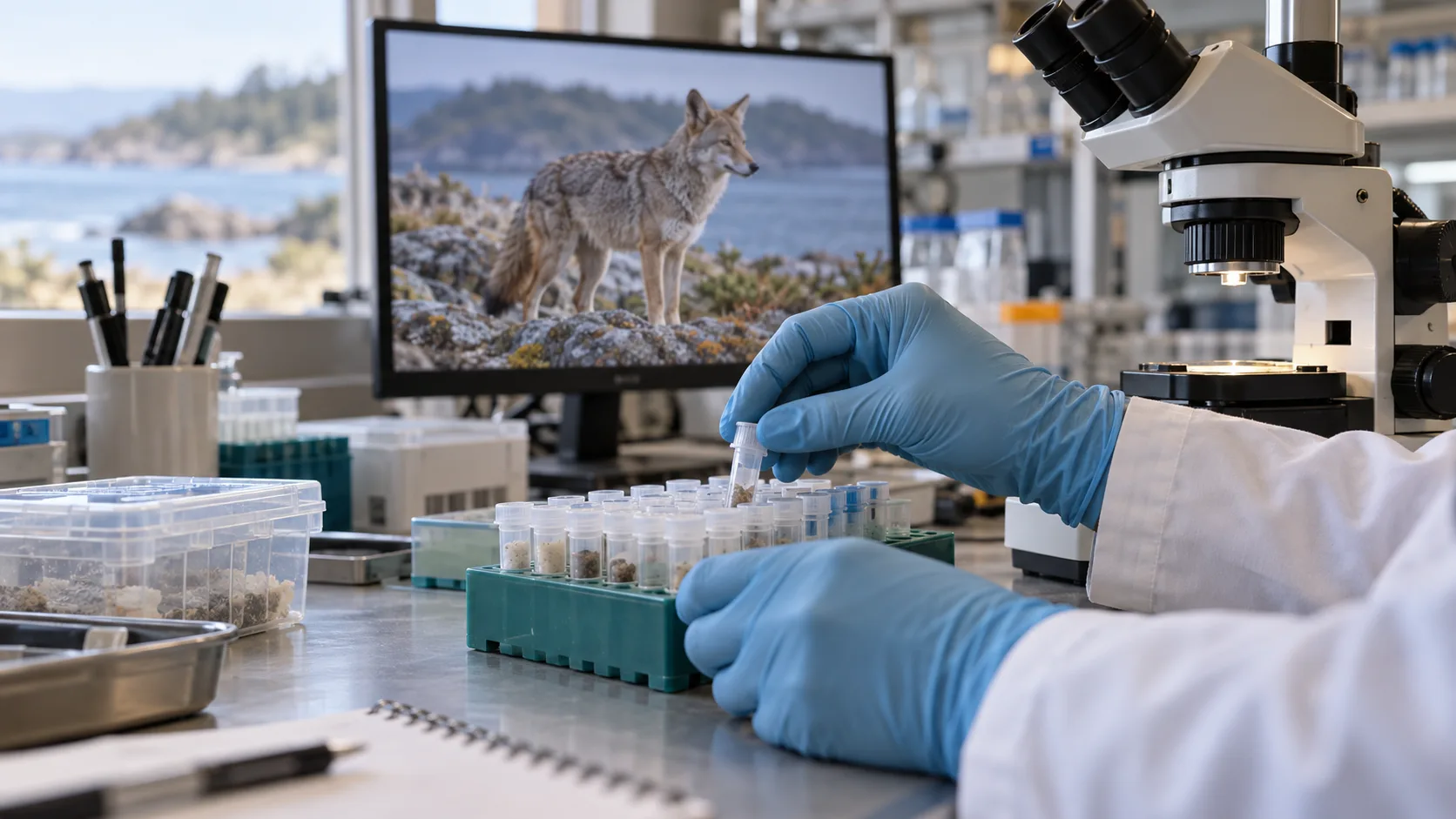
Scientists use genetic samples to study the red wolf ancestry preserved in Gulf Coast canines. AI-generated illustration of a generic laboratory, not a specific researcher or facility.
Red wolves once occupied a much larger range. By the 1970s, the remaining wild population was concentrated along coastal southeast Texas and southwest Louisiana. A captive breeding effort founded with 14 red wolves helped prevent the species’ disappearance. Red wolves were declared extinct in the wild in 1980, and reintroduction began in northeastern North Carolina in 1987. [3]
During their decline on the Gulf Coast, red wolves interbred with coyotes. Their descendants passed some of that ancestry through later generations. The Galveston animals are coyotes with red wolf ancestry; their nickname describes a genetic legacy rather than an untouched population of pure red wolves. [1, 2]
A 2026 Journal of Heredity study examined genetic markers across 413 North American canines. Its authors described Gulf Coast animals as valuable reservoirs of red wolf ancestry and older genetic variation, and proposed breeding strategies to preserve that diversity. [4]
For a species rebuilt from a small founding population, additional genetic diversity could be important. Turning that possibility into recovery benefits requires further conservation work. The study offers approaches to investigate, rather than proof that Galveston coyotes have already restored the red wolf population. [4]
The stakes remain substantial. The U.S. Fish and Wildlife Service’s August 2026 estimate listed just 22–23 adult and subadult red wolves in the wild in eastern North Carolina, plus 14–15 pups. Another 295 were in the managed conservation population. Those are dated estimates, not a count of Galveston’s ghost wolves. [3]
Their world includes roads
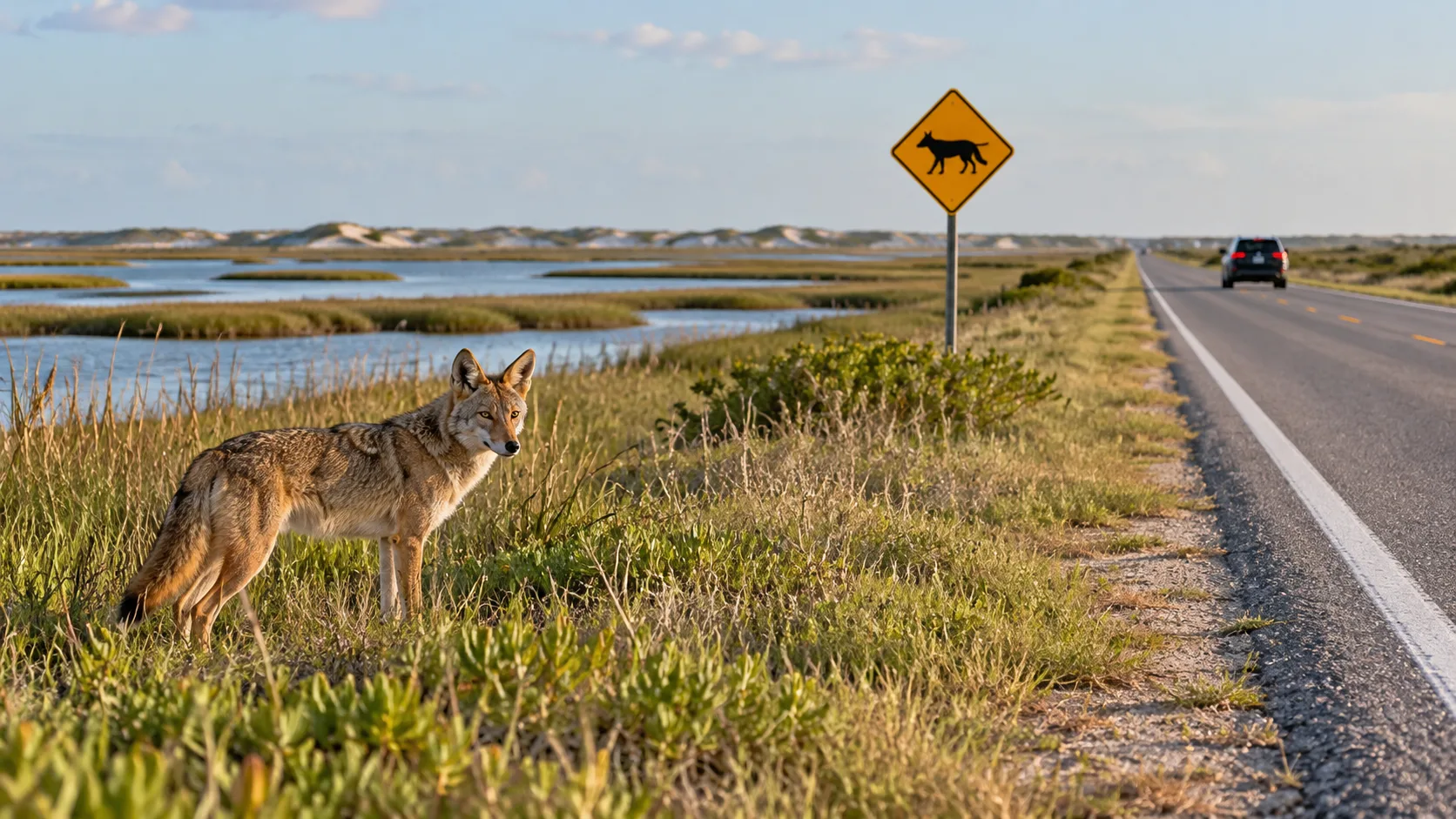
Traffic is one threat facing Galveston’s ghost wolves. AI-generated illustration; the animal, road and sign do not document a specific FM 3005 location or installed TxDOT sign.
While scientists examine DNA, the animals still have to cross roads. In April, TxDOT reported that ten wildlife-crossing signs had been installed along a 19-mile stretch of FM 3005 on Galveston Island. Installation was completed in March. [6]
The effort grew from concerns raised by Gulf Coast Canine Project researchers in 2024. TxDOT and Galveston County officials analyzed coyote mortality records from 2020–2025 to identify locations with the greatest losses. Five signs went in each direction. [6]
The purpose is to alert drivers and reduce collisions involving wildlife. TxDOT’s announcement does not establish that the signs have already reduced deaths. It does show how research and local concern can lead to a practical change along a familiar highway. [6]
The habitat matters too
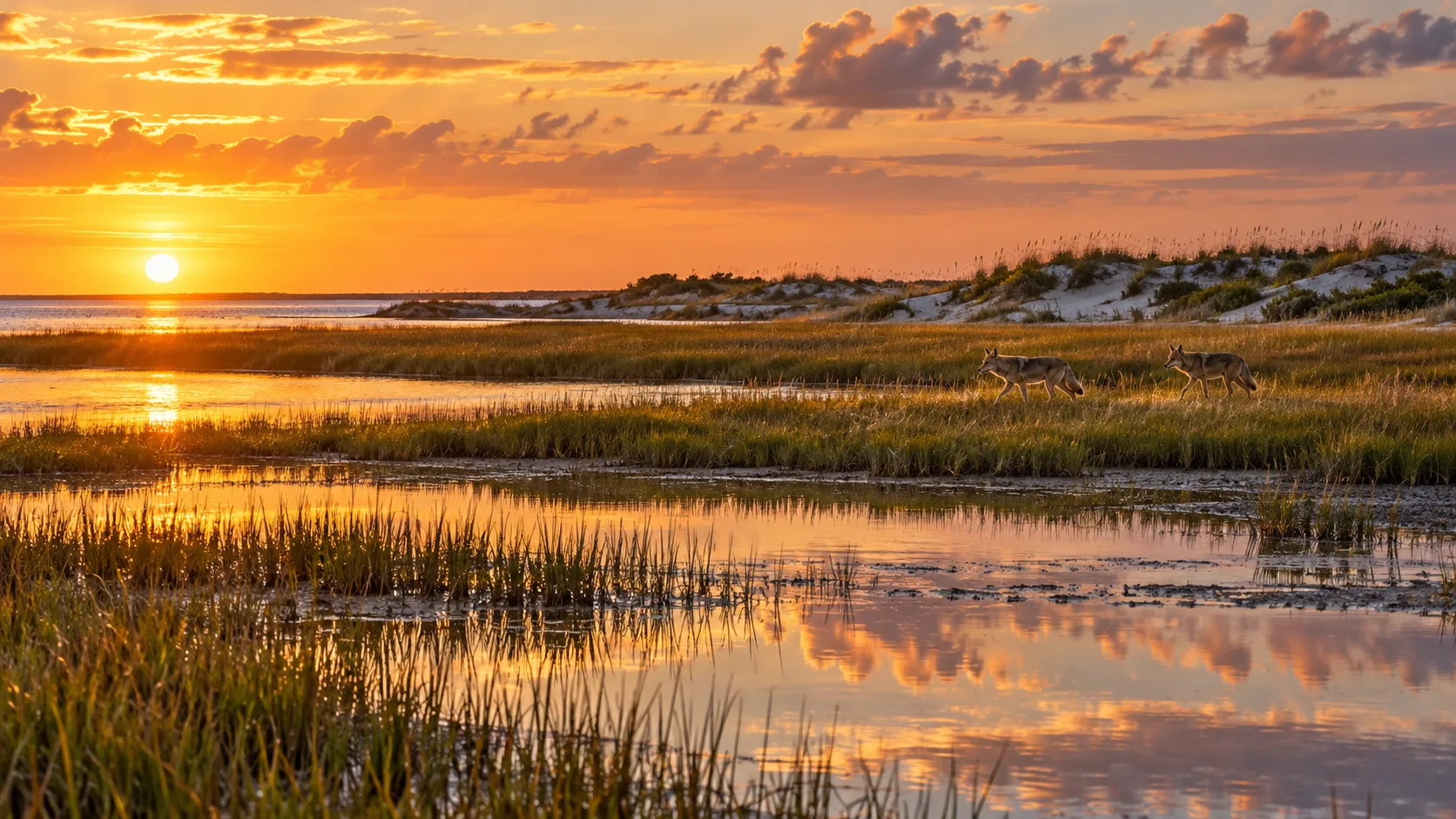
Protecting coastal habitat helps preserve the living animals that carry this genetic inheritance. AI-generated illustration of a generic Gulf Coast marsh.
A separate study published in Ecosphere in February 2026 examined Gulf Coast canines in southwestern Louisiana. Researchers described a wetland-adapted form of coyote shaped by historical red wolf interbreeding. The animals strongly selected wetland habitats, and nutria appeared frequently in their diet samples. [5]
Those findings came from Louisiana and should not be treated as a description of every Galveston animal. They do help explain why the surrounding landscape deserves attention alongside the genetics. The inheritance survives because living animals keep finding food, shelter and places to raise another generation.
A chance to learn more on Saturday
Moody Gardens lists the October 24 expo’s interactive village from 9 a.m. to 1 p.m. at its MG3D Theater, 1 Hope Boulevard, Galveston. Presentations run from 10 a.m. to noon and include the Endangered Wolf Center in St. Louis, with updates on the connection between ghost wolf DNA and red wolf recovery. [7]
Registration is requested through the Moody Gardens event listing. Organizers say one person per group can RSVP with the total number attending. Readers should check the listing for current details before traveling. [7]
The research began years ago, and important questions remain. That makes the story more interesting: a familiar coastal animal still has something to teach us. The next time a coyote disappears into the Galveston grass, it may be carrying a piece of Texas wildlife history that scientists are learning how to preserve.
Images are AI-generated editorial illustrations of generic settings, not photographs of documented animals, researchers, laboratories or specific locations.
Sources and further reading
1. Gulf Coast Canine Project — Galveston Island ghost wolves and Ron Wooten’s observations
2. Gulf Coast Canine Project — Research history and field methods
3. U.S. Fish and Wildlife Service — Red Wolf Recovery Program and August 2026 population estimate
4. Journal of Heredity — The paradoxical extinction study, published online January 2026
5. Ecosphere — Gulf Coast canids as a wetland coyote ecotype, February 2026
6. TxDOT — Helping protect Galveston’s ghost wolves, April 2 2026
7. Moody Gardens — October 24 2026 Howl O Ween Ghost Wolf Expo and registration