Meet the Cicada Killer
It looks like the sort of insect that could clear a backyard in seconds. In reality, this giant native wasp is far more interested in cicadas than people.
It looks like the sort of insect that could clear a backyard in seconds. In reality, this giant native wasp is far more interested in cicadas than people.
By Cheryl Conley | Lake Creek Nature Preserve
Most people consider cicadas loud—and more than a little creepy. They spend years underground, emerge looking like something from a science-fiction movie, and then scream from the treetops as if they have been personally wronged.
Fortunately for those who are not cicada fans, one impressive backyard predator is happy to do something about them: the eastern cicada killer wasp (Sphecius speciosus), also known as the cicada hawk.
Built for Cicadas, Not Trouble
Of course, the name “cicada killer wasp” does little to improve its image. Any insect with both “killer” and “wasp” in its name sounds like something best avoided at all costs.
Despite its intimidating name and impressive size, the cicada killer is far more interested in hunting cicadas than people. Females can sting, but they rarely do unless handled or threatened. Males may hover, patrol and act territorial around nesting sites, but they do not have stingers.
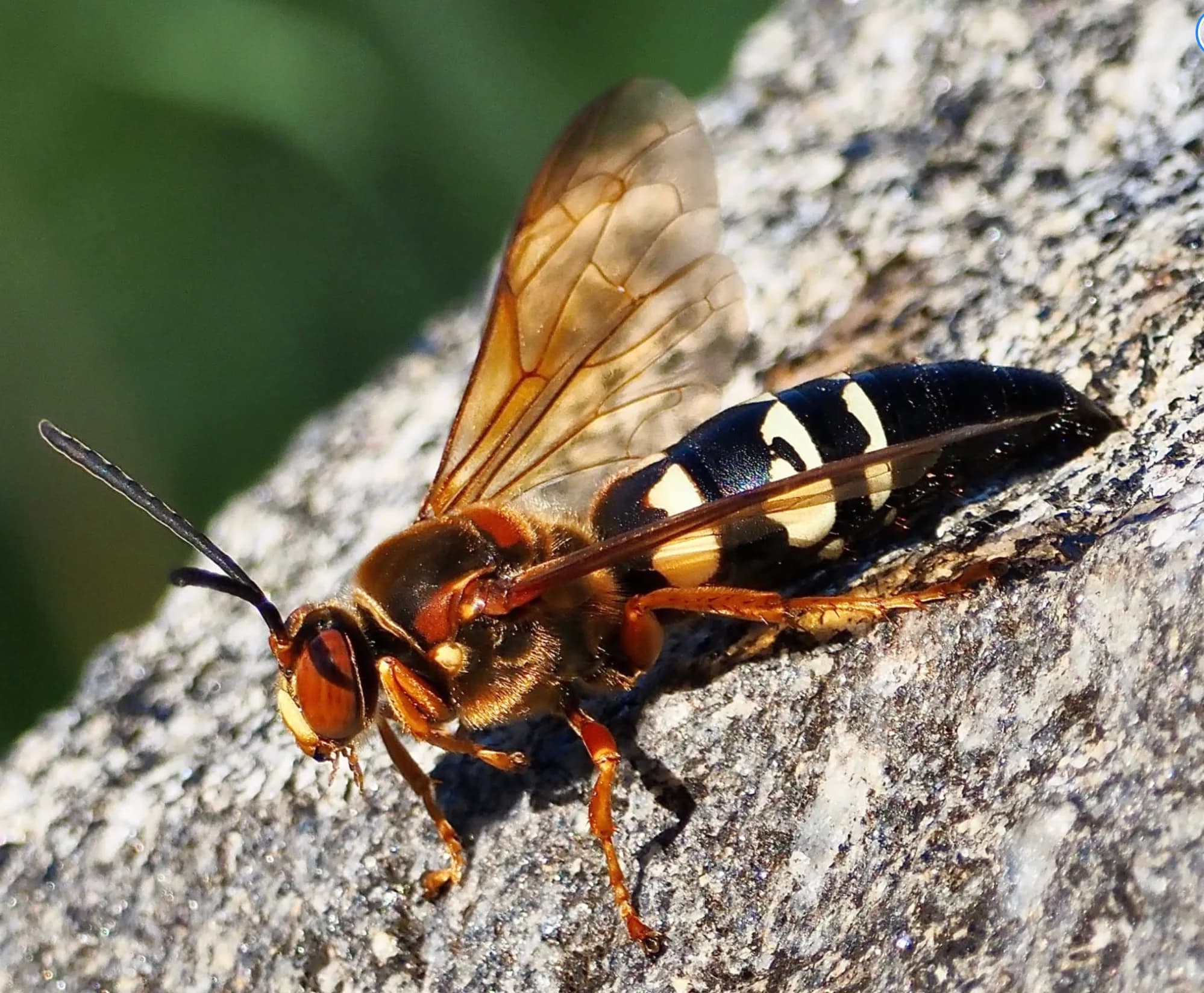
Cicada killers are among the largest wasps commonly encountered in Texas. Adults are often about 1½ inches long, and some may approach 2 inches. Their wings are brownish amber, with rusty-red coloring on the head, thorax and legs and pale yellow markings across the dark abdomen.
A Burrow with a Purpose
Unlike social wasps that build paper nests and defend a colony, cicada killers are solitary. Each female digs and provisions her own underground nest, although many females may choose the same favorable patch of dry, loose or sandy soil.
A typical burrow begins with an entrance roughly half an inch across, descends several inches and then extends through the soil with side chambers branching from the main tunnel. The excavated soil often forms a noticeable mound around the opening.
Males generally appear first in early summer and wait near nesting areas for the females. After mating, a female chooses a site, digs her burrow and begins one of the most demanding hunting jobs in the backyard.
“The prey may outweigh the hunter, but the female still has to get it home.”
The Summer Hunt
Peak hunting takes place in July and August. Only females hunt. She captures a cicada, stings it and injects venom that leaves the cicada alive but completely paralyzed.
Because the cicada may weigh as much as—or more than—the wasp, carrying it back to the burrow is a truly Herculean feat. She may fly, glide or drag her oversized prey to the nest, place it inside one of the underground chambers and lay an egg on it. A chamber may contain one to three cicadas before the female seals it.
The egg hatches within two or three days. The developing larva then feeds on the paralyzed cicada for roughly one to two weeks. Once fully grown, the larva spins a silk-like cocoon and remains underground through the winter. It pupates and emerges as an adult the following summer, while the previous generation of adults dies off by early fall.
More Helpful Than Harmful
Despite being creepy-looking and having a scary name, cicada killer wasps are beneficial members of the local ecosystem. Adult males and females feed on nectar and other plant sugars and may help pollinate flowers. By hunting cicadas, females participate in the natural balance between predator and prey.
Their burrows can loosen and aerate the soil, although clusters of nests may disturb thin turf or create small mounds in sandy areas. In most places, their summer activity is temporary and does not require control.
Cicada killers may never win a backyard popularity contest, but they deserve more respect than fear. Their size, name and hunting habits make them easy to misunderstand, yet they are simply doing what nature designed them to do.
So the next time one cruises past carrying a cicada nearly as large as itself, take a moment to appreciate the effort—and be grateful you are not on the menu.
CICADA KILLER AT A GLANCE
SIZE: Often about 1½ inches long; some approach 2 inches.
ACTIVE: Most visible during the summer, especially July and August.
NEST: A solitary underground burrow in dry, loose or sandy soil.
STING: Females can sting but rarely do; territorial males cannot sting.