The Ladybug Didn't Disappear. Something Else Took Its Place.
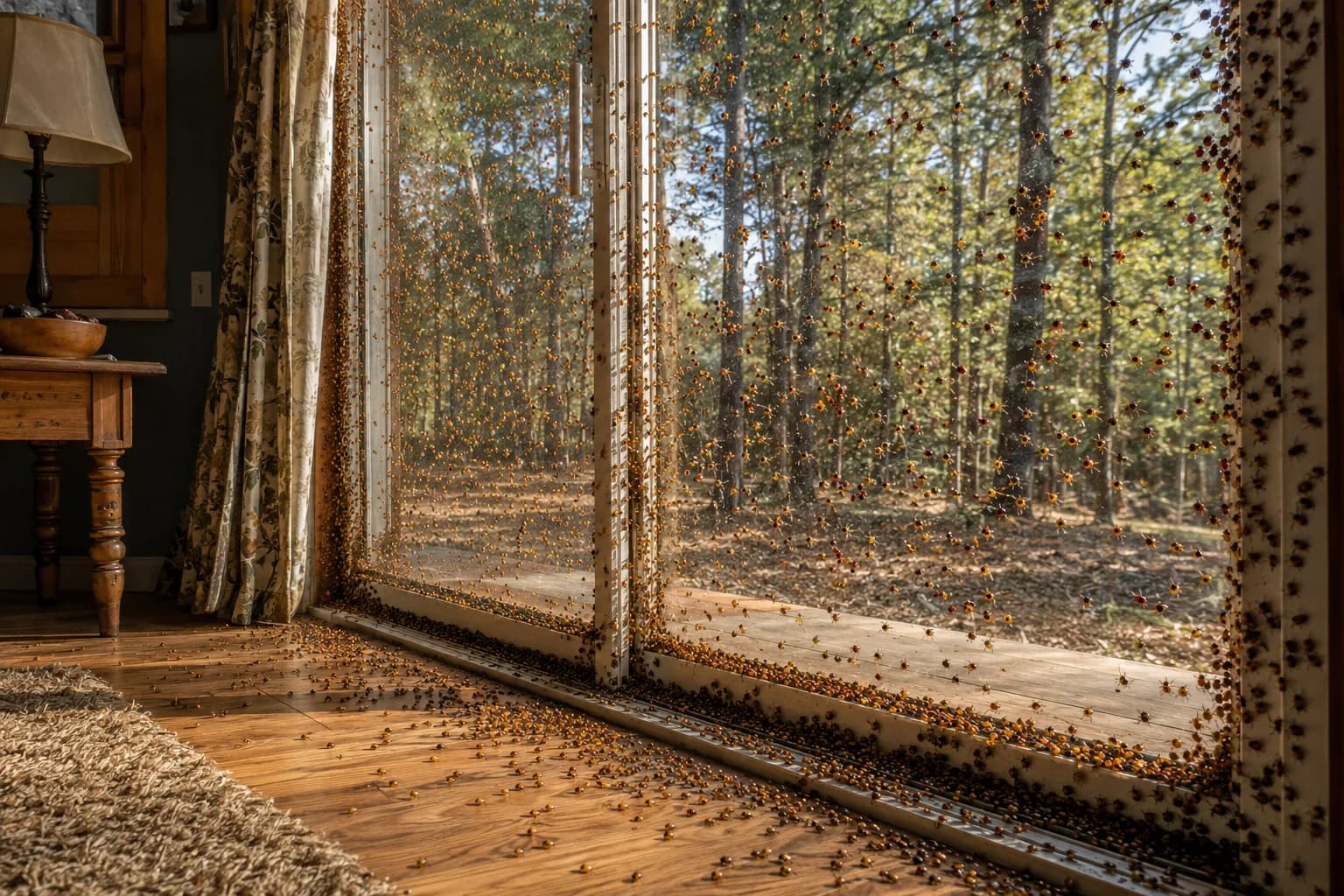
Once a year, thousands of ladybug look-alikes gathered at the sliding glass doors of an East Texas home. The house was not infested — it had become a winter hotel for one of the most successful insect newcomers in North America.
Once a year, thousands of ladybug look-alikes gathered at the sliding glass doors of an East Texas home. The house was not infested. It had become a winter hotel for one of the most successful insect newcomers in North America.
Once a year, the sliding glass doors seemed to turn orange. The house sat on forest land in East Texas, the kind of place where insects were expected. Native ladybugs appeared in the grass and garden from time to time. But these were different. They looked close enough to ladybugs that most people would have used the same name, yet they arrived by the thousands. They collected against the glass. They found the edges of the doors. They appeared inside the house in numbers that seemed impossible for something so small.
Nothing like it had happened before the move to the land. Years later, the memory raises a larger question. If the insects covering the windows were not the familiar native ladybugs, what were they? And if they were doing some of the same work, did it matter that something else had taken the original insect's place?
The answer is almost certainly the multicolored Asian lady beetle. And yes, it matters — although not for the simple reason most people expect.
That Wasn't Just Another Ladybug
First, one small correction: ladybugs are not technically bugs. They are beetles. Texas is home to numerous native and introduced lady beetle species, and they do not all wear the familiar red shell with neat black dots. Some are pink. Some are black with two red spots. Some are tiny enough to be overlooked.
The multicolored Asian lady beetle can be yellow, orange, red or occasionally very dark. It may carry close to 19 spots, only a few, or none at all. That variation is one reason the newcomer hides so easily in plain sight.
The most useful clue is directly behind its head. On a pale patch of the shield-like section called the pronotum, the dark marking often resembles an M when the beetle faces away from the observer — or a W when viewed from the opposite direction. The Asian species is also generally rounder and a little larger than many native lady beetles.

Color alone is not enough. A deep-red beetle may be native or introduced, and an orange beetle is not automatically an invader. But an M-shaped marking combined with thousands gathering on a building is a remarkably strong identification.
The House Became a Winter Hotel
The glass doors were not attracting a new generation born inside the house. They were helping an older generation find its way back outside.
Multicolored Asian lady beetles gather in autumn as temperatures begin to fall. In their native range, they commonly shelter in cracks and protected places in cliffs and rock faces. In an East Texas forest, the tall, sun-warmed wall of a house can become the next best thing. Wooded properties are especially attractive. The beetles collect on bright, warm sides of buildings, then squeeze into gaps around windows, doors, fascia, siding, vents and utility lines. An opening of roughly one-eighth of an inch may be enough.
Once inside, they hide in wall voids, attics and other protected spaces. They do not establish a breeding colony or eat the house. They simply wait. Warm sunlight later reaches the wall or sliding glass door and wakes them. They move toward heat and light, which is why hundreds or thousands can suddenly appear against a window. To the homeowner, it looks like an invasion that began that morning. In reality, the visitors may have been sleeping inside the structure for months.
Why Would Anybody Bring Them Here?
Because they are very good at their job. The multicolored Asian lady beetle was introduced as a biological-control agent. Both the adults and their strange, alligator-shaped larvae consume aphids, scale insects, whiteflies, mealybugs and other soft-bodied pests that damage crops, gardens and trees.
That sounds like an environmental success story. Instead of spraying more chemicals, release a natural predator and allow it to eat the problem. And in part, it worked. The Asian beetle became one of the world's most effective aphid predators. It survives in many habitats, travels well, finds food efficiently and defends itself from enemies. Farmers and gardeners received a tireless worker that did not send an invoice.
The trouble is that living systems rarely stop at the line human beings draw around the original assignment. The beetle did not remain in one orchard or field. It spread across North America, entered forests and neighborhoods, and began competing with the lady beetles already here.
When Help Becomes Competition
Native lady beetles and Asian lady beetles frequently want the same meal. When aphids are plentiful, there may be enough food for everybody. When prey becomes scarce, the stronger traveler and more aggressive feeder has an advantage. The Asian beetle can also consume the eggs and larvae of other lady beetles. Researchers call that intraguild predation: predators eating other predators that hunt the same prey.
That does not make the Asian beetle an insect villain plotting to destroy the neighborhood. It is doing what successful species do — finding food, surviving winter and producing another generation. The environmental concern comes from what happens around it.
USDA researchers have documented major declines in several native lady beetle species in parts of North America. Some once-common species have become difficult to find in agricultural landscapes where introduced species are now abundant. Scientists are careful about the explanation. Invasive competitors are part of the story, but so are pesticide use, changing farming practices, loss of habitat, climate and shifts in the insects available as prey.
A memory from one East Texas property cannot prove that a local native species declined because Asian beetles arrived. But the memory fits a much larger pattern: the newcomer becomes impossible to miss while an insect that once seemed ordinary becomes easier to overlook.
What Was the Native Ladybug Doing?

Quietly protecting nearly everything green. Texas A&M describes lady beetles as beneficial natural enemies. Adults and larvae feed primarily on aphids but also consume scale insects, mites, caterpillar eggs and other soft-bodied pests. A lady beetle can eat hundreds of aphids during its life. In a garden, that means fewer curled leaves, less sticky honeydew and fewer plant diseases carried by sap-feeding insects. In agriculture, it can mean less crop damage and less pressure to reach for a pesticide.
The Asian species performs much of that work too. That is what makes this ecological change difficult to see. The garden does not immediately collapse. Aphids are still being eaten. Leaves remain green. A predator is still present. But one very successful species does not perfectly replace a community of native species. Different lady beetles favor different habitats, plants, prey and seasons. Diversity gives an ecosystem backup systems. If weather, disease or a food shortage hurts one predator, another may continue working. When many species are replaced by one dominant generalist, the immediate job may still be completed while the larger system becomes less varied and potentially less resilient.
Nature can continue looking normal even after one of its original parts has quietly changed.
Not Every Replacement Is an Empty Space
The Asian lady beetle leaves us with an uncomfortable environmental lesson. Some introduced species arrive and destroy what they touch. The emerald ash borer kills trees. Other invasive plants or animals can overwhelm habitat so visibly that nobody has to explain the damage. The Asian lady beetle is more complicated. It is useful and disruptive at the same time. It reduces pests that would otherwise damage crops. It can also crowd native predators, enter homes by the thousands, nip human skin and release a yellow, strong-smelling defensive fluid that stains light surfaces.
Calling it entirely bad ignores the work it performs. Calling it entirely good ignores what may have been displaced. That tension is the real story.
Human beings often measure an environmental decision by whether the assigned task was completed. Did the introduced insect eat aphids? Yes. But nature is not a factory floor where one worker can always replace another without changing anything else.
When Thousands Reach the Glass

Once Asian lady beetles are inside the walls, spraying the visible beetles indoors accomplishes little. More may continue emerging from hidden spaces, and crushing them can release the yellow fluid and odor. The simplest response is a vacuum. A stocking placed inside the vacuum hose can catch the beetles before they reach the bag, allowing them to be removed without staining the house. They do not reproduce indoors, eat clothing or damage the structure.
The better solution begins before the swarm. Seal gaps around windows and sliding doors, repair screens, cover vents and check where pipes, cables and different building materials meet. That work should be completed before cooler weather sends the beetles searching for shelter.
Outside, broad insecticide use may create a second problem by killing native beneficial insects along with the unwanted visitors. Native plants and a garden with limited pesticide use can help support the lady beetles and other predators that belong in the local landscape.
Look at the Beetle Before Calling It a Ladybug
The next time a red or orange beetle crosses a window, look behind its head. If there is a black M on a pale background, it may be the same remarkably successful traveler that once covered sliding glass doors on a piece of East Texas forest land. If it is a different shape or pattern, photograph it. Projects that track lady beetles depend on ordinary people noticing what scientists cannot monitor in every backyard.
The familiar red ladybug did not vanish from North America. Native species are still here, still hunting and still protecting plants. But in many places they now share the landscape with a look-alike that arrived for a job, performed it extraordinarily well and never left. For years, the difference was easy to miss. Then one morning, there were thousands at the glass.
Sources and Further Reading
Texas A&M AgriLife — Lady Beetle (Lady Bug): Texas species, life cycle, prey and their role as beneficial natural enemies.
University of Minnesota Extension — Multicolored Asian Lady Beetles: Identification, the M-shaped marking, overwintering behavior and home prevention.
USDA Agricultural Research Service — A Strong Ally in Biocontrol Is Dwindling: Research into declining native lady beetle abundance and competition with introduced species.
USDA Agricultural Research Service — Ecology of Native and Invasive Lady Beetles: Benefits, invasive behavior and the ecological tradeoffs created by highly competitive introduced species.
University of Georgia Cooperative Extension — Garden Friends or Home Invaders?: Why Asian lady beetles gather in buildings and how their behavior differs from native species.
Lost Ladybug Project: Citizen-science information for identifying and documenting native and introduced lady beetles.