Montgomery County Commissioners Decide How Far Their Authority Reaches Into Other Elected Officials’ Offices | September 2026 Meeting Recap
Montgomery County Commissioner's Court twice weighed how far its authority reaches into other elected offices.
Introduction to the Meeting
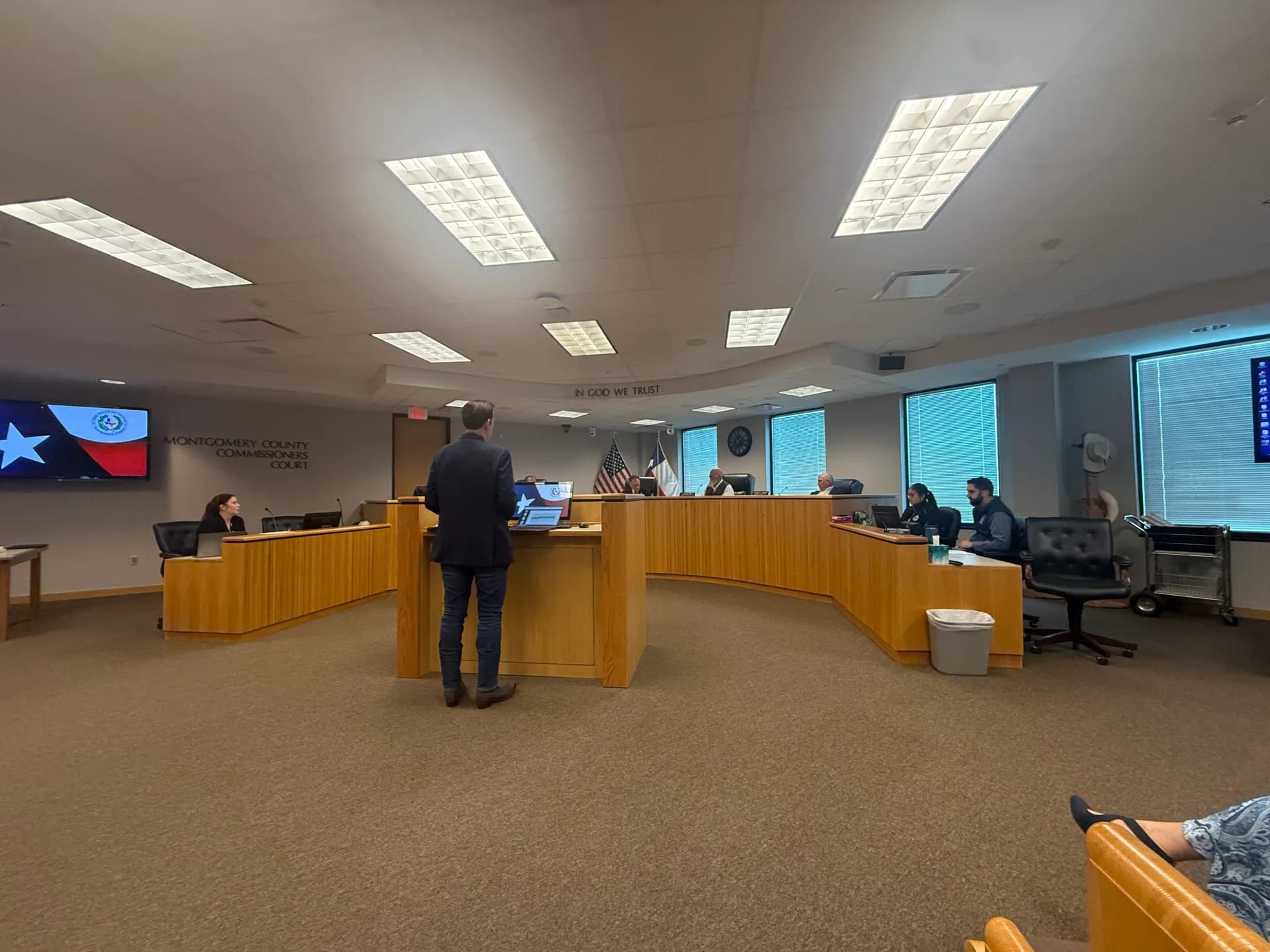
Montgomery County Commissioner’s Court met Thursday morning, September 3rd, at the Alan B. Sadler Commissioner’s Court Building on North Thompson in Conroe, with the four commissioners and county judge present.
The agenda was fairly standard. A proclamation, a check presentation, a consent agenda a hundred items long, and one item about overtime policy.
The court actually spent much of the morning discussing a more bureaucratic question, and it came up twice: once commissioners set another elected official's budget, how much say do they get in how that official spends it?
The Quick Highlights
--Commissioner Matt Gray brought a motion for recognizing October as Bullying Prevention Month
--Friends of NRA handed roughly $22,000 to the sheriff and all five constables.
--A resident told the court the county clerk is paying a salary out of a fund state law restricts. After discussing with County Clerk Brandon Steinmann, the court approved the raise anyway, 4–1, with Judge Keough the only no.
--The sheriff and all five constables won the right to approve their own task-force overtime, over Commissioner Gray's initial objection.
--The courthouse bond missed its filing deadline. It will not be on your November ballot.
--The tax rate gets adopted Tuesday, and the proposed rate is higher than the no-new-revenue rate.
Commissioner Matt Gray Moves an Anti-Bullying Proclamation and Speaks as a Father
Gray brought a motion to approve a proclamation recognizing October 2026 as National Bullying Prevention Month, observed nationally since 2006. He put it on the September agenda because school had just started.
"I want to speak not only as a commissioner but as a father," Gray said. "Bullying looks very different today than it did when many of us were growing up. Some things, however, have not changed. We need to continue to teach our children to be kind, teach them not to pick on someone weaker or smaller or less fortunate than ourselves. But we should also teach them not to stand by when someone else is being mistreated."
"Kindness matters," he said, "but so does courage."
The motion passed with all members approving.

Friends of NRA Gives About $22,000 to the Sheriff and All Five Constables at Once
Liz Foley, NRA employee and Montgomery County resident, presented on behalf of Friends of NRA. Friends of NRA is the organization's fundraising arm, which she described as its non-political side, supporting training and education.
"I do a lot of these check presentations," Foley said. "But it means a lot when you get to do it in your own home county, and you get to give it to the men and women who protect you and your family, friends, and loved ones on a daily basis."
Roughly $22,000 went to Montgomery County law enforcement this cycle, split among the Sheriff's Office and all five constable precincts.
All five constables and the Montgomery County sheriff were present for this presentation, and expressed gratitude. "Having that extra funding to put on special training for our officers is a must,” Philip Cash (MoCo Constable, Pct. 1) said.
In a county this size you do not often see the whole of county law enforcement standing in one frame.

During Public Comments, a Resident Tells the Court the County Clerk Is Paying a Salary Out of a Fund the Law Restricts
A single member of the public spoke during citizens' comments, and she came with printed statutes to argue her points.
Her objection was to a single line inside the consent agenda: payroll change request number 19, a salary increase for the county clerk's operations manager. That position is paid entirely from the County Clerk's Records Management and Preservation Fund, governed by Texas Local Government Code Section 118.0216.
"This statute is very specific," she told the court. "The fee collected under this section may be used only for records management and preservation purposes, including automation projects that directly support those functions."
Her point was that running the clerk's office is not the same thing as preserving records. “It is not a records management or a records preservation function, as defined by this statute. The legislature restricted this fund for a reason."
Brandon Steinmann, County Clerk's Rebuttal to Criticism
On the records management fund, his position was that the law leaves the definition to him. "Records management is what the county clerk says it is," he said, "because again, it comes out of my funds." He noted the fund is backed by the clerk, not the county. An audit finding would land on him, not on Montgomery County.
He also said this type of operating procedure was not new. Paying clerk's office staff from records management has been the practice for at least thirteen years, including under his predecessor Mark Turnbull. Steinmann explained that this specific job position oversees vital statistics, public records and indexing, and supervises twelve supervisors and all sixty of the office's employees. He was promoted in June and did not get a raise then, while the position went through HR scoring.
"We use these funds so that we don't have to come and take general revenue money from the court," Steinmann said. "Because if I came to you and said, ‘hey, I need to preserve these books’, you're not going to give me money for that when you need to give it to a constable, you need to give it to a deputy sheriff."
Budget Officer Amanda Carter confirmed the position is one hundred percent special revenue funded. It does not touch the general fund or the tax rate.

Judge Keough Argues a 15.2% Raise Is Inequitable, Then Loses the Vote 4–1
Keough was not arguing the employee was undeserving. "I want to pay this guy," he said. "I'm not trying to keep the money from him."
His objection was timing, size and process. "Here we are a week before we approve the upcoming budget," he said, putting the increase at 10.2 percent, followed the next week by the 5 percent adjustment county employees are getting generally. "So essentially, he's stepping into this position and getting a 15.2 percent raise."
He called that inequitable next to the rest of the county, and pointed out the court had set 5 percent as the ceiling for departments moving salaries with their own money.
Keough read the position's job description into the record: strategic leadership, policy development, compliance oversight, IT management and stakeholder engagement. How much of the job position is related to records management, Keough asked. “One-Hundred percent,” Steinmann answered.
Commissioner Wheeler had much to say as well. "He's an elected official, and by constitution, which has been backed up by the attorney general, we set his budget, which we already did, and this isn't outside of his budget, and then he runs his department," Wheeler said. "We can't tell him how to run his department. So if he wants to hire, fire, give raises, reduce pay, whatever he wants to do, that's him, and he's held accountable to the voters."
Finally, striking a line of accountability, Wheeler stated: “if they don't like what he paid this guy, they'll let him know at the ballot box next time."
Once discussion had completed, the motion carried with Judge Keough being the sole opposed vote.
Sheriff and All Five Constables Ask to Approve Their Own Task-Force Overtime, and Commissioner Gray Pushes Back
Item 13.A.1 on the agenda came from Ritch Wheeler of Precinct 3. Wheeler moved to exempt county law enforcement from portions of the county overtime policy for task forces and overtime projects, letting elected law enforcement officials authorize it themselves, inside budgets they already have, as long as they stay within those budget limits.
The court had already run it as a roughly ninety-day trial. "If you have a task force event, then you can manage that yourselves, as long as you don't have to come back to us and ask for more overtime budget," Wheeler said. "They managed their budget. I think we should continue on with this same policy."
Pct 4 Commissioner Matt Gray objected on institutional grounds.
"We are over the county compensation policy, the taxpayer transparency, and the institutional checks and balances," Gray said. "So this isn't micromanagement. There's nothing micro about any of these budgets. This is our constitutional duty in this role." He noted the current system had handled these processes up until this point, "We don't have a broken system.”
Wheeler answered with the same argument he had used on the county clerk, and this time read the attorney general's language out loud: "Although a commissioner's court sets an elected county officer's budget, the officer may determine how to best use those funds to accomplish the office's constitutional and statutory duty."
"It's our job to set their budget. It's their job to run their department within that budget," Wheeler said. "If they mess up and they give too much overtime out, and they come back to us and ask for more money, it's absolutely within our ability and authority to say no."
Instead of keeping the debate between the commissioners, Wheeler invited the five constables and sheriff to better explain their needs for their own departments.
Sheriff Wesley Doolittle spoke first. "Once you set our budget, we should have the ability, just like each one of you do, to work within our budget.”

Precinct 4 Constable Rowdy Hayden’s Real-World Example
Precinct 4 Constable Rowdy Hayden gave the court a concrete example, and it provided better context to the commissioners.
His office was scheduled the next morning to escort the funeral procession of a fallen firefighter through the county. A long route, with the sheriff's office and every constable's office sending people.
"I need all hands on deck," Hayden said. "Chief Welch is calling in people on their days off. People are coming in on vacation. This program gives me the ability to pay those people."
"I don't believe that I would have been able to, in the time frame, put this on an agenda to come back and ask for that leniency to be able to pay the guys overtime that are coming in on their days off”.
That example led Pct 2 Commissioner Riley to reexamine the situation, "That's one thing I never thought about.” Pct 1 Commissioner Walker also had a similar sentiment, “it makes perfect sense.”
The sheriff had the last comment before the vote. "You've given us overtime already in our budget. We're not asking for additional overtime. We're asking to spend our budget how we see it. You're asking us to come back twice to ask you for the same money, respectfully."
With discussions concluded, Judge Keough called the vote. Motion carried.
Other County-Related Topics to Keep on your Radar
While these topics did not directly get resolved during the commissioners' regular meeting, these topics are still ongoing and will impact residents in the future.
Tuesday's Special Session Sets a Tax Rate Higher Than No-New-Revenue
Commissioner’s Court meets again in special session Tuesday, September 8th, at 9:00 a.m., and Keough told the room they would want to be involved in that one.
During this special meeting, the budget will be adopted for next year. This includes public hearings on the fiscal year 2027 county budget and the 2026 tax rate, then adoption of both. From the county's own posted taxpayer impact statement:

The proposed rate is higher than the no-new-revenue rate which is the rate that would raise the same money from the same properties as last year. It is also higher than the rate the court adopted last year. Median homestead taxable value barely moved, $270,070 to $270,349, so the increase is coming from the rate, not from appraisals.
Importantly, these rates are still proposed, and the court can still adopt to raise or lower rates Tuesday morning.
The Courthouse Bond Missed Its Deadline in August and Will Not Be on Your November Ballot
On August 6th, this same court sat through a long presentation on a November bond package which would have included a new justice center, jail, and more. After a lengthy discussion, the court decided to hold off on further discussion of the bond package and instead scheduled a workshop on the issue. At that court meeting, the sentiment was still that further discussion and decisions would be made in the near term from information gathered at a workshop.
However, that workshop was not on the Commissioner's Court agenda within the month of August. And, now, the regulatory window has closed.
Texas Election Code Section 3.005(c) requires an election on a uniform election date to be ordered no later than the 78th day before election day. For November 3rd, 2026, that was Monday, August 17th (eleven days after the court deferred). No decisions were made within the legal times required.
So there will be no county bond propositions in November related to this county project. Not delayed; gone for this cycle.
The issue of the Justice Center and Montgomery County's needs has long been brewing. The August meeting of Commissioner’s Court proved just that, with numerous officials in attendance to support the passing of the bond proposition for resident voting.
Residents in Montgomery County will not get the opportunity to vote on this bond proposition because of the repeated deferments of this issue by the Commissioner's Court. The earliest now that this bond reaches voters is next year.
Sources